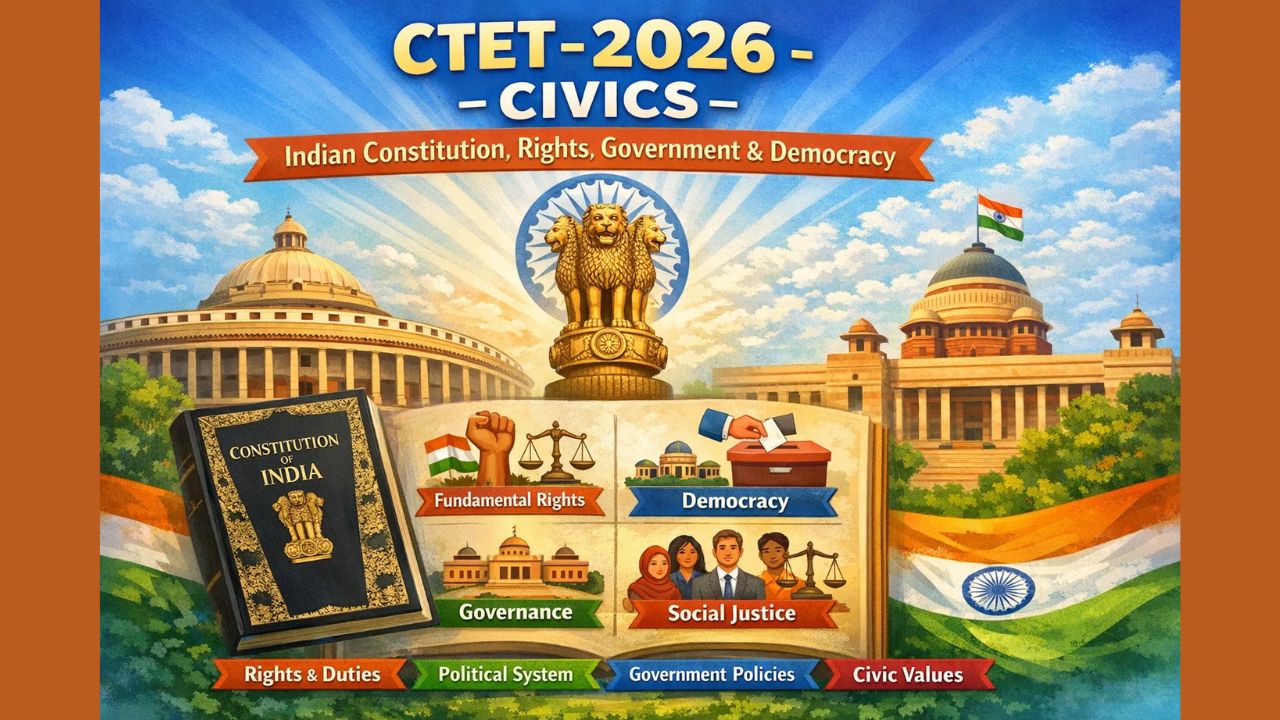
CTET-2026 Social Science (Civics / Political Science) साठी उपयुक्त असा हा लेख भारतीय संविधान, Fundamental Rights & Duties, Parliamentary System, Central & State Government, Local Self Government (Panchayati Raj & Municipalities), Democracy & Equality आणि Judiciary या सर्व महत्त्वाच्या घटकांचे सविस्तर व सोप्या भाषेत स्पष्टीकरण देतो.
हा Marathi + English mix article CTET परीक्षेच्या अभ्यासक्रमानुसार तयार करण्यात आला असून concept clarity, exam-oriented points, revision notes आणि महत्त्वाच्या घटनात्मक तरतुदी समजून घेण्यासाठी उपयुक्त आहे.
प्रस्तावना
Civics किंवा Political Science हा CTET-2026 च्या Social Science विभागातील अत्यंत महत्त्वाचा भाग आहे. Indian Constitution, Fundamental Rights & Duties, Parliamentary System, Central & State Government, Local Self Government, Democracy, Equality आणि Judiciary हे सर्व विषय भारतीय लोकशाहीची मजबूत पायाभरणी स्पष्ट करतात.
या लेखामध्ये Marathi + English mix मध्ये सर्व घटक सविस्तर व सोप्या भाषेत समजावून सांगितले आहेत.
Indian Constitution – Features (CTET Notes)
NCERT – Political Science Textbooks
1. Indian Constitution – Features (भारतीय संविधानाची वैशिष्ट्ये)-Civics
The Indian Constitution is the supreme law of India. It came into force on 26 January 1950.
Key Features / प्रमुख वैशिष्ट्ये
- Lengthiest Written Constitution
भारतीय संविधान हे जगातील सर्वात मोठे written constitution आहे. - Preamble (प्रस्तावना)
It declares India as a Sovereign, Socialist, Secular, Democratic Republic.
प्रस्तावना ही संविधानाची आत्मा (soul of the Constitution) मानली जाते. - Federal System with Unitary Bias
India follows a federal structure, पण emergencies मध्ये unitary form दिसून येते. - Fundamental Rights & Duties
Citizens ना rights दिले आहेत आणि duties पार पाडण्याची जबाबदारी देखील आहे. - Independent Judiciary
न्यायपालिका स्वतंत्र असून संविधानाचे रक्षण करते.
👉 CTET Tip: Preamble words आणि dates नेहमी लक्षात ठेवा.
2. Fundamental Rights & Duties (मूलभूत हक्क आणि कर्तव्ये)
Fundamental Rights (Articles 12–35)
There are 6 Fundamental Rights:
- Right to Equality (समतेचा हक्क – Articles 14–18)
Law before equality & prohibition of discrimination. - Right to Freedom (स्वातंत्र्याचा हक्क – Articles 19–22)
Freedom of speech, expression, movement etc. - Right against Exploitation (शोषणाविरुद्ध हक्क)
Prohibits child labour & forced labour. - Right to Freedom of Religion (धर्मस्वातंत्र्य)
India is a secular country. - Cultural & Educational Rights
Minorities can preserve their culture. - Right to Constitutional Remedies (Article 32)
Dr. B.R. Ambedkar called it “Heart and Soul of the Constitution.”
Fundamental Duties (Article 51A)
There are 11 Fundamental Duties, such as:Civics
- Constitution चा आदर करणे
- National unity जपणे
- Environment चे संरक्षण करणे
👉 Rights without Duties are meaningless.
3. Parliamentary System (संसदीय व्यवस्था)
India follows the Parliamentary form of Government, inspired by Britain.
Features
- President is the nominal head
- Prime Minister is the real executive
- Council of Ministers is responsible to Lok Sabha
Parliament of India consists of:
- President
- Lok Sabha (House of the People)
- Rajya Sabha (Council of States)
👉 CTET Point: Lok Sabha is more powerful than Rajya Sabha.
4. Central & State Government (केंद्र व राज्य शासन)
Central Government
- Head: President
- Real Power: Prime Minister
- Subjects: Defence, Foreign Affairs, Currency
State Government
- Head: Governor
- Real Power: Chief Minister
- Subjects: Police, Health, Agriculture
Distribution of Powers
- Union List
- State List
- Concurrent List
👉 Concurrent List वर दोन्ही कायदे करू शकतात, पण conflict असल्यास Central law prevails.
5. Local Self Government
(Panchayati Raj & Municipalities)
Panchayati Raj System (73rd Amendment – 1992)
Three-tier system:Civics
- Gram Panchayat
- Panchayat Samiti
- Zilla Parishad
Municipalities (74th Amendment)
- Municipal Corporation
- Municipal Council
- Nagar Panchayat
Importance
- Grassroot democracy
- People’s participation
- Local development
👉 CTET Question Alert: 73rd & 74th Constitutional Amendments.
6. Democracy & Equality (लोकशाही व समता)
Democracy
Democracy means rule of the people, by the people, for the people.
Features:Civics
- Free & fair elections
- Universal Adult Franchise
- Rule of Law
- Respect for minority rights
Equality
Equality ensures:
- Equal opportunity
- No discrimination
- Social justice
Indian democracy focuses on Political, Social & Economic equality.
7. Judiciary (न्यायपालिका)
The Judiciary is the guardian of the Constitution.
Structure
- Supreme Court
- High Courts
- Subordinate Courts
Functions
- Judicial Review
- Protection of Fundamental Rights
- Interpretation of Constitution
Independence of Judiciary
- Judges appointment process
- Security of tenure
- No interference from executive
👉 Article 32 & Article 226 are very important for CTET.
CTET Civic / Political Science – 50 PYQs (Answers Included)
1️⃣ A democratic country needs a constitution because it lays down rules for governance and prevents misuse of authority.
✔️ A. Constitution gives set of rules for governance
2️⃣ When did the Indian Constitution come into force?
✔️ 26 January 1950
3️⃣ Which part of the Constitution contains Fundamental Rights?
✔️ Part III
4️⃣ Which article contains Fundamental Duties?
✔️ Article 51A
5️⃣ Right against Exploitation prohibits?
✔️ Child labour and forced labour
6️⃣ Indian Parliamentary System is borrowed from which country?
✔️ United Kingdom
7️⃣ Who is the real executive in Parliamentary system?
✔️ Prime Minister
8️⃣ Which is the third tier of government in India?
✔️ Panchayati Raj
9️⃣ “Law before Equality” relates to?
✔️ Right to Equality
10️⃣ Which right ensures freedom of speech and expression?
✔️ Right to Freedom
11️⃣ Cultural and educational rights protect?
✔️ Minorities
12️⃣ Right to Constitutional Remedies is Article?
✔️ Article 32
13️⃣ Constitution makes India …
✔️ Sovereign, Socialist, Secular, Democratic Republic
14️⃣ Who presides over Rajya Sabha?
✔️ Vice‑President of India
15️⃣ Who appoints the Chief Minister?
✔️ Governor
16️⃣ Concurrent List means?
✔️ Both Centre & State can make laws
17️⃣ Local Self Government for urban areas is called?
✔️ Municipalities
18️⃣ 73rd Amendment deals with?
✔️ Panchayati Raj
19️⃣ Democracy ensures?
✔️ Rule of law and people’s participation
20️⃣ Judiciary’s primary function?
✔️ Judicial Review
21️⃣ Secularism in the Constitution means?
✔️ Equal respect to all religions
22️⃣ Fundamental Rights are enforceable by?
✔️ Courts
23️⃣ Right to equality prohibits?
✔️ Untouchability
24️⃣ The President of India is?
✔️ Nominal head of state
25️⃣ Who has the power to dissolve Lok Sabha?
✔️ President (on PM/ Council of Ministers advice)
26️⃣ Panchayat Samiti is in?
✔️ Block level
27️⃣ Separation of powers ensures?
✔️ Checks and balances between branches
28️⃣ Directive Principles are?
✔️ Not enforceable by courts
29️⃣ Universal Adult Franchise ensures?
✔️ Voting rights to all citizens ≥ age 18
30️⃣ India’s Centre‑State relations are?
✔️ Federal with unitary bias
31️⃣ Election Commission conducts?
✔️ Free & fair elections
32️⃣ Fundamental Duties were added by?
✔️ 42nd Amendment
33️⃣ Secular state means?
✔️ No state religion
34️⃣ Best definition of democracy is?
✔️ Govt by people, for people, of people
35️⃣ Supreme Court Head is?
✔️ Chief Justice of India
36️⃣ State List contains subjects like?
✔️ Police & Public Order
37️⃣ Indian Constitution is?
✔️ Written and lengthiest
38️⃣ Who enforces Fundamental Rights?
✔️ Judiciary
39️⃣ Lok Sabha term is?
✔️ 5 years (unless dissolved)
40️⃣ Municipal Corporation works in?
✔️ Large Urban cities
41️⃣ Council of Ministers is answerable to?
✔️ Lok Sabha
42️⃣ Judiciary independence means?
✔️ Judges security of tenure
43️⃣ Parliamentary form of govt features?
✔️ Collective responsibility
44️⃣ Amendment of Constitution is under?
✔️ Article 368
45️⃣ Electoral roll is prepared by?
✔️ Election Commission
46️⃣ India follows which electoral system?
✔️ First Past the Post
47️⃣ Fundamental Rights apply to?
✔️ All citizens
48️⃣ Judicial Review means?
✔️ Courts can strike down unconstitutional laws
49️⃣ Division of powers between Centre & States is in?
✔️ VIIth Schedule
50️⃣ The Constitution’s preamble reflects?
✔️ Objectives of the Constitution
निष्कर्ष
Indian Constitution आणि Civics विषय हे भारतीय लोकशाहीचे मजबूत स्तंभ आहेत. Fundamental Rights नागरिकांना संरक्षण देतात, Duties जबाबदारीची जाणीव करून देतात, Parliamentary System accountability सुनिश्चित करते, तर Judiciary संविधानाचे रक्षण करते.
CTET-2026 साठी या सर्व घटकांचा conceptual clarity + factual understanding अत्यावश्यक आहे.
✅ CTET-2026 Quick Revision Points-Civics
- Preamble keywords
- Fundamental Rights (Articles)
- 73rd & 74th Amendments
- Parliamentary vs Presidential System
- Role of Judiciary