
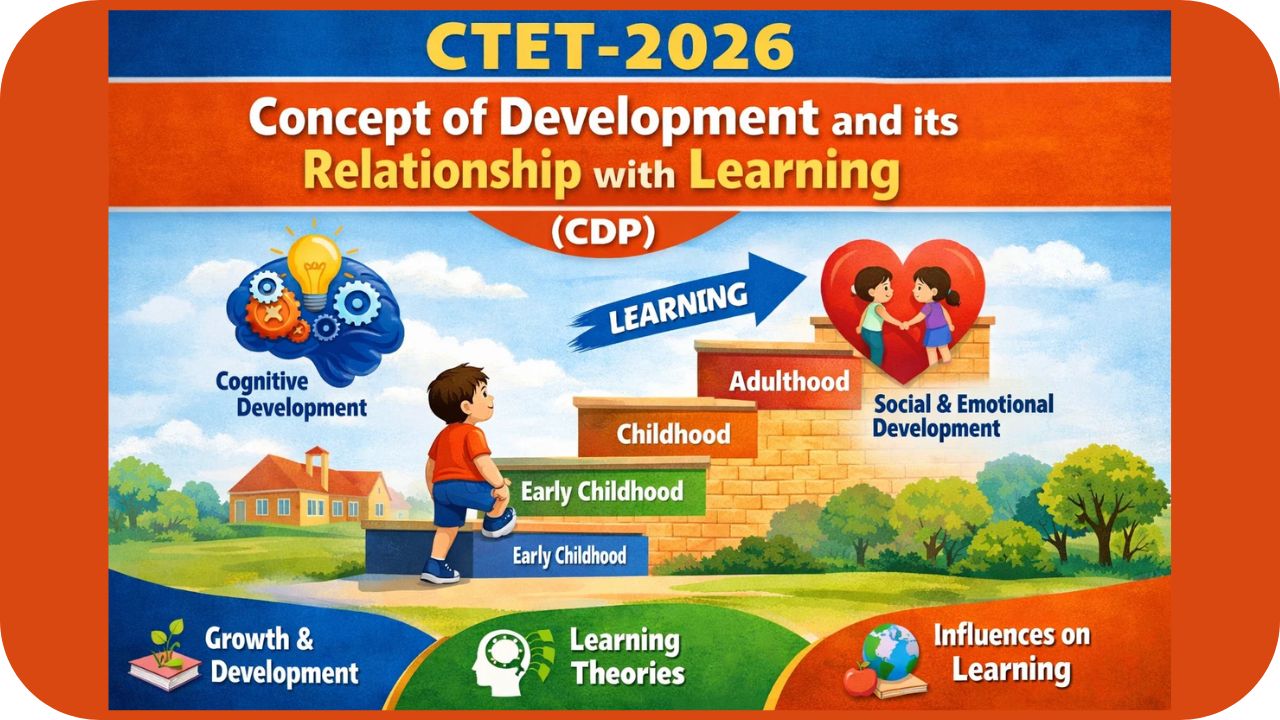
Concept of Development and its Relationship with Learning-विकास संकल्पना आणि अध्ययनाशी त्याचा संबंध
प्रस्तावना
Development is a continuous and progressive process that begins from conception and continues throughout life. It includes physical, cognitive, emotional, social, moral, and language development.
Learning, on the other hand, is a relatively permanent change in behavior due to experience and practice.
Child Development & Pedagogy – CTET 2026 Complete Notes
NCERT – Child Development & Learning Concepts
👉 Development provides the base, while learning builds upon it.
विकास(Concept of Development) ही जन्मापासून मृत्यूपर्यंत चालणारी सततची प्रक्रिया आहे. अध्ययन म्हणजे अनुभव व सरावामुळे वर्तनात होणारा अपेक्षित बदल.
👉 विकासाशिवाय अध्ययन शक्य नाही.
Meaning of Development / विकासाची संकल्पना
English
Development refers to qualitative and quantitative changes in a child, such as growth in height, improvement in thinking, emotional maturity, and social skills.
मराठी
विकास(Concept of Development) म्हणजे मुलांमध्ये होणारे शारीरिक, मानसिक, भावनिक, सामाजिक व भाषिक बदल. हे बदल क्रमशः व विशिष्ट पद्धतीने घडतात.
Characteristics of Development / विकासाची वैशिष्ट्ये
| English | मराठी |
|---|---|
| Development is continuous | विकास सतत चालणारी प्रक्रिया आहे |
| Follows a definite sequence | विकास ठराविक क्रमाने होतो |
| Rate of development varies | विकासाचा वेग प्रत्येक मुलात वेगळा असतो |
| Development is predictable | विकासाचा अंदाज लावता येतो |
| Influenced by heredity & environment | आनुवंशिकता व पर्यावरणाचा प्रभाव |
Meaning of Learning / अध्ययनाची संकल्पना
English-Concept of Development
Learning is a process through which knowledge, skills, attitudes, and values are acquired.
मराठी
अध्ययन म्हणजे अनुभव, निरीक्षण, कृती व सराव यांच्या माध्यमातून ज्ञान, कौशल्य व सवयी आत्मसात करणे.
Difference Between Development and Learning
| Development | Learning |
|---|---|
| Natural & biological | Experience-based |
| Long-term process | Can be short-term |
| Universal | Individual-specific |
| Occurs automatically | Requires effort |
| विकास | अध्ययन |
|---|---|
| नैसर्गिक प्रक्रिया | अनुभवावर आधारित |
| दीर्घकालीन | अल्पकालीन असू शकते |
| सर्वांमध्ये समान क्रम | व्यक्तीनुसार वेगळे |
Relationship Between Development and Learning / विकास व अध्ययनातील संबंध
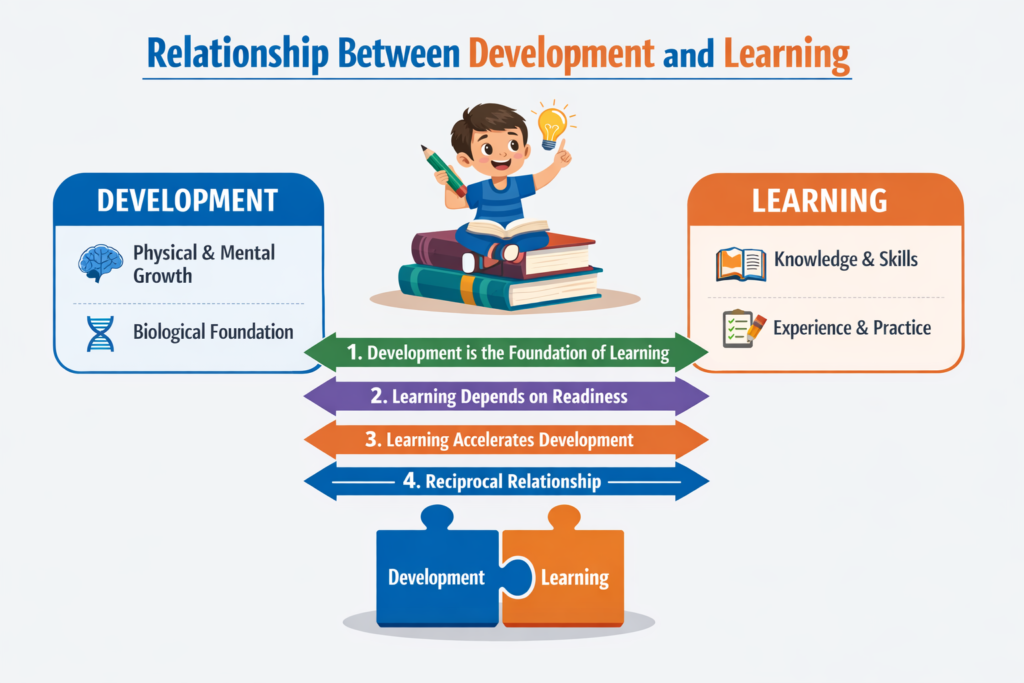
1. Development is the foundation of learning
Without proper physical and mental development, effective learning is not possible.
विकास हा अध्ययनाचा पाया आहे. मेंदूचा व मानसिक विकास नसेल तर अध्ययन घडत नाही.
2. Learning depends on developmental readiness
A child learns only when he/she is developmentally ready.
मुलाची तयारी (Readiness) असेल तेव्हाच अध्ययन प्रभावी होते.
3. Learning accelerates development
Learning experiences help in faster cognitive and social development.
अध्ययनामुळे मानसिक व सामाजिक विकास अधिक वेगाने होतो.
4. Reciprocal relationship
Development and learning influence each other.
विकास व अध्ययन यांचा परस्परावलंबी संबंध आहे.
Role of Teacher in Development & Learning / शिक्षकाची भूमिका
English
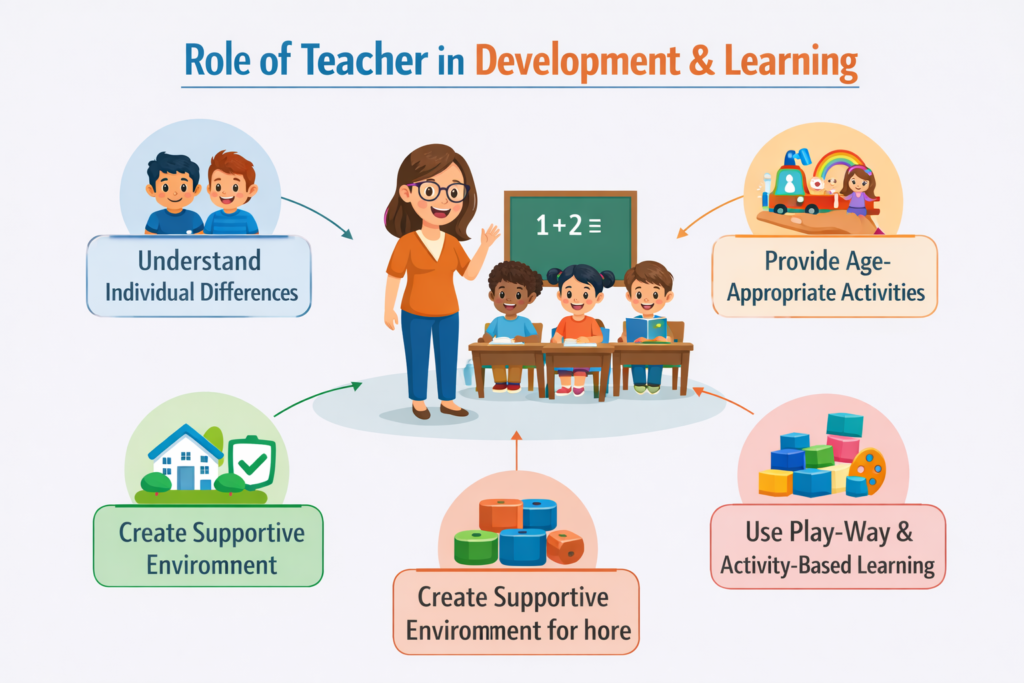
- Understanding individual differences
- Providing age-appropriate activities
- Creating a supportive learning environment
- Using play-way and activity-based learning
मराठी
- वैयक्तिक फरक ओळखणे
- वयानुसार उपक्रम देणे
- सुरक्षित व प्रेरक वातावरण निर्माण करणे
- कृतीआधारित व खेळातून शिक्षण देणे
Educational Implications for CTET / CTET साठी शैक्षणिक महत्त्व
- Teaching should be based on child’s developmental level
- No learning without development
- Emphasis on activity-based learning
- Respect individual differences
👉 CTET मध्ये यावर थेट MCQs व Assertion–Reason प्रश्न विचारले जातात.
MCQs (PYQs Based) – 20 Questions
1. Development is best described as:
A) Sudden change in behaviour
B) Continuous and progressive process
C) Learning by repetition
D) Short-term change
Answer: B
2. Learning is primarily the result of:
A) Maturation only
B) Heredity
C) Experience and practice
D) Growth
Answer: C
3. Which statement shows the correct relationship between development and learning?
A) Learning precedes development
B) Development and learning are unrelated
C) Development is the foundation of learning
D) Learning stops development
Answer: C
4. A child can learn effectively only when he/she is:
A) Forced to learn
B) Developmentally ready
C) Rewarded
D) Repeatedly tested
Answer: B
5. Which aspect of development most directly affects learning ability?
A) Physical development
B) Emotional development
C) Cognitive development
D) Moral development
Answer: C
6. Learning accelerates development by:
A) Ignoring maturation
B) Providing meaningful experiences
C) Stopping natural growth
D) Limiting practice
Answer: B
7. The relationship between development and learning is:
A) One-way
B) Independent
C) Reciprocal
D) Accidental
Answer: C
8. Which of the following is NOT a characteristic of development?
A) Continuous
B) Predictable
C) Uniform rate for all children
D) Sequential
Answer: C
9. Learning is different from development because learning:
A) Is biological
B) Is automatic
C) Depends on experience
D) Is universal
Answer: C
10. According to child-centered education, teaching should be based on:
A) Textbook content
B) Teacher’s convenience
C) Child’s developmental level
D) Examination pattern
Answer: C
Role of Teacher – MCQs
11. The teacher’s most important role in development is to:
A) Control students
B) Understand individual differences
C) Complete syllabus fast
D) Give homework only
Answer: B
12. Age-appropriate activities help in:
A) Overloading children
B) Ignoring readiness
C) Balanced development
D) Rote learning
Answer: C
13. Play-way method mainly supports:
A) Physical punishment
B) Passive learning
C) Holistic development
D) Memorization
Answer: C
14. A supportive classroom environment promotes:
A) Fear
B) Competition only
C) Learning and development
D) Discipline without learning
Answer: C
15. Which strategy best links development and learning?
A) Lecture method only
B) Activity-based learning
C) Excessive testing
D) Homework load
Answer: B
16. The teacher should adapt teaching according to:
A) School timetable
B) Child’s developmental needs
C) Parents’ pressure
D) Examination fear
Answer: B
17. Learning without development is:
A) Effective
B) Long-lasting
C) Not possible
D) Fast
Answer: C
18. Which factor influences both development and learning?
A) Punishment
B) Environment
C) Examination
D) Competition
Answer: B
19. Continuous learning experiences lead to:
A) Delayed development
B) No change
C) Faster development
D) Confusion
Answer: C
20. CTET emphasizes development–learning relationship because:
A) Teaching is content-focused
B) Children learn at same pace
C) Teaching must match child’s readiness
D) Development stops after learning
Answer: C
निष्कर्ष
Concept of Development विकास व अध्ययन एकमेकांशिवाय अपूर्ण आहेत. विकासामुळे अध्ययन शक्य होते आणि अध्ययनामुळे विकास अधिक सशक्त होतो. त्यामुळे शिक्षकाने दोन्हींचा समतोल साधणे आवश्यक आह