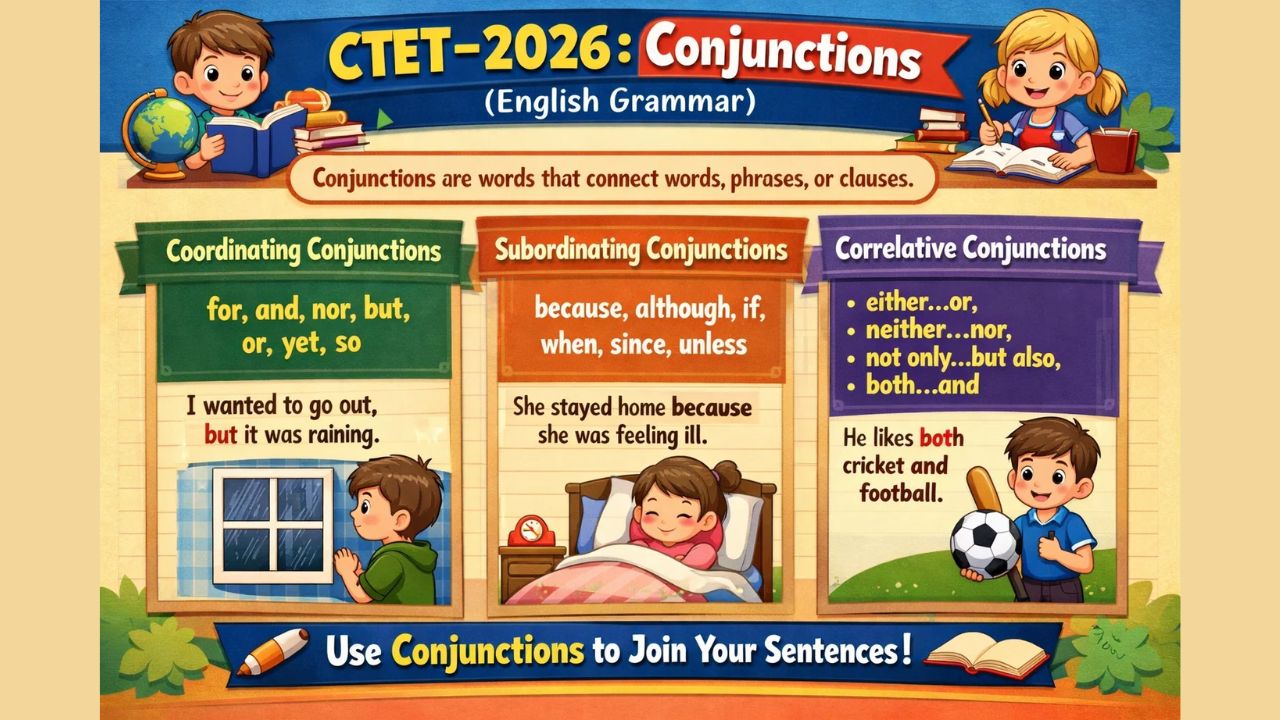
Conjunction म्हणजे वाक्यातील दोन किंवा अधिक शब्द, वाक्यांश किंवा उपवाक्ये जोडणारे शब्द.
English Grammar मध्ये Coordinating, Subordinating आणि Correlative असे तीन प्रकारचे conjunctions आहेत.
CTET–2026 परीक्षेत conjunctions वर fill in the blanks, error spotting आणि sentence correction असे प्रश्न विचारले जातात. योग्य conjunction चा वापर केल्यास वाक्याचा अर्थ स्पष्ट होतो.
प्रस्तावना
In English Grammar, Conjunctions are very important for sentence formation.
English language मध्ये वाक्ये (sentences), शब्द (words), clauses आणि phrases जोडण्यासाठी Conjunctions वापरले जातात.
CTET (Central Teacher Eligibility Test) मध्ये Conjunctions या घटकावर थेट किंवा अप्रत्यक्ष प्रश्न विचारले जातात. त्यामुळे शिक्षक उमेदवारांसाठी हा विषय अत्यंत महत्त्वाचा आहे.
👉 Conjunction म्हणजे काय?
A Conjunction is a word that joins two or more words, phrases, or clauses together.
मराठीत सांगायचे झाल्यास –
दोन किंवा अधिक शब्द, वाक्यांश किंवा उपवाक्ये जोडणाऱ्या शब्दांना Conjunction म्हणतात.
CTET–2026 : Tenses (English Grammar)
NCERT English Grammar (Class 6–10)
Definition of Conjunction / Conjunction ची व्याख्या
English Definition:
A conjunction is a word used to connect words, phrases, clauses, or sentences.
Marathi Meaning:
जे शब्द वाक्यातील घटकांना जोडण्याचे काम करतात त्यांना उभयान्वयी अव्यय (Conjunction) म्हणतात.
Examples / उदाहरणे
- Ram and Shyam are friends.
- I was tired but I continued my work.
- She will come if you invite her.
Types of Conjunctions / Conjunction चे प्रकार
English Grammar मध्ये मुख्यतः तीन प्रकारचे Conjunctions असतात:
- Coordinating Conjunctions
- Subordinating Conjunctions
- Correlative Conjunctions
CTET–2026 साठी हे तिन्ही प्रकार अत्यंत महत्त्वाचे आहेत.
1. Coordinating Conjunctions
Definition:
Coordinating conjunctions join words, phrases, or clauses of equal importance.
मराठीत –
समान दर्जाच्या दोन वाक्ये किंवा शब्द जोडण्यासाठी Coordinating Conjunction वापरले जातात.
FANBOYS Rule
Coordinating conjunctions लक्षात ठेवण्यासाठी FANBOYS हा शब्द वापरला जातो.
| Letter | Conjunction | Meaning |
|---|---|---|
| F | For | कारण |
| A | And | आणि |
| N | Nor | तसेच नाही |
| B | But | पण |
| O | Or | किंवा |
| Y | Yet | तरीसुद्धा |
| S | So | म्हणून |
Examples
- He is poor but honest.
- She likes tea and coffee.
- Work hard or you will fail.
👉 CTET Tip:
Coordinating conjunctions वापरताना दोन्ही clauses independent असतात.
2. Subordinating Conjunctions
Definition:
Subordinating conjunctions join a dependent clause to an independent clause.
मराठीत –
एक वाक्य दुसऱ्या वाक्यावर अवलंबून असेल तर Subordinating Conjunction वापरले जाते.
Common Subordinating Conjunctions
- Because – कारण
- Although / Though – जरी
- If – जर
- When – जेव्हा
- While – असताना
- Since – पासून / कारण
- Unless – जोपर्यंत नाही
- Before / After – आधी / नंतर
Examples
- I stayed at home because it was raining.
- Although he is rich, he is unhappy.
- You will pass if you work hard.
👉 CTET Note:
Subordinating conjunction sentence चा अर्थ बदलू शकते, त्यामुळे योग्य conjunction निवडणे महत्त्वाचे आहे.
3. Correlative Conjunctions
Definition:
Correlative conjunctions are used in pairs to join equal parts of a sentence.
मराठीत –
हे conjunction जोडीनं वापरले जातात.
Common Correlative Conjunctions
- Either – Or (किंवा – किंवा)
- Neither – Nor (ना – ना)
- Both – And (दोन्ही – आणि)
- Not only – But also (फक्त नाही तर – सुद्धा)
- Whether – Or (की – किंवा)
Examples
- Either you come or you stay.
- She is not only intelligent but also hardworking.
- Both the teacher and students were happy.
👉 CTET Exam Tip:
Correlative conjunction मध्ये parallel structure असणे गरजेचे आहे.
Common Errors in Conjunctions / Conjunction मधील सामान्य चुका
CTET परीक्षेत अनेकदा error spotting मध्ये conjunction वर प्रश्न येतात.
Wrong:
❌ Although he is poor but he is honest.
Correct:
✔ Although he is poor, he is honest.
👉 Rule:
Although/Though सोबत but वापरू नये.
Importance of Conjunctions in CTET–2026
- Sentence correction questions
- Fill in the blanks
- Error detection
- Reading comprehension
या सर्व प्रकारच्या प्रश्नांमध्ये Conjunctions महत्त्वाची भूमिका बजावतात.
Practice Examples / सराव उदाहरणे
- She was late ___ she missed the bus.
(because / but) - ___ you study well, you will not pass.
(Unless / If) - He is poor ___ honest.
(and / but)
CTET–2026 : Conjunctions – 50 MCQs
1. He is poor ___ honest.
A) and
B) but
C) or
D) so
✅ Ans: B
2. She worked hard ___ she passed the exam.
A) because
B) but
C) so
D) although
✅ Ans: C
3. ___ it was raining, we went out.
A) Because
B) Although
C) If
D) So
✅ Ans: B
4. I will call you ___ I reach home.
A) but
B) when
C) so
D) or
✅ Ans: B
5. He is ___ intelligent ___ hardworking.
A) either–or
B) neither–nor
C) not only–but also
D) both–or
✅ Ans: C
6. You must hurry ___ you will be late.
A) or
B) and
C) but
D) because
✅ Ans: A
7. ___ you work hard, you will fail.
A) If
B) Unless
C) Because
D) Though
✅ Ans: B
8. She likes tea ___ coffee.
A) but
B) or
C) and
D) yet
✅ Ans: C
9. He was tired ___ he continued working.
A) because
B) but
C) so
D) and
✅ Ans: B
10. ___ you come ___ you stay here.
A) Both–and
B) Either–or
C) Neither–nor
D) Not only–but also
✅ Ans: B
11. I stayed at home ___ it was raining.
A) but
B) because
C) or
D) yet
✅ Ans: B
12. She is poor ___ honest.
A) or
B) but
C) and
D) so
✅ Ans: B
13. ___ he is rich, he is unhappy.
A) Because
B) Although
C) If
D) Since
✅ Ans: B
14. Work hard ___ you will fail.
A) and
B) but
C) or
D) so
✅ Ans: C
15. He cannot read ___ write.
A) and
B) or
C) nor
D) but
✅ Ans: C
16. She was tired ___ she finished her work.
A) but
B) because
C) so
D) if
✅ Ans: A
17. ___ you help me, I will fail.
A) If
B) Unless
C) Though
D) Since
✅ Ans: B
18. I don’t know ___ he will come.
A) that
B) if
C) so
D) but
✅ Ans: B
19. He is ___ strong ___ brave.
A) either–or
B) both–and
C) neither–nor
D) not–but
✅ Ans: B
20. ___ he was ill, he went to school.
A) Because
B) Although
C) If
D) So
✅ Ans: B
21. She will come ___ you invite her.
A) unless
B) if
C) though
D) but
✅ Ans: B
22. He was hungry ___ he ate food.
A) but
B) so
C) or
D) because
✅ Ans: B
23. ___ it rains, we will stay home.
A) Unless
B) Though
C) If
D) Since
✅ Ans: C
24. He tried hard ___ failed.
A) but
B) and
C) or
D) so
✅ Ans: A
25. She is ___ beautiful ___ intelligent.
A) either–or
B) not only–but also
C) neither–nor
D) both–or
✅ Ans: B
26. I will wait ___ you return.
A) because
B) till
C) but
D) or
✅ Ans: B
27. He did not come ___ he was busy.
A) but
B) so
C) because
D) or
✅ Ans: C
28. ___ he was tired, he kept working.
A) Because
B) Although
C) If
D) Since
✅ Ans: B
29. She will sing ___ dance.
A) and
B) or
C) but
D) so
✅ Ans: A
30. He ran fast ___ missed the train.
A) but
B) so
C) and
D) because
✅ Ans: A
31. ___ you study, you will pass.
A) Because
B) If
C) Unless
D) Though
✅ Ans: B
32. I like him ___ his brother.
A) and
B) or
C) but
D) nor
✅ Ans: A
33. He is weak ___ clever.
A) or
B) but
C) so
D) and
✅ Ans: B
34. She stayed ___ the rain stopped.
A) till
B) because
C) but
D) or
✅ Ans: A
35. ___ he is poor, he is honest.
A) Because
B) Although
C) Since
D) If
✅ Ans: B
36. He was late ___ he missed the bus.
A) but
B) so
C) or
D) yet
✅ Ans: B
37. She will not go ___ you allow her.
A) if
B) unless
C) though
D) but
✅ Ans: B
38. He was angry ___ he said nothing.
A) but
B) and
C) or
D) so
✅ Ans: A
39. ___ Ram ___ Shyam was selected.
A) Both–and
B) Either–or
C) Neither–nor
D) Not only–but also
✅ Ans: B
40. I like coffee ___ I don’t like tea.
A) and
B) but
C) or
D) so
✅ Ans: B
41. She was afraid ___ she spoke loudly.
A) but
B) because
C) or
D) if
✅ Ans: A
42. He failed ___ he did not study.
A) but
B) so
C) because
D) or
✅ Ans: C
43. ___ you hurry, you will be late.
A) If
B) Unless
C) Though
D) Because
✅ Ans: B
44. He came early ___ waited.
A) but
B) and
C) or
D) so
✅ Ans: B
45. She is ___ smart ___ polite.
A) either–or
B) both–and
C) neither–nor
D) not–but
✅ Ans: B
46. I don’t know ___ he is coming.
A) but
B) so
C) if
D) and
✅ Ans: C
47. He worked hard ___ he could succeed.
A) so
B) but
C) or
D) yet
✅ Ans: A
48. ___ it was cold, we went swimming.
A) Because
B) Although
C) If
D) So
✅ Ans: B
49. She cannot sing ___ dance.
A) and
B) or
C) nor
D) but
✅ Ans: C
50. He was late ___ he apologized.
A) but
B) so
C) because
D) or
✅ Ans: B
निष्कर्ष
Conjunctions are the backbone of sentence structure in English Grammar.
CTET–2026 साठी Conjunction चे प्रकार, नियम आणि उदाहरणे नीट समजून घेणे अत्यंत आवश्यक आहे. योग्य conjunction वापरल्याने sentence स्पष्ट, अर्थपूर्ण आणि grammatically correct बनते.
👉 नियमित सराव आणि मागील वर्षांचे प्रश्न (PYQs) सोडवल्यास Conjunctions हा विषय सोपा आणि scoring ठरतो.