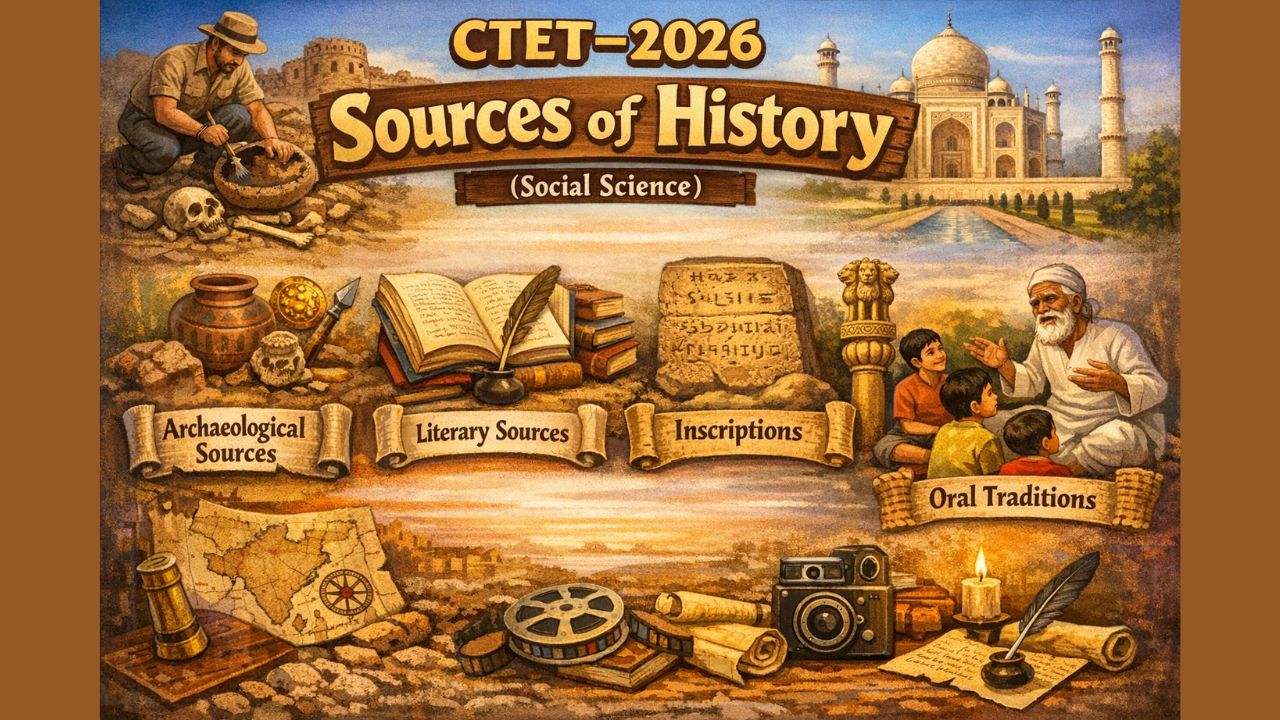
CTET–2026 Social Science साठी Sources of History हा अत्यंत महत्त्वाचा विषय आहे. या लेखामध्ये इतिहासाची साधने (Archaeological, Literary, Oral आणि Visual Sources) सविस्तरपणे Marathi आणि English mix भाषेत समजावून सांगितली आहेत. विद्यार्थ्यांना भूतकाळाचा अभ्यास कसा केला जातो, इतिहास लेखनासाठी पुरावे कसे वापरले जातात आणि CTET परीक्षेच्या दृष्टीने या विषयाचे शैक्षणिक महत्त्व काय आहे, याची स्पष्ट माहिती या लेखातून मिळेल. हा लेख CTET, TET आणि Social Science तयारी करणाऱ्या विद्यार्थ्यांसाठी उपयुक्त आहे.
प्रस्तावना
History म्हणजे भूतकाळातील मानवी जीवनाचा अभ्यास. Past events, ancient civilizations, culture, traditions, wars, administration या सर्व गोष्टींचा अभ्यास करण्यासाठी आपल्याला जे पुरावे मिळतात, त्यांना Sources of History (इतिहासाची साधने) असे म्हणतात.
इतिहासाच्या साधनांमुळेच आपल्याला मानवाचा विकास, समाजरचना आणि संस्कृती समजते. CTET–2026 Social Science मध्ये हा विषय खूप महत्त्वाचा आहे कारण यावर conceptual questions, MCQs, आणि teaching-based questions विचारले जातात.
CTET–2026 : The Revolt of 1857–58 (History)
Archaeological Survey of India (ASI)
Meaning of Sources of History / इतिहासाची साधने म्हणजे काय?
Sources of History म्हणजे भूतकाळातील घटनांची माहिती देणारे materials, records, and evidences.
मराठीत म्हणायचे तर –
👉 भूतकाळातील मानवी जीवनाबद्दल माहिती देणाऱ्या सर्व साधनांना इतिहासाची साधने म्हणतात.
Classification of Sources of History / इतिहासाच्या साधनांचे प्रकार
इतिहासाची साधने मुख्यतः खालील प्रकारात विभागली जातात :
- Archaeological Sources (पुरातत्त्वीय साधने)
- Literary Sources (साहित्यिक साधने)
- Oral Sources (मौखिक साधने)
- Visual Sources (दृक् साधने)
1. Archaeological Sources / पुरातत्त्वीय साधने
Archaeological sources म्हणजे जमिनीतून किंवा उत्खननातून मिळणारे भौतिक पुरावे. हे साधने ancient history साठी अत्यंत महत्त्वाची आहेत.
Types of Archaeological Sources
a) Inscriptions (शिलालेख)
- दगड, तांबे, धातूवर कोरलेली लेखन.
- राजांचे आदेश, दानपत्रे, युद्धवर्णन यांची माहिती मिळते.
- Example: Ashoka’s inscriptions
👉 Inscriptions are the most reliable sources of ancient history.
b) Coins (नाणी)
- राजांची नावे, पदव्या, धर्म, आर्थिक स्थिती कळते.
- Coins help us understand trade and economy.
- Example: Gupta gold coins
c) Monuments (स्मारके)
- मंदिरे, स्तूप, मशिदी, किल्ले
- स्थापत्यकला (Architecture) आणि धार्मिक जीवनाची माहिती
- Example: Ajanta Caves, Taj Mahal
d) Tools and Weapons (अवजारे व शस्त्रे)
- Stone Age, Bronze Age, Iron Age यांची ओळख
- मानवाचा तांत्रिक विकास समजतो
2. Literary Sources / साहित्यिक साधने
Literary sources म्हणजे लिखित स्वरूपातील साधने. ही साधने religious, historical, and secular texts मध्ये विभागली जातात.
Types of Literary Sources
a) Religious Literature (धार्मिक ग्रंथ)
- Vedas, Upanishads, Ramayana, Mahabharata
- Bible, Quran, Tripitaka
- समाजरचना, धर्म, मूल्ये यांची माहिती
b) Historical Texts (ऐतिहासिक ग्रंथ)
- Rajatarangini – Kalhana
- Harshacharita – Banabhatta
- Ain-i-Akbari – Abul Fazl
👉 These texts provide political and administrative information.
c) Foreign Accounts (परकीय प्रवासी वर्णने)
- Megasthenes – Indica
- Fa-Hien, Hiuen Tsang
- India’s social and economic condition described by foreigners
3. Oral Sources / मौखिक साधने
Oral sources म्हणजे पिढ्यान्पिढ्या चालत आलेली तोंडी माहिती.
Examples of Oral Sources
- Folk songs (लोकगीते)
- Folk tales (लोककथा)
- Ballads (पोवाडे)
- Proverbs (म्हणी)
👉 Oral sources are important for understanding local history and culture.
4. Visual Sources / दृक् साधने
Visual sources म्हणजे पाहण्याच्या स्वरूपातील साधने.
Examples
- Paintings
- Sculptures
- Photographs
- Maps
- Drawings
👉 Visual sources help students understand history more clearly and creatively.
Importance of Sources of History / इतिहासाच्या साधनांचे महत्त्व
- Past events are reconstructed
- Cultural development is understood
- Political and economic systems are explained
- Help in objective study of history
- Useful for teaching-learning process
मराठीत –
👉 इतिहासाची साधने नसती तर इतिहास लेखन अशक्य झाले असते.
Sources of History in Teaching (CTET Perspective)
CTET मध्ये इतिहास शिकवताना sources-based teaching वर भर दिला जातो.
- Use of pictures and monuments
- Storytelling through oral sources
- Coins and inscriptions for activity-based learning
- Encourages critical thinking in students
Difference between Archaeological and Literary Sources
| Archaeological Sources | Literary Sources |
|---|---|
| Physical evidences | Written records |
| Found by excavation | Written by authors |
| More reliable | Sometimes biased |
| Example: Coins | Example: Books |
CTET–2026 : Sources of History – 50 MCQs
1. History म्हणजे काय?
A) भविष्याचा अभ्यास
B) भूतकाळातील मानवी जीवनाचा अभ्यास
C) वर्तमानकाळाचा अभ्यास
D) भूगोलाचा अभ्यास
👉 उत्तर: B
2. Sources of History म्हणजे काय?
A) Historical stories
B) Past events
C) Past evidence and records
D) Future plans
👉 उत्तर: C
3. खालीलपैकी कोणते पुरातत्त्वीय साधन आहे?
A) रामायण
B) शिलालेख
C) लोककथा
D) कविता
👉 उत्तर: B
4. Inscriptions म्हणजे काय?
A) Coins
B) Paintings
C) Written records on stone or metal
D) Books
👉 उत्तर: C
5. Coins कोणती माहिती देतात?
A) हवामान
B) धार्मिक कथा
C) आर्थिक व राजकीय माहिती
D) भविष्यवाणी
👉 उत्तर: C
6. स्मारके (Monuments) कोणत्या साधनात येतात?
A) Literary
B) Oral
C) Archaeological
D) Visual
👉 उत्तर: C
7. Ajanta Caves हे कोणते साधन आहे?
A) Literary
B) Archaeological
C) Oral
D) Written
👉 उत्तर: B
8. Vedas कोणत्या प्रकारचे साधन आहेत?
A) Archaeological
B) Oral
C) Religious Literary
D) Visual
👉 उत्तर: C
9. Ramayana आणि Mahabharata हे कोणते स्रोत आहेत?
A) Secular
B) Religious
C) Archaeological
D) Oral only
👉 उत्तर: B
10. Rajatarangini हा ग्रंथ कोणी लिहिला?
A) Banabhatta
B) Kalhana
C) Megasthenes
D) Abul Fazl
👉 उत्तर: B
11. Ain-i-Akbari हा ग्रंथ कोणी लिहिला?
A) Kalhana
B) Tulsidas
C) Abul Fazl
D) Hiuen Tsang
👉 उत्तर: C
12. Foreign accounts म्हणजे काय?
A) भारतीय ग्रंथ
B) शिलालेख
C) परकीय प्रवाशांची वर्णने
D) लोककथा
👉 उत्तर: C
13. Megasthenes ने कोणता ग्रंथ लिहिला?
A) Indica
B) Arthashastra
C) Harshacharita
D) Rajatarangini
👉 उत्तर: A
14. Hiuen Tsang कोण होता?
A) राजा
B) कवी
C) परकीय प्रवासी
D) शिल्पकार
👉 उत्तर: C
15. Oral sources मध्ये काय येते?
A) Coins
B) Folk songs
C) Inscriptions
D) Books
👉 उत्तर: B
16. लोककथा (Folk tales) कोणत्या साधनात मोडतात?
A) Archaeological
B) Literary
C) Oral
D) Visual
👉 उत्तर: C
17. Visual sources मध्ये काय येते?
A) Vedas
B) Coins
C) Paintings
D) Stories
👉 उत्तर: C
18. Photographs कोणत्या प्रकारचे स्रोत आहेत?
A) Oral
B) Visual
C) Literary
D) Archaeological
👉 उत्तर: B
19. इतिहासासाठी सर्वात विश्वासार्ह साधन कोणते?
A) Oral
B) Archaeological
C) Stories
D) Poems
👉 उत्तर: B
20. Tools and weapons कशाची माहिती देतात?
A) राजकारण
B) धर्म
C) तांत्रिक विकास
D) साहित्य
👉 उत्तर: C
21. Stone Age माहिती कोणत्या साधनातून मिळते?
A) Books
B) Coins
C) Tools
D) Stories
👉 उत्तर: C
22. Literary sources म्हणजे काय?
A) Spoken
B) Written sources
C) Visual
D) Excavated
👉 उत्तर: B
23. Secular literature मध्ये काय येते?
A) Vedas
B) Quran
C) Historical texts
D) Folk songs
👉 उत्तर: C
24. Harshacharita हा ग्रंथ कोणी लिहिला?
A) Kalhana
B) Banabhatta
C) Ashoka
D) Fa-Hien
👉 उत्तर: B
25. Archaeological sources कसे मिळतात?
A) Writing
B) Reading
C) Excavation
D) Singing
👉 उत्तर: C
26. Coins help us to understand?
A) Climate
B) Trade and economy
C) Language
D) Poetry
👉 उत्तर: B
27. Maps कोणत्या स्रोतांत मोडतात?
A) Literary
B) Visual
C) Oral
D) Archaeological
👉 उत्तर: B
28. Proverbs (म्हणी) कोणत्या साधनात येतात?
A) Visual
B) Oral
C) Literary
D) Archaeological
👉 उत्तर: B
29. Inscriptions कोणत्या भाषेत असू शकतात?
A) Only Sanskrit
B) Only English
C) Different ancient languages
D) Only Hindi
👉 उत्तर: C
30. ASI म्हणजे काय?
A) Archaeological Survey of India
B) Ancient Study of India
C) Art Society of India
D) Asian Survey Institute
👉 उत्तर: A
31. Monuments give information about?
A) Architecture
B) Religion
C) Culture
D) All of the above
👉 उत्तर: D
32. CTET मध्ये Sources of History का महत्त्वाचे आहेत?
A) Essay writing साठी
B) Teaching approach साठी
C) Grammar साठी
D) Math साठी
👉 उत्तर: B
33. Folk songs उपयोगी असतात कारण?
A) They are written
B) They show local culture
C) They are modern
D) They are scientific
👉 उत्तर: B
34. Which source is written by foreigners?
A) Vedas
B) Indica
C) Ramayana
D) Quran
👉 उत्तर: B
35. Visual sources help students to?
A) Memorize dates
B) Understand history clearly
C) Learn grammar
D) Write essays
👉 उत्तर: B
36. Coins are also called?
A) Manuscripts
B) Numismatic sources
C) Oral sources
D) Visual arts
👉 उत्तर: B
37. Numismatics म्हणजे काय?
A) Study of coins
B) Study of books
C) Study of monuments
D) Study of paintings
👉 उत्तर: A
38. History without sources is?
A) Easy
B) Impossible
C) Interesting
D) Optional
👉 उत्तर: B
39. Oral sources are mostly?
A) Written
B) Visual
C) Passed from generation to generation
D) Excavated
👉 उत्तर: C
40. Taj Mahal कोणत्या स्रोतामध्ये येते?
A) Oral
B) Archaeological
C) Literary
D) Written
👉 उत्तर: B
41. Visual sources are useful in classroom because?
A) They are costly
B) They are old
C) They make learning interesting
D) They are difficult
👉 उत्तर: C
42. Which is NOT a source of history?
A) Coins
B) Inscriptions
C) Future plans
D) Monuments
👉 उत्तर: C
43. Manuscripts कोणत्या स्रोतांत येतात?
A) Archaeological
B) Literary
C) Oral
D) Visual
👉 उत्तर: B
44. History teaching should be based on?
A) Only textbooks
B) Only stories
C) Sources and evidences
D) Only imagination
👉 उत्तर: C
45. Which source is most useful for ancient history?
A) Newspapers
B) Archaeological sources
C) Photographs
D) Internet
👉 उत्तर: B
46. Folk dances belong to which source?
A) Visual
B) Oral
C) Archaeological
D) Literary
👉 उत्तर: B
47. Maps are helpful to understand?
A) Time
B) Place and region
C) Poetry
D) Religion
👉 उत्तर: B
48. History sources help us to know about?
A) Only kings
B) Only wars
C) Human life in the past
D) Only religion
👉 उत्तर: C
49. CTET मध्ये Sources of History प्रश्न कसे विचारले जातात?
A) Essay only
B) MCQs and pedagogy
C) Numerical
D) Practical
👉 उत्तर: B
50. Correct statement is?
A) Literary sources are always unbiased
B) Oral sources are useless
C) Archaeological sources are reliable
D) History has no sources
👉 उत्तर: C
निष्कर्ष
Sources of History हे इतिहासाचे आधारस्तंभ आहेत. Archaeological, Literary, Oral, and Visual sources यांच्या मदतीने आपण भूतकाळ समजून घेतो. CTET–2026 Social Science साठी हा विषय अत्यंत महत्त्वाचा असून, विद्यार्थ्यांनी examples सह अभ्यास करणे आवश्यक आहे.
👉 “No Sources, No History.”
👉 इतिहासाची साधने म्हणजेच इतिहासाची ओळख.