
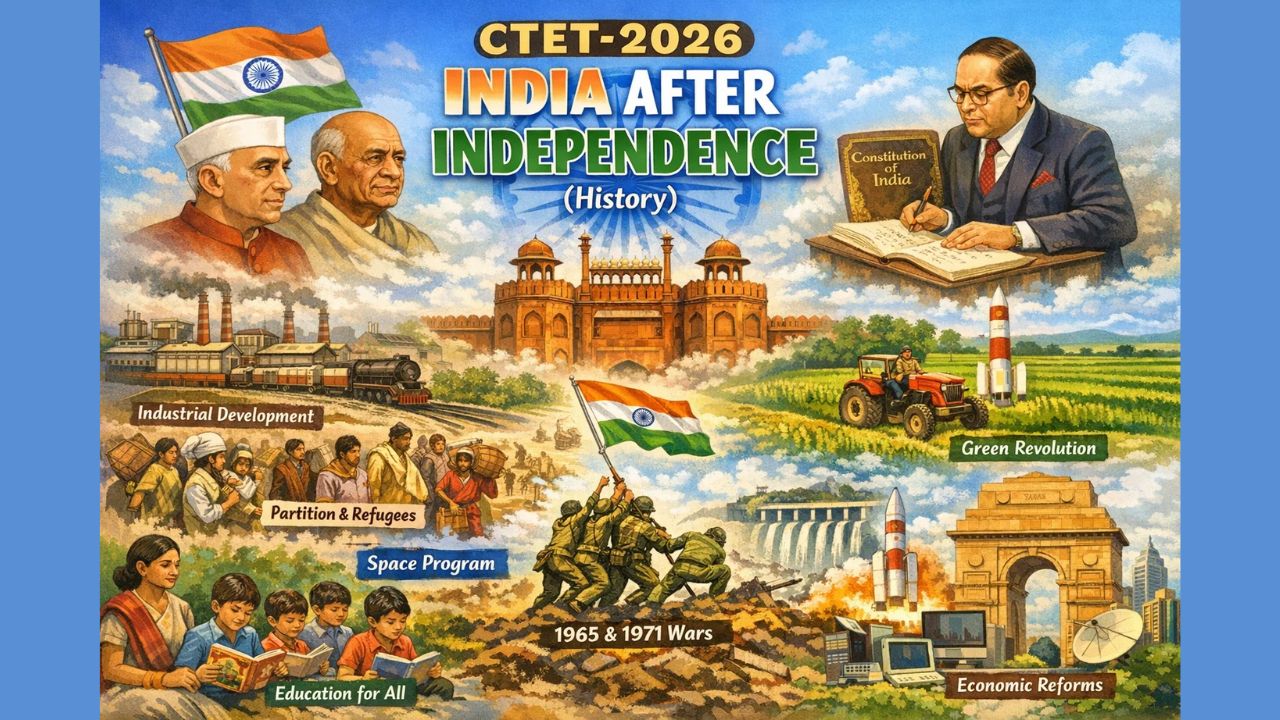
CTET-2026 साठी अत्यंत महत्त्वाचा असलेला “India After Independence (History)” हा लेख स्वातंत्र्योत्तर भारतातील प्रमुख ऐतिहासिक घडामोडी, आव्हाने आणि राष्ट्रनिर्मितीची प्रक्रिया सविस्तरपणे स्पष्ट करतो. या लेखामध्ये Partition of India, Integration of Princely States, Making of Indian Constitution, Democratic System, Economic Planning, Social Reforms, Linguistic Reorganisation of States आणि Non-Aligned Movement या सर्व महत्त्वाच्या मुद्द्यांचा समावेश आहे.
प्रस्तावना
India got Independence on 15 August 1947, but freedom came with huge challenges. British rule ended, yet the country faced Partition, refugee crisis, economic backwardness, social inequalities and political instability. The period after independence is therefore called a phase of Nation Building.
स्वातंत्र्यानंतरचा भारत हा केवळ राजकीय बदलांचा नव्हे, तर सामाजिक, आर्थिक व सांस्कृतिक पुनर्रचनेचा काळ होता.
भारतीय संविधान : निर्मिती व वैशिष्ट्ये
NCERT – इयत्ता १२ इतिहास (स्वातंत्र्योत्तर भारत)
1. Immediate Challenges After Independence | स्वातंत्र्यानंतरची तातडीची आव्हाने
(a) Partition of India
India was divided into India and Pakistan, leading to one of the largest migrations in history.
➡️ Around 1.4 crore people migrated
➡️ Communal riots caused lakhs of deaths
👉 या फाळणीमुळे मानवी दु:ख, धार्मिक तणाव आणि आर्थिक संकट निर्माण झाले.
(b) Refugee Rehabilitation
Millions of refugees from Pakistan needed:
- Housing
- Employment
- Food and security
Government established rehabilitation camps and introduced land distribution programs.
2. Integration of Princely States | संस्थानांचे एकत्रीकरण
At Independence, India had 565 princely states.
Sardar Vallabhbhai Patel and V.P. Menon played a crucial role in integrating them.
Major Examples:
- Hyderabad – Police Action (Operation Polo, 1948)
- Junagadh – Plebiscite
- Kashmir – Accession followed by conflict
👉 संस्थानांचे विलिनीकरण हे भारताच्या एकात्मतेसाठी अत्यंत महत्त्वाचे पाऊल होते.
3. Making of the Indian Constitution | भारतीय संविधान निर्मिती
The Constituent Assembly was formed in 1946.
- Chairman of Drafting Committee – Dr. B.R. Ambedkar
- Constitution adopted on 26 November 1949
- Came into force on 26 January 1950
Features:
- Longest written constitution
- Fundamental Rights & Duties
- Federal structure with strong centre
➡️ Constitution made India a Sovereign, Socialist, Secular, Democratic Republic.
4. Political System and Democracy | लोकशाही व्यवस्थेची उभारणी
First General Elections (1951–52)
India successfully conducted elections with:
- Universal Adult Franchise
- Over 17 crore voters
Indian National Congress emerged victorious, and Jawaharlal Nehru became the first Prime Minister.
👉 हे सिद्ध झाले की लोकशाही भारतात यशस्वीपणे रुजवता येऊ शकते.
5. Economic Planning and Development | आर्थिक नियोजन व विकास
India adopted a Mixed Economy Model.
Planning Commission (1950)
Introduced Five-Year Plans:
- Focus on agriculture, industry, education
- Public sector given importance
Key Initiatives:
- Green Revolution
- Industrialization
- Large dams called “Temples of Modern India”
👉 भारताने self-reliant economy घडवण्याचा प्रयत्न केला.
6. Social Reforms After Independence | सामाजिक सुधारणांचा काळ
Post-independence India focused on:
- Abolition of untouchability (Article 17)
- Equality before law
- Women empowerment
Important Laws:
- Hindu Code Bills
- Right to Education (later period)
👉 सामाजिक न्याय आणि समता ही संविधानाची मुख्य मूल्ये बनली.
7. Linguistic Reorganization of States | भाषावार राज्यरचना
Initially, states were formed on administrative basis.
But due to public demand, States Reorganisation Act, 1956 was passed.
Examples:
- Maharashtra & Gujarat (1960)
- Andhra Pradesh (first linguistic state)
👉 यामुळे लोकशाही सहभाग वाढला, पण काही ठिकाणी प्रादेशिक तणावही निर्माण झाले.
8. Foreign Policy and Non-Alignment | परराष्ट्र धोरण
India followed Non-Aligned Movement (NAM) under Nehru.
Principles:
- No military alliance
- Peaceful coexistence
- Anti-colonialism
India played an important role in Asia-Africa unity.
9. Challenges in the Early Decades | सुरुवातीच्या दशकातील समस्या
- Poverty
- Illiteracy
- Casteism
- Regionalism
- Wars with China (1962) and Pakistan (1965, 1971)
Despite these challenges, India maintained unity and democratic values.
10. India After Independence – CTET Exam Perspective
Important CTET Focus Points:
- Role of Nehru & Patel
- Constitution & Fundamental Rights
- Five Year Plans
- Democratic setup
- National integration
👉 Questions are often conceptual + analytical, not only factual.
India After Independence (History) – 50 PYQs**
1. India got independence on –
भारताला स्वातंत्र्य केव्हा मिळाले?
A) 26 January 1950
B) 15 August 1947 ✅
C) 2 October 1947
D) 26 November 1949
2. Partition of India resulted in –
A) Formation of linguistic states
B) Migration of millions of people ✅
C) End of princely states
D) Green Revolution
3. Who played the most important role in integration of princely states?
संस्थानांचे विलिनीकरण कोणी केले?
A) Jawaharlal Nehru
B) Dr. B.R. Ambedkar
C) Sardar Vallabhbhai Patel ✅
D) Rajendra Prasad
4. How many princely states were there at the time of independence?
A) 365
B) 465
C) 565 ✅
D) 600
5. Hyderabad was integrated into India through –
A) Plebiscite
B) Treaty
C) Police Action (Operation Polo) ✅
D) Referendum
6. The Constituent Assembly was formed in –
A) 1942
B) 1945
C) 1946 ✅
D) 1947
7. Chairman of Drafting Committee of Indian Constitution was –
A) Jawaharlal Nehru
B) Rajendra Prasad
C) B.R. Ambedkar ✅
D) Sardar Patel
8. Indian Constitution was adopted on –
A) 15 August 1947
B) 26 January 1950
C) 26 November 1949 ✅
D) 2 October 1949
9. Indian Constitution came into force on –
A) 26 November 1949
B) 15 August 1947
C) 26 January 1950 ✅
D) 1 April 1950
10. India is declared as a –
A) Monarchy
B) Socialist Republic
C) Federal Dictatorship
D) Sovereign Democratic Republic ✅
11. First General Elections in India were held in –
A) 1947–48
B) 1948–49
C) 1950–51
D) 1951–52 ✅
12. First Prime Minister of India was –
A) Rajendra Prasad
B) Jawaharlal Nehru ✅
C) Lal Bahadur Shastri
D) Sardar Patel
13. Universal Adult Franchise means –
A) Only educated people can vote
B) Only men can vote
C) All adults have right to vote ✅
D) Only property holders can vote
14. Planning Commission of India was set up in –
A) 1947
B) 1948
C) 1950 ✅
D) 1952
15. Five Year Plans were inspired by –
A) USA
B) Japan
C) Soviet Union (USSR) ✅
D) Britain
16. India adopted which type of economy after independence?
A) Capitalist
B) Socialist
C) Mixed Economy ✅
D) Traditional Economy
17. Large dams were called “Temples of Modern India” by –
A) Ambedkar
B) Patel
C) Nehru ✅
D) Rajendra Prasad
18. Green Revolution mainly aimed at –
A) Industrial growth
B) Increase in food grain production ✅
C) Population control
D) Education reform
19. Untouchability was abolished under which Article?
A) Article 14
B) Article 15
C) Article 16
D) Article 17 ✅
20. Linguistic Reorganisation of States took place in –
A) 1952
B) 1954
C) 1956 ✅
D) 1960
21. First linguistic state of India was –
A) Maharashtra
B) Andhra Pradesh ✅
C) Gujarat
D) Kerala
22. Maharashtra state was formed in –
A) 1956
B) 1958
C) 1960 ✅
D) 1962
23. Non-Aligned Movement means –
A) Supporting USA
B) Supporting USSR
C) Not joining any military bloc ✅
D) Military neutrality only
24. Leader associated with Non-Aligned Movement was –
A) Subhash Bose
B) Jawaharlal Nehru ✅
C) Lal Bahadur Shastri
D) Indira Gandhi
25. India followed which principle in foreign policy?
A) Expansionism
B) Colonialism
C) Peaceful coexistence ✅
D) Imperialism
26. War of 1962 was fought between India and –
A) Pakistan
B) Bangladesh
C) China ✅
D) Sri Lanka
27. Major challenge after independence was –
A) Over-industrialization
B) Refugee rehabilitation ✅
C) Overpopulation control
D) Language uniformity
28. Refugee crisis was mainly due to –
A) Constitution making
B) Partition of India ✅
C) Linguistic states
D) Industrialization
29. Kashmir issue started due to –
A) Linguistic reorganization
B) Accession problem of princely state ✅
C) Five Year Plans
D) Green Revolution
30. Fundamental Rights are included in –
A) Directive Principles
B) Preamble
C) Part III of Constitution ✅
D) Part IV
31. India became Republic in –
A) 1947
B) 1949
C) 1950 ✅
D) 1952
32. Head of Indian State is –
A) Prime Minister
B) Chief Justice
C) President ✅
D) Governor
33. Which body framed the Indian Constitution?
A) Parliament
B) Constituent Assembly ✅
C) Planning Commission
D) Supreme Court
34. Main aim of Five Year Plans was –
A) Political stability
B) Social entertainment
C) Economic development ✅
D) Religious unity
35. Democracy in India is based on –
A) Hereditary rule
B) Military power
C) People’s participation ✅
D) Bureaucracy
36. India follows which system of government?
A) Presidential
B) Parliamentary ✅
C) Military
D) Monarchical
37. Social justice mainly means –
A) Equality and fairness ✅
B) Only economic growth
C) Religious dominance
D) Political power
38. Abolition of Zamindari system was related to –
A) Political reform
B) Economic reform ✅
C) Cultural reform
D) Educational reform
39. Main objective of Constitution was –
A) Only governance
B) Welfare of people ✅
C) Military power
D) Industrial profit
40. Indian democracy is strengthened by –
A) Dictatorship
B) One party rule
C) Free and fair elections ✅
D) Military control
41. India’s unity is best described by –
A) Uniformity
B) Diversity
C) Unity in Diversity ✅
D) Centralization
42. Planning Commission was replaced by –
A) Finance Commission
B) NITI Aayog ✅
C) Election Commission
D) UPSC
43. Directive Principles aim at –
A) Legal enforcement
B) Moral guidance to state ✅
C) Judicial control
D) Political opposition
44. Refugees were mainly rehabilitated in –
A) Eastern India
B) Northern and Western India ✅
C) Southern India
D) Central India
45. India is a secular country means –
A) One religion state
B) No religion allowed
C) Equal respect to all religions ✅
D) Religious rule
46. Role of education after independence was to –
A) Create elites only
B) Promote equality and development ✅
C) Increase unemployment
D) Promote caste system
47. First President of India was –
A) Jawaharlal Nehru
B) Dr. Rajendra Prasad ✅
C) Dr. Ambedkar
D) Sardar Patel
48. National integration mainly focuses on –
A) Regionalism
B) Unity of the country ✅
C) Religious dominance
D) Language superiority
49. Constitution ensures equality under –
A) Article 12
B) Article 13
C) Article 14 ✅
D) Article 15
50. India after independence focused on –
A) Expansion of empire
B) Nation building ✅
C) Colonial rule
D) Military dictatorship
निष्कर्ष
India after Independence is a story of struggle, determination and success.
स्वातंत्र्यानंतर भारताने लोकशाही, धर्मनिरपेक्षता आणि सामाजिक न्याय या मूल्यांवर आधारित राष्ट्र उभारले. अनेक अडचणी असूनही भारताने एक मजबूत, एकसंध आणि प्रगत राष्ट्र म्हणून स्वतःला सिद्ध केले.
👉 “Unity in Diversity” is the real strength of post-independent India.
✅ CTET-2026 Quick Revision Keywords
Independence – Partition – Constitution – Nehru – Patel – Five Year Plans – Democracy – Social Justice – Non Alignment – Nation Building