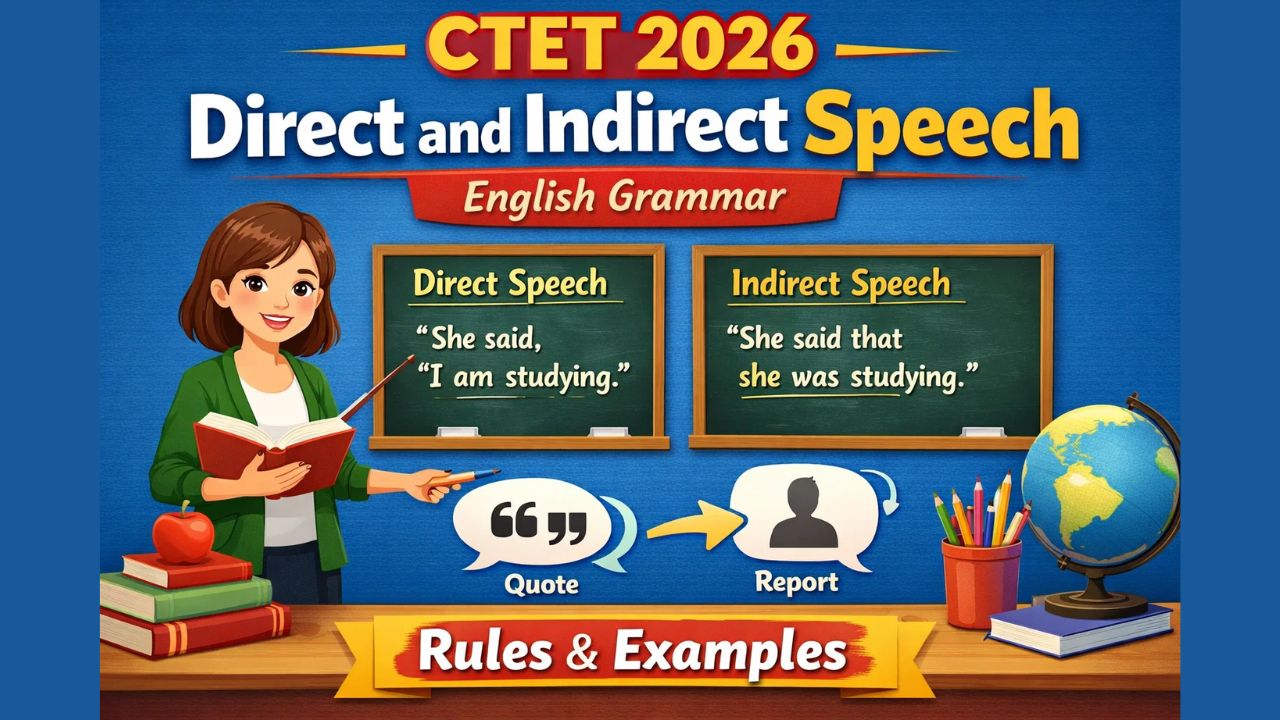
हा लेख इंग्रजी व्याकरणातील Direct आणि Indirect Speech (प्रत्यक्ष आणि अप्रत्यक्ष वाक्य) यावर आधारित आहे. या लेखामध्ये नियम, बदलाचे उदाहरण, टिप्स आणि सराव प्रश्न दिले आहेत जे CTET 2026 परीक्षेसाठी उपयुक्त आहेत.
परिचय
Direct Speech (प्रत्यक्ष वाक्य) म्हणजे बोलणाऱ्याचे शब्द जसे ते आहेत तसेच लिहिणे किंवा सांगणे.
उदा:
- He said, “I am going to school.”
तो म्हणाला, “मी शाळेत जात आहे.”
Indirect Speech (अप्रत्यक्ष वाक्य) म्हणजे दुसऱ्या व्यक्तीच्या शब्दांचा सारांश घेऊन किंवा बदलून सांगणे.
उदा:
- He said that he was going to school.
तो म्हणाला की तो शाळेत जात होता.
लक्षात ठेवा: Direct Speech मध्ये कोटेशन मार्क (“ ”) वापरले जातात, पण Indirect Speech मध्ये वापरले जात नाहीत.
“CTET परीक्षार्थ्यांसाठी टिप्स Tips for CTET विभागात पाहता येतील.”
CareerPower – Direct & Indirect Speech Rules + Exercises
Rules / नियम
2.1 Reporting Verb बदलणे
साधारणपणे said किंवा told या शब्दांचा वापर केला जातो.
- Direct: She said, “I am tired.”
- Indirect: She said that she was tired.
टीप: told चा वापर करताना व्यक्तीचाही उल्लेख करणे आवश्यक आहे:
- Direct: He said to me, “I like mangoes.”
- Indirect: He told me that he liked mangoes.
2.2 Pronoun बदलणे (सर्वनाम बदलणे)
सारखा अर्थ राखण्यासाठी सर्वनाम बदलले जाते.
- Direct: I am happy.
- Indirect: He said that he was happy.
- Direct: We are going.
- Indirect: They said that they were going.
2.3 Tense बदलणे (काल बदलणे)
साधारणपणे Direct Speech मधील Present → Past, Past → Past Perfect, Future → Conditional असे बदलले जाते.
| Direct Tense | Indirect Tense |
|---|---|
| Present Simple | Past Simple |
| Present Continuous | Past Continuous |
| Present Perfect | Past Perfect |
| Past Simple | Past Perfect |
| Past Continuous | Past Perfect Continuous |
| Future (will) | would |
उदा:
- Direct: He said, “I play football.”
- Indirect: He said that he played football.
2.4 Time & Place बदलणे
Direct Speech मध्ये दिलेल्या time आणि place शब्दांचा Indirect Speech मध्ये बदल होतो.
| Direct Speech | Indirect Speech |
|---|---|
| today | that day |
| yesterday | the day before |
| tomorrow | the next day |
| now | then |
| here | there |
| this | that |
| these | those |
उदा:
- Direct: She said, “I will come here tomorrow.”
- Indirect: She said that she would come there the next day.
2.5 Question बदलणे
Yes/No questions:
- Direct: “Are you coming?”
- Indirect: He asked me if I was coming.
Wh- questions:
- Direct: “Where do you live?”
- Indirect: He asked me where I lived.
टीप: Question च्या Indirect रूपात subject-predicate order साधा नियम वापरला जातो.
2.6 Imperatives / आदेश
- Direct: “Close the door.”
- Indirect: He told me to close the door.
- Direct: “Don’t be late.”
- Indirect: She advised me not to be late.
2.7 Exclamations / उद्गार
- Direct: “What a beautiful day!”
- Indirect: He exclaimed that it was a beautiful day.
- Direct: “How well you sing!”
- Indirect: She said that I sang very well.
3. Examples / उदाहरणे
- Direct: “I am studying English,” said Ramesh.
Indirect: Ramesh said that he was studying English. - Direct: “We will help you,” they said.
Indirect: They said that they would help me. - Direct: “Have you done your homework?” asked the teacher.
Indirect: The teacher asked me if I had done my homework. - Direct: “Please open the window,” she said.
Indirect: She requested me to open the window. - Direct: “What a nice song!” he exclaimed.
Indirect: He exclaimed that it was a nice song.
4. Tips for CTET / CTET साठी टिप्स
- Pronoun आणि Tense वर विशेष लक्ष द्या.
- Time & Place शब्दांच्या बदलाची नोंद ठेवा.
- Reporting verb (said, told, asked) योग्य वापरा.
- Yes/No questions मध्ये if/whether वापरणे विसरू नका.
- Imperatives मध्ये to + verb वापरणे आवश्यक आहे.
- Exclamations मध्ये that + clause वापरा.
5. Practice MCQs / सराव प्रश्न (50)
Sample 10 MCQs:
- He said, “I like chocolate.”
a) He said that he liked chocolate
b) He said he likes chocolate
c) He said I liked chocolate
Answer: a - She said, “I am reading a book.”
a) She said that she was reading a book
b) She said that she is reading a book
c) She said I was reading a book
Answer: a - Direct: “Where are you going?”
Indirect: …
a) He asked me where I was going
b) He asked where am I going
c) He asked where I go
Answer: a - Direct: “Please help me.”
Indirect: …
a) He asked me help him
b) He asked me to help him
c) He asked to help him
Answer: b - Direct: “I have finished my homework,” he said.
Indirect: …
a) He said that he has finished his homework
b) He said that he had finished his homework
c) He said he finished his homework
Answer: b - She said, “I will call you tomorrow.”
a) She said she would call me tomorrow
b) She said she would call me the next day
c) She said she will call me the next day
Answer: b - Direct: “Don’t be late.”
Indirect: …
a) He said not to be late
b) He told me not to be late
c) He said don’t be late
Answer: b - “How beautiful is this painting!”
a) He said how beautiful was that painting
b) He exclaimed that the painting was beautiful
c) He said the painting is beautiful
Answer: b - Direct: “I saw him yesterday,” she said.
Indirect: …
a) She said she saw him yesterday
b) She said she had seen him the day before
c) She said she saw him the day before
Answer: b - Direct: “Are you coming with us?”
Indirect: …
a) He asked me if I was coming with them
b) He asked me are you coming with us
c) He asked me if I come with them
Answer: a
बाकीचे 40 MCQs तुम्ही या नियमांवरून सहज बनवू शकता.
CTET 2026 – Direct & Indirect Speech PYQs (50 MCQs)
1–10
- Direct: He said, “I am going to school.”
a) He said that he was going to school
b) He said he is going to school
c) He said I was going to school
Answer: a - Direct: She said, “I like apples.”
a) She said she liked apples
b) She said she likes apples
c) She said I like apples
Answer: a - Direct: “Are you coming to the party?” he asked me.
a) He asked me are you coming to the party
b) He asked me if I was coming to the party
c) He asked me whether I come to the party
Answer: b - Direct: “Please open the door,” he said.
a) He requested me to open the door
b) He requested to open the door
c) He requested me open the door
Answer: a - Direct: “I have finished my homework,” he said.
a) He said he has finished his homework
b) He said he had finished his homework
c) He said I finished my homework
Answer: b - Direct: “We are going to the market,” they said.
a) They said they were going to the market
b) They said they are going to the market
c) They said we were going to the market
Answer: a - Direct: “Do not be late,” she said.
a) She told me not to be late
b) She said me not to be late
c) She told not to be late
Answer: a - Direct: “Where do you live?” he asked me.
a) He asked where do I live
b) He asked me where I lived
c) He asked me where do I live
Answer: b - Direct: “I will call you tomorrow,” he said.
a) He said he will call me tomorrow
b) He said he would call me the next day
c) He said I would call you tomorrow
Answer: b - Direct: “How beautiful this painting is!”
a) He said how beautiful that painting was
b) He exclaimed that the painting was beautiful
c) He said the painting is beautiful
Answer: b
11–20
- Direct: “I saw her yesterday,” he said.
a) He said he had seen her yesterday
b) He said he saw her the day before
c) He said he had seen her the day before
Answer: c - Direct: “Are you ready?” she asked.
a) She asked if I am ready
b) She asked if I was ready
c) She asked whether I ready
Answer: b - Direct: “I enjoy reading books,” he said.
a) He said that he enjoyed reading books
b) He said that he enjoys reading books
c) He said I enjoy reading books
Answer: a - Direct: “Bring me a glass of water,” she said.
a) She requested me bring a glass of water
b) She requested me to bring a glass of water
c) She requested to bring a glass of water
Answer: b - Direct: “We have completed our project,” they said.
a) They said they have completed their project
b) They said they had completed their project
c) They said we had completed our project
Answer: b - Direct: “Don’t speak loudly,” the teacher said.
a) The teacher said not to speak loudly
b) The teacher told not speaking loudly
c) The teacher said don’t speak loudly
Answer: a - Direct: “Can you help me?” he asked.
a) He asked if I can help him
b) He asked if I could help him
c) He asked I can help him
Answer: b - Direct: “I am very tired,” she said.
a) She said she is very tired
b) She said she was very tired
c) She said I am very tired
Answer: b - Direct: “What are you doing?” he asked.
a) He asked what am I doing
b) He asked what I was doing
c) He asked what I do
Answer: b - Direct: “Please sit down,” he said.
a) He asked me to sit down
b) He requested me to sit down
c) He said me to sit down
Answer: b
21–30
- Direct: “I will help you,” he said.
a) He said he will help me
b) He said he would help me
c) He said I will help you
Answer: b - Direct: “Don’t forget to call me,” she said.
a) She reminded me not to forget to call her
b) She told me don’t forget to call her
c) She said me don’t forget
Answer: a - Direct: “How many books do you have?” he asked.
a) He asked how many books do I have
b) He asked how many books I had
c) He asked how many books I have
Answer: b - Direct: “I am going now,” he said.
a) He said he was going then
b) He said he is going now
c) He said I am going now
Answer: a - Direct: “Please don’t make noise,” the teacher said.
a) The teacher requested not to make noise
b) The teacher requested me not to make noise
c) The teacher said don’t make noise
Answer: b - Direct: “I like chocolate,” she said.
a) She said she liked chocolate
b) She said she likes chocolate
c) She said I like chocolate
Answer: a - Direct: “Have you completed your homework?” he asked.
a) He asked if I have completed my homework
b) He asked if I had completed my homework
c) He asked I had completed my homework
Answer: b - Direct: “I will be there at 5 PM,” he said.
a) He said he will be there at 5 PM
b) He said he would be there at 5 PM
c) He said he would be there at 5 PM
Answer: c - Direct: “Do your work properly,” the teacher said.
a) The teacher told me to do my work properly
b) The teacher said me do my work properly
c) The teacher told me do my work properly
Answer: a - Direct: “We are happy,” they said.
a) They said they were happy
b) They said they are happy
c) They said we are happy
Answer: a
31–40
- Direct: “I saw him yesterday,” she said.
a) She said she saw him yesterday
b) She said she had seen him the day before
c) She said she had seen him yesterday
Answer: b - Direct: “Can you help me with this?” he asked.
a) He asked me if I could help him with this
b) He asked me can I help him with this
c) He asked me if I can help him with this
Answer: a - Direct: “What a lovely day!” she said.
a) She said what a lovely day it was
b) She exclaimed that it was a lovely day
c) She said it was a lovely day
Answer: b - Direct: “Don’t touch this,” he said.
a) He told me not to touch this
b) He said not to touch this
c) He said don’t touch this
Answer: a - Direct: “Where is your father?” she asked.
a) She asked where is my father
b) She asked where my father was
c) She asked where is my father
Answer: b - Direct: “I am watching TV,” he said.
a) He said he is watching TV
b) He said he was watching TV
c) He said I am watching TV
Answer: b - Direct: “Please give me a pen,” she said.
a) She requested me to give her a pen
b) She asked me to give her a pen
c) Both a and b
Answer: c - Direct: “I will meet you tomorrow,” he said.
a) He said he will meet me tomorrow
b) He said he would meet me the next day
c) He said he would meet me tomorrow
Answer: b - Direct: “Do you like cricket?” he asked.
a) He asked if I like cricket
b) He asked if I liked cricket
c) He asked do I like cricket
Answer: b - Direct: “Don’t be late for the meeting,” she said.
a) She told me not to be late for the meeting
b) She said don’t be late for the meeting
c) She advised not to be late for the meeting
Answer: a
41–50
Direct: “Why are you crying?” she asked.
a) She asked why am I crying
b) She asked why I was crying
c) She asked why I cry
Answer: b
Direct: “I am learning English,” he said.
a) He said he was learning English
b) He said he is learning English
c) He said I am learning English
Answer: a
Direct: “Will you help me?” she asked.
a) She asked if I would help her
b) She asked if I will help her
c) She asked I would help her
Answer: a
Direct: “I am very hungry,” he said.
a) He said he is very hungry
b) He said he was very hungry
c) He said I am very hungry
Answer: b
Direct: “Where are you going?” she asked.
a) She asked where am I going
b) She asked where I was going
c) She asked where I go
Answer: b
Direct: “Please don’t forget to bring the book,” he said.
a) He requested me not to forget to bring the book
b) He said don’t forget to bring the book
c) He told me don’t forget the book
Answer: a
Direct: “I have never seen such a place,” she said.
a) She said she had never seen such a place
b) She said she has never seen such a place
c) She said I have never seen such a place
Answer: a
Direct: “Do your homework properly,” the teacher said.
a) The teacher told me to do my homework properly
b) The teacher said me do my homework properly
c) The teacher asked me to do my homework properly
Answer: a
Direct: “I will tell him the truth,” she said.
a) She said she would tell him the truth
b) She said she will tell him the truth
c) She said I will tell him the truth
Answer: a
Direct: “I can swim,” he said.
a) He said he could swim
b) He said he can swim
c) He said I can swim
Answer: a
निष्कर्ष
Direct आणि Indirect Speech या CTET परीक्षेत Grammar आणि Language Comprehension चा महत्त्वाचा भाग आहे.
- Direct Speech मध्ये कोटेशन मार्क्स आणि मूळ शब्दांचा वापर होतो.
- Indirect Speech मध्ये Tense, Pronoun, Time & Place बदल करणे आवश्यक आहे.
- सराव करून नियम लक्षात ठेवणे CTET परीक्षेसाठी खूप उपयुक्त ठरते.