
Jean Piaget’s Cognitive Development Theory explains how children think, learn, and solve problems. हा लेख चार stages, key concepts (schema, assimilation, accommodation) आणि classroom application Marathi-English mix मध्ये स्पष्ट करतो. CTET 2026 मध्ये CDP साठी अत्यंत उपयुक्त.
परिचय
Jean Piaget (1896–1980) हे Swiss psychologist होते. त्यांनी children think differently than adults हा revolutionary विचार मांडला. Piaget यांच्या मते, child is not a passive learner, but an active constructor of knowledge.
CTET 2026 च्या Child Development & Pedagogy (CDP) मध्ये Jean Piaget’s Cognitive Development Theory हा अत्यंत महत्त्वाचा topic आहे. प्रश्न थेट stages, concepts आणि classroom application वर विचारले जातात.
CTET 2026 – Child Development & Pedagogy Overview
NCERT – Child Development Textbook PDF
Meaning of Cognitive Development
(संज्ञानात्मक विकास म्हणजे काय?)
Cognitive Development म्हणजे:
The development of thinking, reasoning, problem-solving, memory and intelligence in children.
मराठीत सांगायचं तर –
मुलांची विचारशक्ती, समज, तर्कशक्ती, स्मरणशक्ती आणि समस्या सोडवण्याची क्षमता वाढणे म्हणजे संज्ञानात्मक विकास.
Piaget यांच्या मते:
- Cognitive development occurs in stages
- Each stage is qualitatively different
- Stages are universal (सर्व मुलांमध्ये आढळतात)
Basic Assumptions of Piaget’s Theory
(पियाजेच्या सिद्धांताची मूलभूत तत्त्वे)
- Children are active learners
- Learning occurs through interaction with environment
- Cognitive development happens in fixed stages
- Stages cannot be skipped
- Development precedes learning
👉 CTET Point:
According to Piaget, development comes before learning.
Key Concepts of Piaget’s Theory
(मुख्य संकल्पना)
1. Schema
Schema म्हणजे mental structure or framework.
Example:
- A child’s schema of “dog” includes four legs, tail, barking.
2. Assimilation
New information fit करणे existing schema मध्ये.
Example:
- Cow ला पण “dog” म्हणणे (because both have four legs)
3. Accommodation
Existing schema change करणे new information साठी.
Example:
- Child learns that dog and cow are different animals
4. Equilibration
Assimilation आणि Accommodation यामधील balance.
👉 Learning occurs when disequilibrium happens.
Stages of Cognitive Development
(संज्ञानात्मक विकासाचे टप्पे)
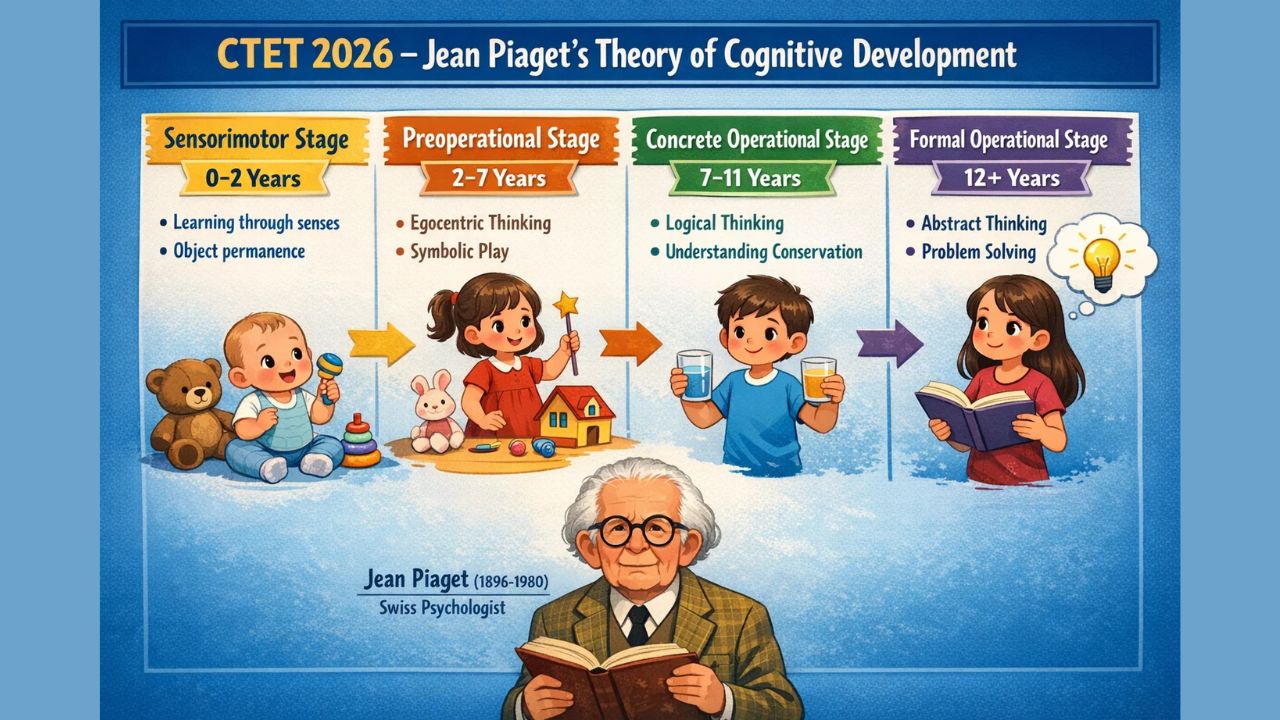
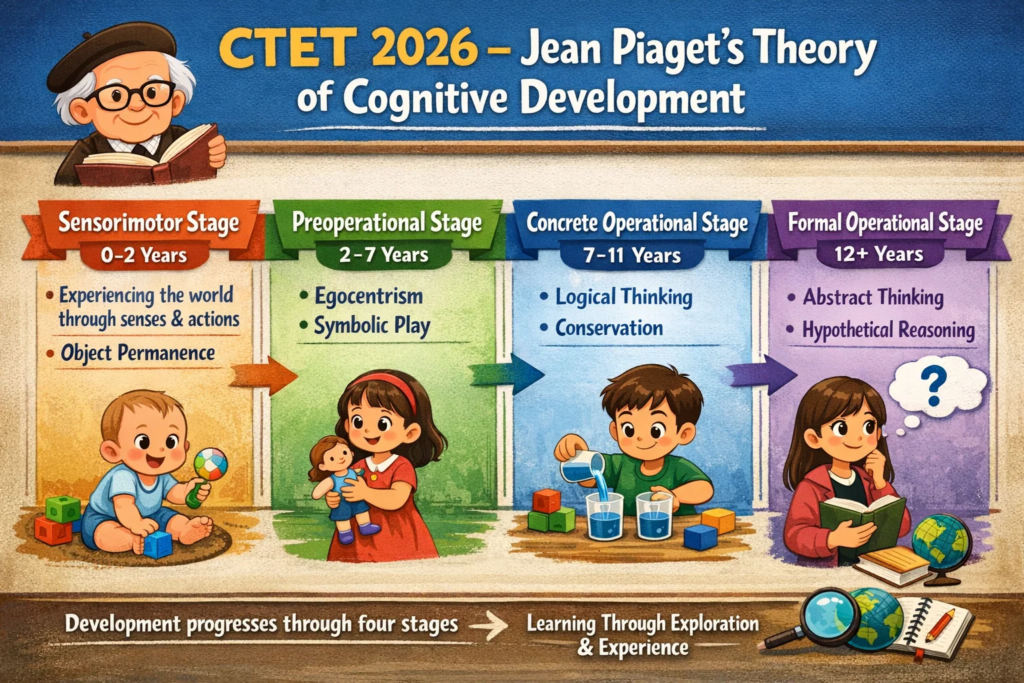
Jean Piaget यांनी cognitive development चे 4 stages सांगितले आहेत.
1. Sensorimotor Stage (0–2 Years)
Key Features:
- Learning through senses and motor activities
- No symbolic thinking
- Object Permanence develops
Object Permanence:
Understanding that objects exist even when they are not visible.
Example:
- Toy लपवले तरी ते आहे हे समजणे
👉 CTET Question:
Object Permanence develops in which stage?
Answer: Sensorimotor Stage
2. Pre-operational Stage (2–7 Years)
Characteristics:
- Symbolic thinking develops
- Language development
- Egocentrism
- Animism
- Lack of conservation
Egocentrism:
Child cannot see things from others’ perspective.
Example:
- Child thinks everyone sees what he sees
Animism:
Non-living things ला life देणे.
Example:
- “Sun is smiling”
Conservation:
Understanding that quantity remains same despite change in shape.
Example:
- Same water in different shaped glasses
👉 Children fail conservation tasks in this stage.
3. Concrete Operational Stage (7–11 Years)
Key Features:
- Logical thinking develops
- Conservation achieved
- Classification and seriation possible
- Thinking is concrete, not abstract
Conservation Achieved:
- Number
- Length
- Mass
- Volume
Seriation:
Arranging objects in order (small to big)
Example:
- Sticks arranged by length
👉 CTET Tip:
Logical thinking + conservation = Concrete Operational Stage
4. Formal Operational Stage (11 Years & Above)
Characteristics:
- Abstract thinking
- Hypothetical reasoning
- Problem-solving ability
- Scientific thinking
Example:
- Algebra
- Philosophy
- Moral reasoning
👉 Adolescents can think about “what might be”, not just “what is”.
Role of Teacher According to Piaget
(शिक्षकाची भूमिका)
Teacher should be:
- Facilitator
- Guide
- Environment creator
Teacher should:
- Encourage exploration
- Use activity-based learning
- Provide concrete experiences
- Avoid rote learning
Piaget’s Theory and Classroom Implications
(वर्गातील उपयोग)
| Stage | Teaching Strategy |
|---|---|
| Sensorimotor | Use sensory activities |
| Pre-operational | Use pictures, stories |
| Concrete operational | Use charts, models |
| Formal operational | Use discussions, debates |
👉 CTET Focus:
Teaching must be stage-appropriate.
Advantages of Piaget’s Theory
(फायदे)
- Child-centered approach
- Focus on active learning
- Useful for curriculum planning
- Basis for constructivist teaching
Limitations of Piaget’s Theory
(मर्यादा)
- Underestimated children’s abilities
- Stages may overlap
- Cultural factors ignored
- Less emphasis on social interaction
Comparison: Piaget vs Vygotsky (Brief)
| Piaget | Vygotsky |
|---|---|
| Individual learning | Social learning |
| Development before learning | Learning before development |
| Stages | No fixed stages |
Importance for CTET 2026 Exam
(CTET साठी महत्त्व)
CTET मध्ये विचारले जाणारे मुद्दे:
- Stages & age
- Egocentrism
- Conservation
- Schema, Assimilation, Accommodation
- Classroom application
👉 CDP section मध्ये 5–6 प्रश्न Piaget वर येऊ शकतात.
50 MCQs – Jean Piaget Cognitive Development
1–10: Basic Concepts
- Piaget was a psychologist from which country?
a) USA
b) Switzerland ✅
c) UK
d) Germany - Cognitive development means:
a) Physical growth
b) Development of thinking, problem-solving & intelligence ✅
c) Social skills only
d) Emotional growth only - According to Piaget, children are:
a) Passive learners
b) Active learners ✅
c) Observers only
d) Copycats - Piaget’s theory focuses on:
a) Memory
b) Learning through interaction with environment ✅
c) Physical development
d) Emotional development - Which comes first according to Piaget?
a) Learning
b) Development ✅
c) Teaching
d) Socialization - Schema is:
a) Mental framework or structure ✅
b) Physical activity
c) Language skill
d) Memory - Assimilation means:
a) Changing existing schema
b) Fitting new info into existing schema ✅
c) Ignoring new info
d) Learning by trial and error - Accommodation means:
a) Fitting new info into old schema
b) Changing existing schema to adjust new info ✅
c) Forgetting previous info
d) Memorizing - Equilibration is:
a) Balance between assimilation & accommodation ✅
b) Forgetting new info
c) Teaching method
d) Stage of learning - Piaget believed development occurs in:
a) Random stages
b) Fixed stages ✅
c) One stage only
d) Culture-specific stages
11–20: Sensorimotor Stage (0–2 years)
- Sensorimotor stage age:
a) 0–2 years ✅
b) 2–7 years
c) 7–11 years
d) 11+ years - Learning in sensorimotor stage is through:
a) Thinking only
b) Senses & motor activities ✅
c) Language
d) Abstract reasoning - Object permanence develops in:
a) Pre-operational stage
b) Sensorimotor stage ✅
c) Concrete operational stage
d) Formal operational stage - Example of object permanence:
a) Child hides toy and forgets
b) Child understands toy exists even if hidden ✅
c) Child can count objects
d) Child solves abstract problems - Symbolic thinking is:
a) Present in sensorimotor stage
b) Not present in sensorimotor stage ✅
c) Same as concrete thinking
d) Present in formal operational stage - Sensorimotor children are:
a) Egocentric
b) Active learners through senses ✅
c) Abstract thinkers
d) Hypothetical thinkers - Language development is:
a) Major in sensorimotor stage
b) Minimal in sensorimotor stage ✅
c) Absent in formal operational stage
d) Same in all stages - Piaget emphasized interaction with environment in which stage?
a) Pre-operational
b) Sensorimotor ✅
c) Formal operational
d) None - Sensorimotor stage involves:
a) Conservation
b) Exploration through senses ✅
c) Abstract reasoning
d) Moral reasoning - Sensorimotor stage is mostly:
a) Passive
b) Active exploration ✅
c) Logical reasoning
d) Social interaction
21–30: Pre-operational Stage (2–7 years)
- Pre-operational stage age:
a) 0–2
b) 2–7 ✅
c) 7–11
d) 11+ - Characteristics of this stage include:
a) Logical thinking
b) Symbolic thinking & language development ✅
c) Abstract reasoning
d) Scientific thinking - Egocentrism means:
a) Child sees others’ perspective
b) Child cannot see others’ perspective ✅
c) Child is selfish only
d) Child shares ideas - Animism means:
a) Giving life to non-living things ✅
b) Thinking logically
c) Conservation skill
d) Problem-solving skill - Conservation is:
a) Ability to preserve toys
b) Understanding quantity remains same despite change ✅
c) Language development
d) Social skill - Pre-operational children:
a) Can solve abstract problems
b) Fail conservation tasks ✅
c) Think scientifically
d) Reason hypothetically - Example of egocentrism:
a) Child thinks everyone sees what he sees ✅
b) Child counts objects
c) Child solves algebra
d) Child debates moral issues - Pre-operational stage involves:
a) Abstract thinking
b) Concrete reasoning
c) Symbolic thinking ✅
d) Hypothetical reasoning - Classroom strategy for this stage:
a) Activity-based learning with objects ✅
b) Debates on abstract ideas
c) Algebra exercises
d) Scientific experiments - Pre-operational children learn mainly through:
a) Observation & imitation ✅
b) Abstract thinking
c) Hypothetical reasoning
d) Scientific method
31–40: Concrete Operational Stage (7–11 years)
- Concrete operational stage age:
a) 2–7
b) 7–11 ✅
c) 11+
d) 0–2 - Logical thinking develops in:
a) Sensorimotor
b) Pre-operational
c) Concrete operational ✅
d) Formal operational - Conservation is achieved in which stage?
a) Pre-operational
b) Concrete operational ✅
c) Sensorimotor
d) Formal operational - Seriation means:
a) Arranging objects in order ✅
b) Abstract thinking
c) Language development
d) Hypothetical reasoning - Concrete operational children can classify objects by:
a) Size, shape, function ✅
b) Abstract ideas
c) Moral values
d) Hypothetical thinking - Thinking in concrete operational stage is:
a) Abstract
b) Logical & concrete ✅
c) Symbolic
d) Hypothetical - Example: Sorting sticks from small to big – which stage?
a) Pre-operational
b) Concrete operational ✅
c) Formal operational
d) Sensorimotor - Classroom method:
a) Activity-based concrete tasks ✅
b) Debates on morality
c) Abstract problem-solving
d) Hypothetical experiments - Concrete operational stage focuses on:
a) Abstract reasoning
b) Logical thinking with tangible objects ✅
c) Hypothetical situations
d) Scientific method - Child can solve problems related to:
a) Concrete objects ✅
b) Hypothetical situations
c) Philosophy
d) Future predictions
41–50: Formal Operational Stage (11+ years)
- Formal operational stage age:
a) 7–11
b) 2–7
c) 11+ ✅
d) 0–2 - Abstract thinking develops in:
a) Pre-operational
b) Concrete operational
c) Formal operational ✅
d) Sensorimotor - Hypothetical reasoning is possible in:
a) Sensorimotor
b) Concrete operational
c) Formal operational ✅
d) Pre-operational - Example of formal operational thinking:
a) Solving algebra problems ✅
b) Counting objects
c) Arranging sticks
d) Playing with toys - Adolescents can think about:
a) Only what is
b) What might be ✅
c) Only toys
d) Only objects - Classroom strategy for formal operational children:
a) Discussions & debates ✅
b) Play-based learning
c) Simple object manipulation
d) Memorization - Problem-solving in formal operational stage is:
a) Concrete
b) Abstract & logical ✅
c) Symbolic
d) Imitative - Piaget emphasized this skill in formal operational stage:
a) Scientific thinking ✅
b) Animism
c) Egocentrism
d) Object permanence - Formal operational stage allows children to:
a) Solve real & hypothetical problems ✅
b) Only memorize facts
c) Only play
d) Only imitate adults - Piaget’s theory helps teachers to:
a) Understand stage-appropriate teaching ✅
b) Teach only memorization
c) Avoid classroom activities
d) Focus on rote learning
निष्कर्ष
Jean Piaget’s Theory of Cognitive Development explains how children think, learn and understand the world. His theory emphasizes that children are active learners and cognitive development happens in stages.
CTET 2026 च्या दृष्टीने हा सिद्धांत अत्यंत महत्त्वाचा असून योग्य समज, उदाहरणे आणि stages लक्षात ठेवल्यास प्रश्न सहज सोडवता येतात.
I like it.
It is very good and
Very nice 👍👍
Thank You.