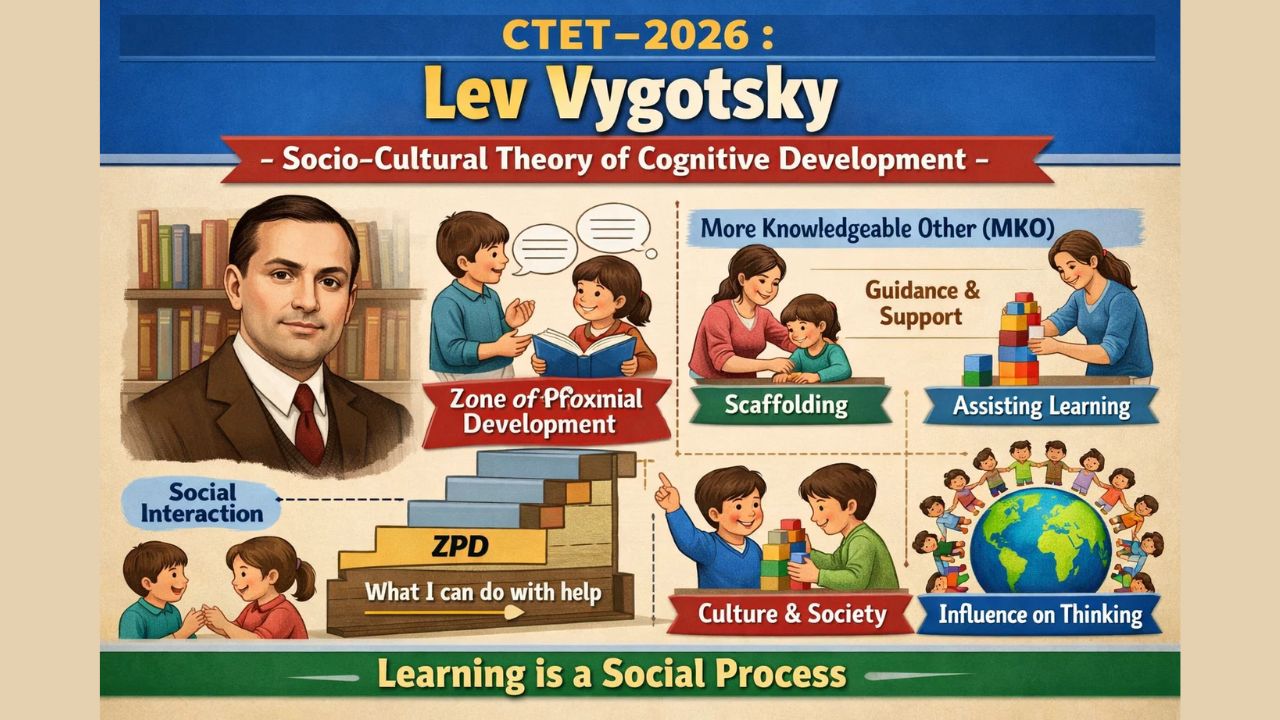
CTET-2026 Child Psychology अंतर्गत Lev Vygotsky यांचा Socio-Cultural Theory सविस्तरपणे समजावून सांगणारा हा लेख आहे. यात ZPD (Zone of Proximal Development), MKO (More Knowledgeable Other), Scaffolding, Language & Thought, Social Interaction या संकल्पना Marathi + English mix मध्ये सोप्या शब्दांत स्पष्ट केल्या आहेत. CTET, TET, D.Ed, B.Ed परीक्षांसाठी अत्यंत उपयुक्त, परीक्षाभिमुख उदाहरणे व तुलना (Vygotsky vs Piaget) यांचा समावेश आहे.
प्रस्तावना
Child Psychology मध्ये Lev Vygotsky यांचे योगदान अत्यंत महत्त्वाचे आहे. CTET–2026 मध्ये Child Development & Pedagogy (CDP) या घटकात Vygotsky यांचा सिद्धांत हमखास विचारला जातो.
Vygotsky यांनी learning आणि development याकडे social interaction च्या दृष्टीने पाहिले. त्यांचा सिद्धांत Socio-Cultural Theory of Cognitive Development म्हणून ओळखला जातो.
Vygotsky यांचा मुख्य विचार असा आहे की child’s cognitive development happens through interaction with society, culture, language and more knowledgeable people.
Jean Piaget – Cognitive Development Theory (CTET)
NCERT – Child Development & Pedagogy पुस्तके
Who was Lev Vygotsky? / लेव्ह वायगॉट्स्की कोण होते?
- जन्म : 1896, Russia
- व्यवसाय : Psychologist
- प्रसिद्ध सिद्धांत : Socio-Cultural Theory
- लक्ष केंद्रित क्षेत्र :
- Language & Thought
- Social interaction
- Learning & Development
Vygotsky यांनी Piaget पेक्षा वेगळा दृष्टिकोन मांडला. Piaget child-centred development वर भर देतो, तर Vygotsky society-centred learning वर भर देतो.
Socio-Cultural Theory – संकल्पना
Lev Vygotsky यांच्या मते,
“Learning is a social process and it leads development.”
म्हणजेच, मुलांचा बौद्धिक विकास हा एकट्याने होत नाही, तर तो:
- समाज
- भाषा
- संस्कृती
- शिक्षक, पालक, मोठी माणसे
यांच्या सहकार्याने घडतो.
Key Concepts of Vygotsky’s Theory (महत्त्वाच्या संकल्पना)
CTET साठी खालील concepts अतिशय महत्त्वाचे आहेत
1️⃣ Social Interaction (सामाजिक परस्परसंवाद)
Lev Vygotskyयांच्या मते,
Learning first happens at social level, then at individual level.
उदा.
- मूल प्रथम शिक्षक/पालकांसोबत शिकते
- नंतर तेच ज्ञान स्वतः वापरते
👉 याला म्हणतात : Inter-psychological → Intra-psychological
2️⃣ Role of Culture (संस्कृतीची भूमिका)
Culture म्हणजे:Lev Vygotsky
- भाषा
- परंपरा
- values
- beliefs
Different cultures = different ways of thinking.
उदा.
ग्रामीण व शहरी मुलांची learning style वेगळी असते.
3️⃣ Language and Thought (भाषा आणि विचार)
Vygotsky यांच्या मते:
- Language is the most powerful tool of cognitive development.
Language Development Stages:
- Social Speech – इतरांशी बोलणे
- Private Speech – स्वतःशी मोठ्याने बोलणे
- Inner Speech – मनात विचार करणे
👉 CTET मध्ये Private Speech वर प्रश्न विचारले जातात.
4️⃣ More Knowledgeable Other (MKO)
MKO म्हणजे:
अशी व्यक्ती जिने त्या task बद्दल जास्त knowledge असते.
MKO असू शकतो:
- Teacher
- Parent
- Elder sibling
- Peer
- Even computer / digital tool
MKO learner ला योग्य guidance देतो.
5️⃣ Zone of Proximal Development (ZPD)
CTET साठी सर्वात महत्त्वाची संकल्पना-Lev Vygotsky
ZPD म्हणजे काय?
ZPD म्हणजे:
Difference between what a child can do alone and what a child can do with help.
ZPD has three levels:
- Actual Development Level
– जे मूल स्वतः करू शकते - Potential Development Level
– जे मूल guidance ने करू शकते - Beyond ZPD
– जे मूल अजून करू शकत नाही
📌 Teacher ने teaching नेहमी ZPD मध्ये करावी.
6️⃣ Scaffolding (आधार देणे)
Scaffolding म्हणजे:
- Temporary support given by teacher
- As child learns, support is gradually removed
उदा.
- सुरुवातीला शिक्षक जास्त मदत करतो
- नंतर हळूहळू मुलाला independent बनवतो
👉 Scaffolding ही Lev Vygotsky theory वर आधारित teaching technique आहे.
Comparison: Vygotsky vs Piaget (CTET Favourite)
| Piaget | Vygotsky |
|---|---|
| Individual learning | Social learning |
| Development → Learning | Learning → Development |
| Less role of language | Major role of language |
| Child as independent learner | Child learns with help |
Educational Implications (शैक्षणिक उपयुक्तता)
CTET मध्ये application-based questions येतात.
Teacher should:
- Encourage group work
- Use peer learning
- Provide scaffolding
- Focus on discussion & interaction
- Teach according to child’s ZPD
Role of Teacher according to Vygotsky
Teacher म्हणजे:
- Guide
- Facilitator
- MKO
Teacher should not dominate, but support learning socially.
Criticism of Vygotsky’s Theory
- Individual differences कमी लक्षात घेतले
- Biological factors वर कमी भर
- Theory practical apply करणे कधी कधी कठीण
Importance for CTET Exam
CTET मध्ये विचारले जातात:
- ZPD meaning
- MKO example
- Language & thought
- Learning is social process
- Comparison with Piaget
दरवर्षी 2–3 प्रश्न Vygotsky वर आधारित असतात.
CTET PYQs – Lev Vygotsky (50 Questions)
Q1. Vygotsky च्या मते learning कशी होते?
A) Individual process
B) Trial and error
C) Social interaction द्वारे
D) Conditioning द्वारे
✅ Ans: C
Q2. “Learning leads development” हा विचार कोणाचा आहे?
A) Piaget
B) Skinner
C) Vygotsky
D) Thorndike
✅ Ans: C
Q3. ZPD म्हणजे काय?
A) Child’s IQ level
B) Difference between mental age and CA
C) What child can do alone & with help यातील फरक
D) Teaching method
✅ Ans: C
Q4. ZPD ही संकल्पना कोणाशी संबंधित आहे?
A) Bruner
B) Vygotsky
C) Kohlberg
D) Freud
✅ Ans: B
Q5. More Knowledgeable Other (MKO) कोण असू शकतो?
A) Teacher
B) Parent
C) Peer
D) All of the above
✅ Ans: D
Q6. Scaffolding म्हणजे काय?
A) Punishment
B) Temporary support
C) Reinforcement
D) Motivation
✅ Ans: B
Q7. Scaffolding concept कोणत्या theory वर आधारित आहे?
A) Conditioning
B) Cognitive theory
C) Socio-cultural theory
D) Moral theory
✅ Ans: C
Q8. Vygotsky नुसार language ची भूमिका काय आहे?
A) Minor
B) No role
C) Major role in thinking
D) Only communication
✅ Ans: C
Q9. “Private Speech” म्हणजे काय?
A) Social discussion
B) Silent thinking
C) Self-talk aloud
D) Group talk
✅ Ans: C
Q10. Private Speech नंतर कोणती stage येते?
A) Social speech
B) Inner speech
C) Echo speech
D) Public speech
✅ Ans: B
Q11. Vygotsky कोणत्या देशातील मानसशास्त्रज्ञ होते?
A) USA
B) Germany
C) Russia
D) France
✅ Ans: C
Q12. Culture चा learning वर काय परिणाम होतो?
A) No impact
B) Negative only
C) Shapes thinking
D) Confuses child
✅ Ans: C
Q13. Lev Vygotsky theory कशावर भर देते?
A) Biological factors
B) Social & cultural factors
C) Reinforcement
D) Intelligence testing
✅ Ans: B
Q14. Piaget vs Vygotsky मध्ये learning कोणाआधी येते?
A) Piaget – Learning first
B) Vygotsky – Learning first
C) Both same
D) None
✅ Ans: B
Q15. Teaching according to Lev Vygotsky should focus on?
A) Memorization
B) ZPD
C) Drill
D) Punishment
✅ Ans: B
Q16. ZPD च्या बाहेर teaching केल्यास काय होते?
A) Fast learning
B) No learning
C) Effective learning
D) Overlearning
✅ Ans: B
Q17. Peer learning concept कोणाशी संबंधित आहे?
A) Thorndike
B) Skinner
C) Vygotsky
D) Pavlov
✅ Ans: C
Q18. Group work ही कोणत्या theory शी संबंधित आहे?
A) Behaviourism
B) Socio-cultural theory
C) Psychoanalysis
D) Moral theory
✅ Ans: B
Q19. Lev Vygotsky नुसार child कसा शिकतो?
A) Alone
B) By observation only
C) With guidance
D) By punishment
✅ Ans: C
Q20. Teacher चा role Lev Vygotsky नुसार काय आहे?
A) Controller
B) Authority
C) Facilitator
D) Examiner
✅ Ans: C
Q21. Inner Speech म्हणजे काय?
A) Speaking loudly
B) Thinking silently
C) Group discussion
D) Teacher talk
✅ Ans: B
Q22. Vygotsky theory मध्ये child कोण आहे?
A) Passive learner
B) Social learner
C) Rote learner
D) Mechanical learner
✅ Ans: B
Q23. MKO always adult असतो का?
A) Yes
B) No
C) Sometimes
D) Never
✅ Ans: B
Q24. Computer किंवा digital tool MKO असू शकतो का?
A) Yes
B) No
C) Only teacher
D) Only parent
✅ Ans: A
Q25. ZPD concept teaching ला कशी मदत करते?
A) Discipline maintain
B) Right level task देण्यासाठी
C) परीक्षा घेण्यासाठी
D) Punishment देण्यासाठी
✅ Ans: B
Q26. Vygotsky theory कोणत्या प्रकारची आहे?
A) Behavioural
B) Cognitive
C) Socio-cultural
D) Psychoanalytic
✅ Ans: C
Q27. Learning is first social then individual – हा विचार कोणाचा?
A) Piaget
B) Vygotsky
C) Skinner
D) Kohlberg
✅ Ans: B
Q28. Cooperative learning कोणत्या theory शी जुळते?
A) Vygotsky
B) Freud
C) Pavlov
D) Thorndike
✅ Ans: A
Q29. Language development cognition ला कशी मदत करते?
A) Limits thinking
B) No effect
C) Enhances thinking
D) Distracts child
✅ Ans: C
Q30. CTET मध्ये Vygotsky वर किती प्रश्न अपेक्षित असतात?
A) 0
B) 1–2
C) 2–3
D) 10
✅ Ans: C
Q31–50 (Exam trend based – PYQ type)
- ZPD teaching strategy
- Scaffolding example
- Peer tutoring
- Social interaction example
- Teacher as MKO
- Culture & learning
- Language tool of thought
- Child-centred classroom
- Inclusive education & Vygotsky
- Collaborative learning
- Guided discovery
- Difference Piaget–Vygotsky
- Learning difficulties & support
- Teacher support withdrawal
- Classroom discussion importance
- Social constructivism
- Cooperative task example
- Role of dialogue
- Guided practice
- Application-based ZPD question
निष्कर्ष
Lev Vygotsky यांचा सिद्धांत child psychology मध्ये अत्यंत प्रभावी आहे. त्यांनी शिकवले की learning is not isolated, but socially constructed.
CTET–2026 साठी Vygotsky theory समजून घेतल्यास conceptual + MCQ questions दोन्ही सहज सोडवता येतात.