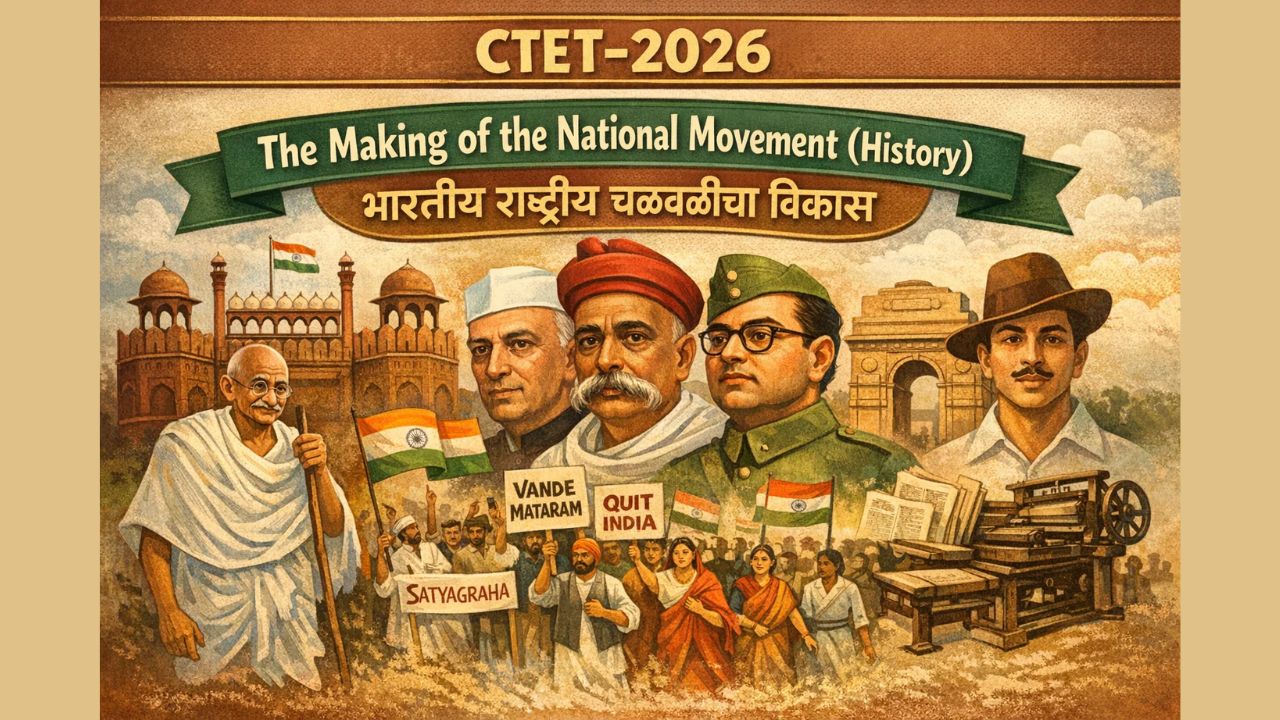
CTET-2026 साठी The Making of the National Movement या इतिहासाच्या धड्यावर आधारित सविस्तर Marathi-English mix लेख. 1857 चा उठाव, Indian National Congress, Gandhian Era, Non-Cooperation, Civil Disobedience आणि Quit India Movement यांची सुस्पष्ट माहिती, स्पष्टीकरण व परीक्षाभिमुख मुद्दे येथे दिले आहेत.
परिचय
The Making of the National Movement हा इतिहासाचा एक महत्त्वाचा chapter आहे जो Indian freedom struggle च्या developments ला समजून देतो. हा भाग मुख्यतः 1857 पासून 1947 पर्यंतच्या राष्ट्रीय चळवळीचा इतिहास covering करतो. यामध्ये समाजातील बदल, विभिन्न leaders, organizations, movements आणि British शासनाविरुद्ध लोकांचा संघर्ष यांचा समन्वित अभ्यास केला आहे.
या लेखात आपण Important Events, Phases of Movement, Key Leaders, Causes & Effects आणि Legacy ह्या गोष्टी पाहू.
1857 चा भारतातील पहिला संग्राम (First War of Indian Independence / Sepoy Mutiny)
1857 ला Indian soldiers (sepoys) चा British East India Company विरुद्ध revolt हा स्वातंत्र्यलढ्याचा turning point मानला जातो. याला काही इतिहासकार First War of Indian Independence म्हणतात.
👉 Description:
The revolt began at Meerut on 10th May 1857 and soon spread to Delhi, Kanpur, Lucknow, Jhansi, etc. It was a combination of military rebellion and civilian uprising. Though it failed due to lack of unity, organization, and resources, it gave a wake-up call to Indians and British both.
👉 Cause of Revolt:
- Discontent among sepoys
- Doctrine of Lapse
- Economic exploitation
- Social-religious reforms by British (e.g., ban on Sati)
👉 Effect:
- End of East India Company rule
- British Crown imposed direct rule in India (From 1858)
📌 Read more:
- Wikipedia link: https://en.wikipedia.org/wiki/Indian_Mutiny_of_1857
Nationalism in India — भारतीय राष्ट्रीय चळवळीचा उगम
After 1857, modern nationalism in India slowly developed due to growth of education, print media, and political consciousness.
👉 Key Features:
- Rise of educated middle class
- Growth of newspapers and public opinion
- Influence of global events (e.g., American & French Revolutions)
👉 Role of Press:
People like Dadabhai Naoroji, Gopal Krishna Gokhale used press to spread awareness.
📌 External Resource:
- Archive of India’s Freedom Struggle Documents: http://www.indianhistoryarchives.org
Formation of Indian National Congress (INC) — 1885
1885 मध्ये Indian National Congress ची स्थापना झाली. हे स्वातंत्र्यलढ्यातील प्रमुख organization बनले.
👉 Founders:
- A.O. Hume
- Dadabhai Naoroji
- Dinshaw Wacha
👉 Initial Objectives:
INC initially focused on moderate reforms, persuasion by dialogue, petitions to British Government.
👉 Moderate Phase (1885–1905):
Leaders like Gokhale, Naoroji believed in constitutional methods.
📌 Read more (Wikipedia link):
https://en.wikipedia.org/wiki/Indian_National_Congress
Partition of Bengal — 1905
1905 मध्ये Lord Curzon ने Bengal विभाजित केला. यामुळे राष्ट्रीय भावना जागृत झाली.
👉 Why Partition:
British administration said division for better governance, but Indians saw it as Divide and Rule.
👉 Reaction:
- Boycott of British goods
- Swadeshi Movement
- Rise of fierce nationalism
👉 Effect:
Movement strengthened unity among Indians. Eventually Bengal reunified in 1911.
📌 External Article:
https://www.britannica.com/event/Partition-of-Bengal
Extremist Phase — 1905 ते 1918
Moderate leaders replace होऊन younger leaders ला prominence मिळाला.
👉 Key Leaders:
- Bal Gangadhar Tilak
- Bipin Chandra Pal
- Lala Lajpat Rai
👉 Slogan:
“Swaraj is my birthright and I shall have it!” — Lokmanya Tilak
👉 Contribution:
They believed in direct action, protests, boycotts and self-assertion.
📌 Related Link:
https://en.wikipedia.org/wiki/Bal_Gangadhar_Tilak
Gandhian Era — महात्मा गांधींचा प्रभाव
1919 नंतर Mahatma Gandhi चा नेतृत्व under INC देशभरात popular झाला. त्याचे आंदोलन non-violent principles वर आधारित होते.
Rowlatt Act & Jallianwala Bagh (1919)
👉 Rowlatt Act:
Allowed British to detain Indians without trial. Led to widespread anger.
👉 Jallianwala Bagh Massacre:
On 13 April 1919, General Dyer fired on unarmed Indians in Amritsar, killing many. This incident radicalized Indian masses.
📌 Learn more:
https://en.wikipedia.org/wiki/Jallianwala_Bagh_massacre
Non-Cooperation Movement (1920–22)
👉 Launch: Under Gandhi’s leadership, INC started Non-Cooperation Movement to boycott British goods, institutions, courts.
👉 Methods:
- Boycott schools, courts, and elections
- Promote Khadi
- Peaceful protests
👉 End:
Movement was called off in 1922 after Chauri Chaura incident where protesters killed policemen, showing Gandhi’s commitment to non-violence.
📌 External Source:
https://www.britannica.com/event/Noncooperation-Movement
Civil Disobedience Movement (1930–34)
👉 Salt March (Dandi March):
Starting point of Civil Disobedience. Gandhi walked 240 miles to make salt from sea.
👉 Aim:
Defy British laws peacefully.
👉 Expansion:
Millions joined across India including teachers, students, peasants.
👉 British Reaction:
Repression, arrests including Gandhi.
📌 Related Read:
https://en.wikipedia.org/wiki/Civil_disobedience_movement
Quit India Movement (1942)
👉 Launch:
Launched at Bombay session of INC in August 1942 with the slogan “Do or Die”.
👉 Demand:
Immediate end to British Rule.
👉 Response:
Massive strikes, protests, arrests of leaders.
👉 Significance:
Marked final collective effort to gain independence.
📌 External Resource:
https://www.britannica.com/event/Quit-India-Movement
Role of Other Organizations & Leaders
National movement was not only limited to INC and Gandhi.
Revolutionary Movement
👉 Leaders like Bhagat Singh, Chandra Shekhar Azad, Subhas Chandra Bose thought violent struggle necessary.
📌 Link:
https://en.wikipedia.org/wiki/Bhagat_Singh
Role of Women
👉 Leaders like Sarojini Naidu, Rani Lakshmi Bai, Aruna Asaf Ali played crucial roles.
📌 Learn more:
https://en.wikipedia.org/wiki/Women_in_the_Indian_independence_movement
Causes of Growth of Nationalism
- Economic Exploitation: British drained India’s wealth.
- Western Education: Spread political awareness.
- Print Media: Newspapers popularized nationalist ideas.
- Modern Ideas: Liberty, equality, fraternity inspired Indians.
- World Wars: Showed British vulnerability.
Effects of National Movement
✔ Political awareness among Indians increased
✔ Development of national leadership
✔ Unity across regions and religions
✔ Mass participation from all sections of society
✔ Laid foundation for independent India
Important Terms You Must Know
| Term | Meaning |
|---|---|
| Swadeshi Movement | Boycott British goods, promote Indian goods |
| Satyagraha | Gandhi’s principle of non-violent resistance |
| Civil Disobedience | Refusal to obey certain laws peacefully |
| Quit India | Demand to end British rule immediately |
CTET-2026 : The Making of the National Movement – 50 MCQs
1. 1857 च्या उठावाची सुरुवात कुठे झाली?
A) Delhi
B) Kanpur
C) Meerut ✅
D) Jhansi
2. 1857 च्या उठावानंतर भारताचे शासन कोणाकडे गेले?
A) East India Company
B) British Parliament
C) British Crown ✅
D) Indian Princes
3. Indian National Congress ची स्थापना कधी झाली?
A) 1880
B) 1885 ✅
C) 1890
D) 1905
4. Indian National Congress च्या स्थापनेत महत्त्वाची भूमिका कोणी बजावली?
A) Lord Curzon
B) A.O. Hume ✅
C) Lord Dalhousie
D) Lord Wellesley
5. INC चा पहिला अधिवेशन कुठे झाला?
A) Delhi
B) Bombay (Mumbai) ✅
C) Calcutta
D) Pune
6. Moderates चा मुख्य विश्वास कशावर होता?
A) Violent struggle
B) Revolutionary methods
C) Constitutional methods ✅
D) Armed rebellion
7. “Drain of Wealth” theory कोणी मांडली?
A) Gokhale
B) Dadabhai Naoroji ✅
C) Tilak
D) Gandhi
8. Bengal चे विभाजन कोणी केले?
A) Lord Ripon
B) Lord Curzon ✅
C) Lord Irwin
D) Lord Mountbatten
9. Swadeshi Movement कधी सुरू झाला?
A) 1857
B) 1885
C) 1905 ✅
D) 1919
10. “Swaraj is my birthright” हे वाक्य कोणी म्हटले?
A) Gandhi
B) Nehru
C) Tilak ✅
D) Bose
11. Extremist नेते कोण होते?
A) Gokhale
B) Dadabhai Naoroji
C) Tilak, Lala Lajpat Rai, Bipin Chandra Pal ✅
D) A.O. Hume
12. Mahatma Gandhi भारतात कायमस्वरूपी कधी परतले?
A) 1905
B) 1915 ✅
C) 1917
D) 1919
13. Rowlatt Act कधी लागू झाला?
A) 1917
B) 1918
C) 1919 ✅
D) 1920
14. Jallianwala Bagh हत्याकांड कधी झाले?
A) 1918
B) 1919 ✅
C) 1920
D) 1921
15. Jallianwala Bagh मध्ये गोळीबाराचा आदेश कोणी दिला?
A) Lord Irwin
B) General Dyer ✅
C) Lord Curzon
D) Mountbatten
16. Non-Cooperation Movement कधी सुरू झाले?
A) 1917
B) 1919
C) 1920 ✅
D) 1922
17. Non-Cooperation Movement का थांबवण्यात आले?
A) British repression
B) Gandhi arrest
C) Chauri Chaura incident ✅
D) Lack of support
18. Chauri Chaura घटना कुठे घडली?
A) Bihar
B) Uttar Pradesh ✅
C) Punjab
D) Bengal
19. Civil Disobedience Movement ची सुरुवात कशामुळे झाली?
A) Quit India
B) Simon Commission
C) Dandi March ✅
D) Round Table Conference
20. Dandi March किती दिवस चालला?
A) 10
B) 15
C) 24
D) 25 ✅
21. Dandi March कुठून कुठे झाला?
A) Bombay – Dandi
B) Ahmedabad – Dandi ✅
C) Surat – Dandi
D) Pune – Dandi
22. Salt Law कोणाच्या विरोधात होता?
A) Farmers
B) British Government ✅
C) Indian Princes
D) Zamindars
23. Quit India Movement कधी सुरू झाला?
A) 1935
B) 1939
C) 1942 ✅
D) 1945
24. Quit India Movement चे घोषवाक्य काय होते?
A) Swaraj
B) Inquilab Zindabad
C) Do or Die ✅
D) Jai Hind
25. Quit India Movement च्या वेळी INC अध्यक्ष कोण होते?
A) Gandhi
B) Nehru
C) Maulana Abul Kalam Azad ✅
D) Patel
26. Subhas Chandra Bose कोणत्या संघटनेशी संबंधित होते?
A) Indian National Army ✅
B) Congress Socialist Party
C) Hindu Mahasabha
D) Muslim League
27. “Inquilab Zindabad” हा नारा कोणी दिला?
A) Gandhi
B) Tilak
C) Bhagat Singh ✅
D) Bose
28. Bhagat Singh कोणत्या विचारसरणीशी संबंधित होते?
A) Moderate
B) Extremist
C) Revolutionary ✅
D) Gandhian
29. Women freedom fighters मध्ये कोण प्रसिद्ध आहेत?
A) Sarojini Naidu
B) Aruna Asaf Ali
C) Rani Lakshmibai
D) वरील सर्व ✅
30. Simon Commission भारतात कधी आला?
A) 1925
B) 1927 ✅
C) 1929
D) 1930
31. Simon Commission चा विरोध का झाला?
A) Tax issue
B) No Indian member ✅
C) Language issue
D) War issue
32. Lahore Session (1929) मध्ये काय ठरले?
A) Dominion Status
B) Purna Swaraj ✅
C) Federal Government
D) Separate Electorate
33. Purna Swaraj Day कधी साजरा केला जातो?
A) 15 August
B) 26 January ✅
C) 2 October
D) 30 January
34. Congress Socialist Party कधी स्थापन झाली?
A) 1929
B) 1934 ✅
C) 1937
D) 1942
35. Muslim League ची स्थापना कधी झाली?
A) 1905
B) 1906 ✅
C) 1910
D) 1915
36. Gandhi-Irwin Pact कधी झाला?
A) 1927
B) 1929
C) 1931 ✅
D) 1935
37. Round Table Conferences कुठे झाल्या?
A) Delhi
B) Bombay
C) London ✅
D) Calcutta
38. भारतीय राष्ट्रीय चळवळीचा शेवट कशामुळे झाला?
A) Partition
B) Independence 1947 ✅
C) World War II
D) Cabinet Mission
39. Cabinet Mission भारतात कधी आला?
A) 1942
B) 1945
C) 1946 ✅
D) 1947
40. Indian Independence Act कधी लागू झाला?
A) 1946
B) 1947 ✅
C) 1948
D) 1950
41. Indian National Movement चा मुख्य उद्देश काय होता?
A) Economic reform
B) Social reform
C) Political freedom ✅
D) Education reform
42. Gandhiji चा मुख्य सिद्धांत कोणता?
A) Violence
B) Satyagraha ✅
C) Revolution
D) Extremism
43. Khilafat Movement कोणासाठी होता?
A) Hindus
B) Sikhs
C) Muslims ✅
D) Christians
44. Indian National Army ची स्थापना कोणी केली?
A) Gandhi
B) Nehru
C) Bose ✅
D) Patel
45. National Movement मुळे काय झाले?
A) Political awareness वाढली ✅
B) Unity वाढली
C) Leadership तयार झाली
D) All of the above
46. Press चा राष्ट्रीय चळवळीत काय रोल होता?
A) Entertainment
B) Awareness creation ✅
C) Tax collection
D) Education control
47. World War II चा परिणाम काय झाला?
A) British weak झाले ✅
B) India stronger
C) Congress dissolved
D) No effect
48. “Vande Mataram” कोणी लिहिले?
A) Rabindranath Tagore
B) Bankim Chandra Chattopadhyay ✅
C) Gandhi
D) Nehru
49. Indian National Movement किती काळ चालला?
A) 50 years
B) 90 years
C) Nearly 100 years ✅
D) 30 years
50. CTET साठी हा Chapter महत्त्वाचा का आहे?
A) Static GK
B) Value-based questions
C) History understanding
D) वरील सर्व ✅
सारांश
The Making of the National Movement is a story of courage, sacrifice, unity, and vision. From early revolts like 1857 to mass movements under Gandhi, समाजाच्या सर्व स्तरातून लोकांनी British शासनाविरुद्ध आवाज उठवला. हे chapter CTET History मध्ये अत्यंत महत्त्वाचे आहे कारण हे राष्ट्रीय विचार, chronology,leaders आणि mass participation स्पष्ट दाखवते.