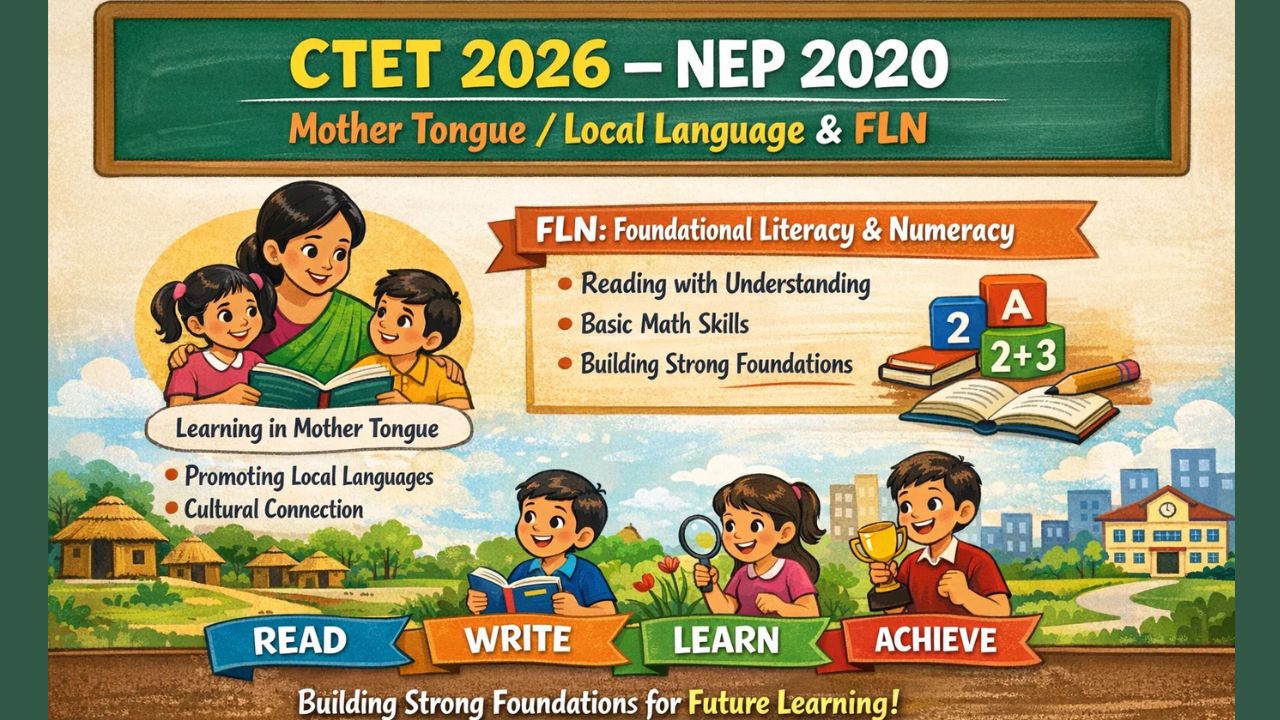
हा लेख NEP 2020 अंतर्गत प्राथमिक भाषा शिक्षण वर आधारित आहे. यात मातृभाषा/स्थानिक भाषा मध्ये शिक्षण, मूलभूत साक्षरता व अंकज्ञान (FLN), क्रियाकलापावर आधारित शिक्षण (Activity-based learning) आणि संवाद-केंद्रित पद्धती यावर भर दिला आहे. लेखात मुलांच्या भाषिक, गणितीय व सर्वांगीण विकासासाठी प्रत्यक्ष वर्गातील उदाहरणे दिली आहेत, ज्यामुळे शिक्षण आनंदी, समावेशक आणि प्रभावी होते.
प्रस्तावना
The National Education Policy (NEP) 2020 emphasizes the importance of early childhood education, mother tongue instruction, and foundational literacy and numeracy (FLN). प्राथमिक शिक्षणात मुलांच्या भाषिक, संख्यात्मक आणि संवाद कौशल्यांवर विशेष भर देणे गरजेचे आहे. NEP 2020 नुसार, प्राथमिक शिक्षणाचे उद्दिष्ट म्हणजे मुलांना सर्वांगीण कौशल्ये विकसित करणे ज्यामध्ये भाषा, गणित आणि संवाद यांचा समावेश आहे.
CTET Study Material-click here
NEP 2020 Official Document – Ministry of Education – NEP 2020 पूर्ण PDF.
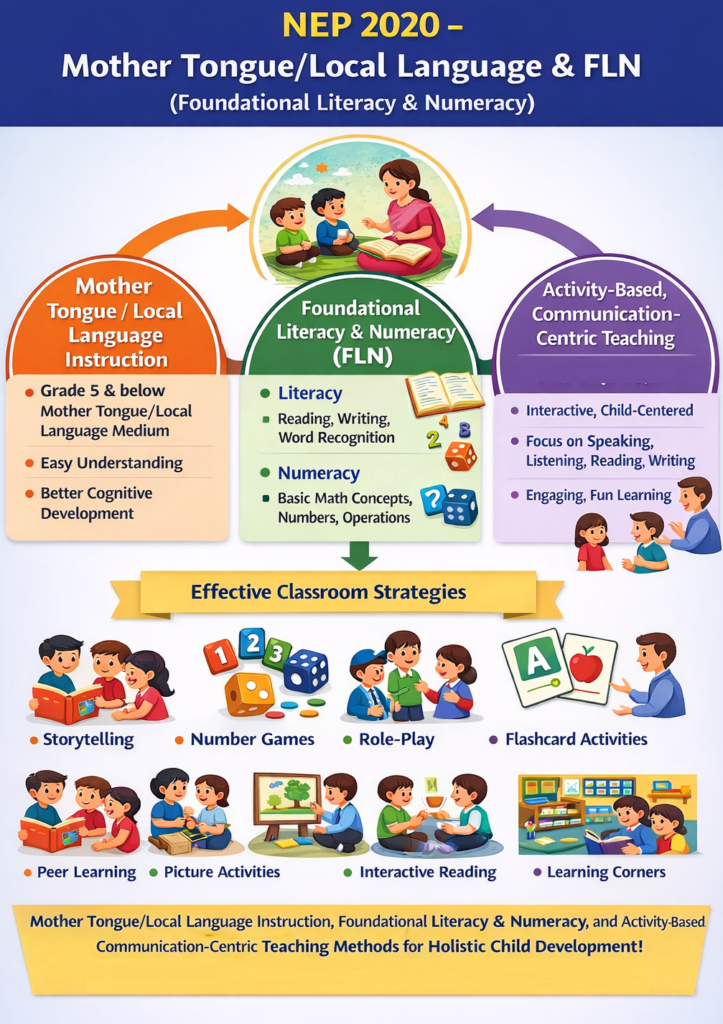
मातृभाषा / स्थानिक भाषा मध्ये शिक्षण (Mother Tongue / Local Language Instruction)
NEP 2020 नुसार, Grade 5 पर्यंत मातृभाषा किंवा स्थानिक भाषा मध्ये शिक्षण देणे अत्यंत महत्त्वाचे आहे.
- मुलांना सहजपणे भाषेची समज येते.
- Cognitive development सुलभ होते.
- Learning outcomes सुधारतात.
मूलभूत साक्षरता व अंकज्ञान (FLN – Foundational Literacy and Numeracy)
FLN म्हणजे प्रत्येक मुलासाठी प्राथमिक शिक्षणात आवश्यक literacy आणि numeracy skills.
- Literacy (साक्षरता): वाचन, लेखन, शब्द ओळख, simple comprehension.
- Numeracy (अंकज्ञान): गणिताच्या मूलभूत संकल्पना, संख्या ओळख, basic operations.
- Activity-based exercises द्वारे मुलांना FLN शिकवणे अधिक प्रभावी ठरते.
Activity-based Learning (ABL) / क्रियाकलापावर आधारित शिक्षण
Activity-based learning हे एक interactive and child-centered approach आहे.
- मुलांना hands-on activities करून शिकवले जाते.
- Group activities, role-play, flashcards, games यांचा वापर केला जातो.
- Learning becomes engaging and meaningful.
संवाद-केंद्रित पद्धतीवर भर (Communication-centric Approach)
- Teacher-child interaction emphasizes listening, speaking, reading, and writing.
- Classrooms encourage questions, discussions, and storytelling.
- Helps in developing confidence and language fluency.
Practical Classroom Examples / प्रत्यक्ष शिक्षण उदाहरणे
- Storytelling in mother tongue – Students narrate stories in their local language.
- Number games & puzzles – Helps develop basic numeracy.
- Role-play – Encourages conversational skills and social interaction.
- Flashcard activities – Vocabulary enhancement.
- Peer learning – Students work in pairs or small groups to teach and learn from each other, boosting collaboration.
- Picture-based activities – Using images to develop comprehension and creative expression in mother tongue.
- Interactive reading sessions – Teacher reads aloud and students ask questions, predict outcomes, or summarize, enhancing reading skills.
- Learning corners / stations – Classrooms with different activity zones for reading, math games, storytelling, and writing practice, making learning hands-on and diversified.
CTET 2026 – 40 MCQs with Answers
NEP 2020 / Language & FLN (10 Questions)
- According to NEP 2020, up to which class should instruction preferably be in mother tongue/home language?
A) Class 2
B) Class 5
C) Class 8
D) Class 10
Answer: B - NEP 2020 emphasises achieving Foundational Literacy and Numeracy (FLN) by which grade?
A) Grade 1
B) Grade 3
C) Grade 5
D) Grade 8
Answer: B - The National Mission on FLN under NEP 2020 aims to ensure basic literacy & numeracy for every child.
A) True
B) False
Answer: A - Multilingualism in schools is seen as a policy, resource and strategy by NEP 2020. Testbook
A) True
B) False
Answer: A - NEP 2020 supports teaching Indian Sign Language (ISL) as an optional language at all levels.
A) True
B) False
Answer: A - NEP 2020 recommends the study of mother tongue/home language, Indian languages, classical languages and foreign languages. PreppyQ
A) True
B) False
Answer: A - FLN focuses on which of the following?
A) Advanced algebra
B) Reading, writing and basic numeracy
C) Vocational education
D) Competitive exams
Answer: B - NEP 2020 proposes that assessments should be mainly:
A) Stressful memorisation
B) Continuous and formative
C) Only annual summative
D) Competitive with ranking
Answer: B - According to NEP 2020, technology use in education is for:
A) Only entertainment
B) Enhancing learning outcomes
C) Reducing teacher roles
D) Eliminating classroom teaching
Answer: B - NEP 2020 emphasises holistic and integrated learning across subjects.
A) True
B) False
Answer: A
Language Pedagogy & CDP (20 Questions)
- Which of the following is a developmentally appropriate practice in early literacy?
A) Rote memorisation
B) Phonics and story reading
C) Long written tests
D) Strict grammar drills
Answer: B - Mother tongue first approach helps in:
A) Slower learning
B) Better conceptual understanding
C) Confusion in language
D) Focus on only English
Answer: B - A learner says “goed” instead of “went.” This is an example of:
A) Language disorder
B) Overgeneralisation error
C) Echo speech
D) Negative reinforcement
Answer: B - Language learning should focus on:
A) Only writing
B) Listening, speaking, reading, writing
C) Only grammar
D) Only vocabulary
Answer: B - Use of storytelling in class primarily develops:
A) Numeracy
B) Comprehension & speaking skills
C) Physical fitness
D) Only grammar knowledge
Answer: B - Which of the following is a language error common in early child language?
A) Syntax error
B) Memorisation error
C) Rigid rote learning
D) Translation from textbook only
Answer: A - Reading comprehension skills include:
A) Guessing meanings always
B) Understanding context & inference
C) Only reading silently
D) Ignoring meaning
Answer: B - Peer learning in language classroom helps in:
A) Creating competition
B) Mutual learning & communication practice
C) Isolation
D) Grammar memorisation only
Answer: B - Learning corners with pictures and word cards promote:
A) Drill and kill method
B) Active engagement
C) Only teacher talking
D) Book banning
Answer: B - A teacher should encourage children to speak in class to develop:
A) Writing only
B) Oral fluency and confidence
C) Silence
D) Memorised recitation
Answer: B - CLT in language teaching stands for:
A) Classical Language Training
B) Communicative Language Teaching
C) Child Learning Theory
D) Classroom Learning Tools
Answer: B - Remedial teaching in language is meant for:
A) All children equally
B) Students with learning gaps
C) Only advanced students
D) Only grammar correction
Answer: B - Assessment for FLN should be:
A) Harsh pass/fail
B) Continuous and supportive
C) Only written summative
D) Only multiple choice
Answer: B - A child handling a book upside down indicates issues with:
A) Numeracy
B) Book handling & foundational literacy
C) Grammar
D) Writing skills
Answer: B (practice item) PGT Prime - Phonics instruction is best introduced when children are:
A) Ready for mechanical aspects of language
B) Only in grade 10
C) After complete spoken fluency
D) In higher classes only
Answer: A PGT Prime - Effective language class includes:
A) Only grammar
B) Activities, listening and speaking
C) No teacher involvement
D) Only textbooks
Answer: B - Language teaching should avoid:
A) Contextual learning
B) Rote memorisation only
C) Interaction
D) Group work
Answer: B - A learner’s errors should be treated as:
A) Failure
B) A step in learning
C) Punishment
D) Ignored always
Answer: B - Vocabulary development in early grades is best through:
A) Only dictionaries
B) Contextual experiences
C) Only lecture
D) Memorised lists
Answer: B - Listening activities help in:
A) Making no progress
B) Language comprehension
C) Only writing skills
D) Fear of language
Answer: B
General CTET CDP & Language MCQs (10 More)
- Critical period for language development is:
A) Prenatal
B) Early childhood
C) Adolescence
D) Adulthood
Answer: B (general CDP pattern). Jagranjosh.com - Progressive classroom is:
A) Teacher‑centric
B) Learner‑centric
C) Textbook‑centric
D) Exam‑centric
Answer: B CBSE Digital Education - Children construct and use knowledge through:
A) Rote learning
B) Interaction with environment
C) Only listening
D) Only copying
Answer: B - Continuous and Comprehensive Evaluation focuses on:
A) Only scoring marks
B) Students’ overall development
C) Only written tests
D) Only oral recitations
Answer: B - Which theory emphasises social interaction in learning?
A) Piaget
B) Vygotsky
C) Skinner
D) Freud
Answer: B - Language errors in children should be addressed by:
A) Punishment
B) Supportive correction
C) Ignoring totally
D) Large tests
Answer: B - Learning through play contributes to:
A) Only fun
B) Cognitive and language development
C) Only memorisation
D) Silence
Answer: B - Teaching listening skills is important because it helps in:
A) Only speaking
B) Speaking and comprehension
C) Only reading
D) Only writing
Answer: B - Environment that supports learning is:
A) Competitive only
B) Inclusive and engaging
C) Harsh and strict
D) Silent only
Answer: B - For FLN, classroom activities must be:
A) Teacher talk only
B) Activity‑based and interactive
C) Strictly textbook based
D) Lecture only
Answer: B
निष्कर्ष
NEP 2020 नुसार, प्राथमिक शिक्षणात मातृभाषा/स्थानिक भाषा मध्ये शिक्षण, मूलभूत साक्षरता व अंकज्ञान (FLN), क्रियाकलापावर आधारित शिक्षण (Activity-based Learning) आणि संवाद-केंद्रित पद्धती यावर विशेष भर दिला पाहिजे.
हे पद्धती मुलांच्या भाषिक, संख्यात्मक, संवाद कौशल्यांच्या सर्वांगीण विकासासाठी अत्यंत महत्त्वाच्या आहेत.
शिक्षकांनी या दृष्टिकोनांचा समावेश करून आनंदी, समावेशक आणि प्रभावी शिक्षणाचे वातावरण तयार करावे, ज्यामुळे मुलांची रुची वाढते, आत्मविश्वास सुधारतो आणि शिक्षण परिणामकारक होते.