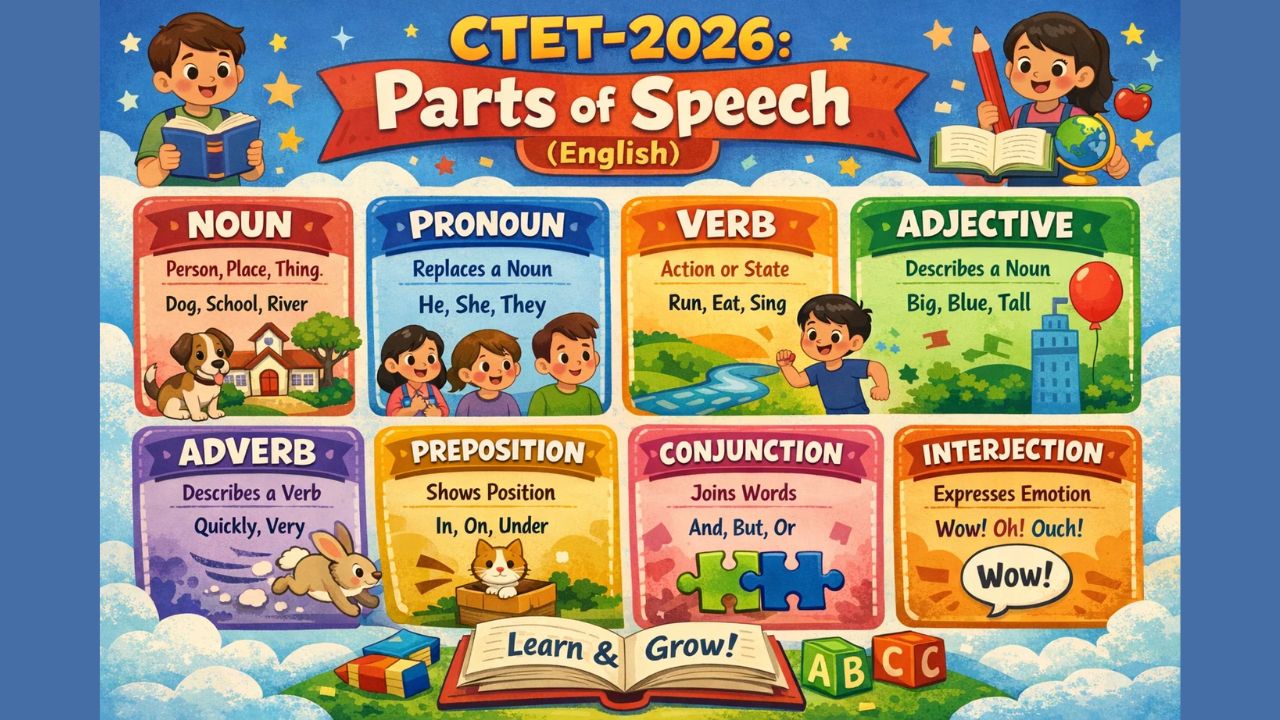
CTET Parts of Speech हा लेख CTET-2026 परीक्षार्थींसाठी आहे. यात इंग्रजीतील 8 Parts of Speech — Noun, Pronoun, Verb, Adjective, Adverb, Preposition, Conjunction, Interjection — उदाहरणांसह इंग्रजी आणि मराठीत समजावले आहेत.
सोप्या शिकण्यासाठी colorful infographic (JPG) आणि 50 practice MCQs दिले आहेत, जे grammar सुधारण्यासाठी आणि परीक्षा तयारीसाठी उपयुक्त आहेत.
प्रस्तावना:
In English grammar, understanding Parts of Speech is very important for constructing correct sentences. Parts of Speech म्हणजे इंग्रजी भाषेतील शब्दांचे विविध प्रकार, जे त्यांच्या कार्यानुसार वर्गीकृत केले जातात. प्रत्येक शब्दाचा वापर वेगवेगळ्या प्रकारच्या वाक्य रचनेसाठी केला जातो. CTET मध्ये Parts of Speech वर नेहमी प्रश्न विचारले जातात, म्हणून त्याचे नीट ज्ञान असणे आवश्यक आहे.
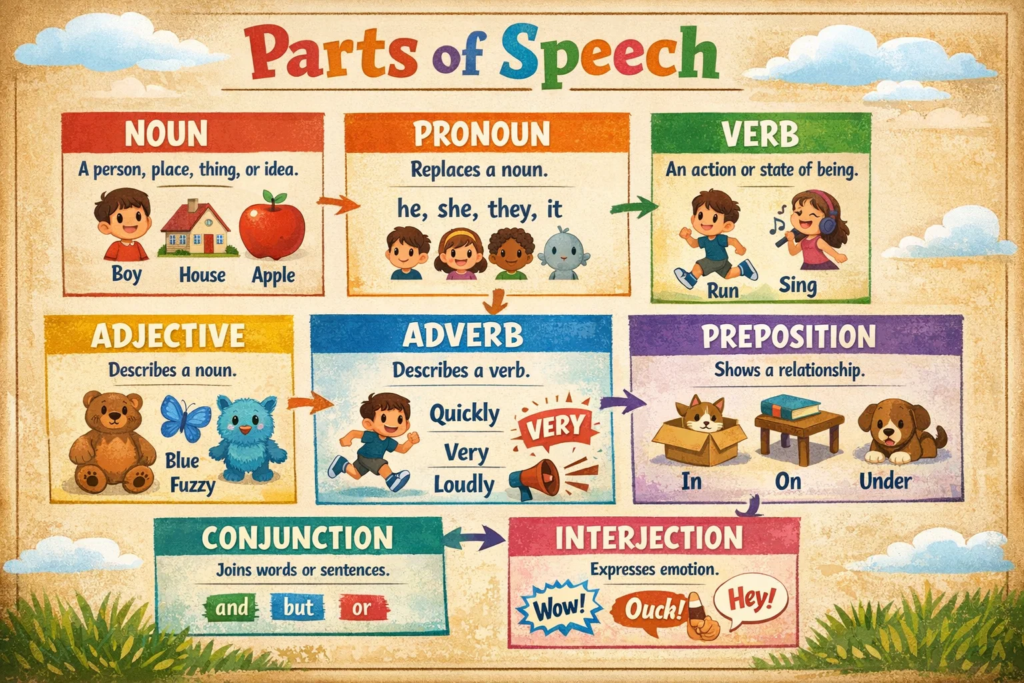
इंग्रजीत मुख्यतः ८ Parts of Speech आहेत. चला त्यांचे तपशीलवार विश्लेषण करूया.
CTET-2026 English Grammar Notes – Comprehensive grammar topics for CTET
Parts of Speech – British Council – Detailed explanation and exercises
1. Noun (संज्ञा)
A Noun is a word used to name a person, place, thing, or idea.
संज्ञा म्हणजे व्यक्ती, ठिकाण, वस्तू किंवा कल्पनेचे नाव दर्शविणारा शब्द.
Types / प्रकार:
- Proper Noun (सही संज्ञा): Specific name of a person, place, or organization.
- Examples: Ramesh, Mumbai, India
- Marathi: व्यक्ती, शहर किंवा संस्थेचे विशिष्ट नाव.
- Common Noun (साधी संज्ञा): General name for a person, place, or thing.
- Examples: boy, city, book
- Marathi: सर्वसामान्य व्यक्ती, ठिकाण किंवा वस्तू.
- Abstract Noun (अव्यक्त संज्ञा): Name of a quality, idea, or feeling.
- Examples: happiness, honesty, love
- Marathi: भावना, गुण किंवा कल्पनांचे नाव.
- Collective Noun (समूह संज्ञा): Name of a group.
- Examples: team, family, flock
- Marathi: व्यक्ती किंवा वस्तूंचा समूह.
Usage Example:
- Ramesh went to school.
- रमेश शाळेत गेला.
2. Pronoun (सर्वनाम)
A Pronoun is a word used instead of a noun to avoid repetition.
सर्वनाम म्हणजे संज्ञेऐवजी वापरला जाणारा शब्द.
Types / प्रकार:
- Personal Pronoun (वैयक्तिक सर्वनाम): I, you, he, she, it, we, they
- Demonstrative Pronoun (सूचक सर्वनाम): this, that, these, those
- Interrogative Pronoun (प्रश्नवाचक सर्वनाम): who, whom, whose, which, what
- Relative Pronoun (संबंध दर्शक सर्वनाम): who, which, that
- Reflexive Pronoun (प्रतिबिंब सर्वनाम): myself, yourself, himself, themselves
Example:
- She is my friend.
- ती माझी मैत्रीण आहे.
3. Verb (क्रियापद / क्रिया)
A Verb expresses action or state of being.
क्रियापद / Verb म्हणजे एखादी क्रिया किंवा स्थिती व्यक्त करणारा शब्द.
Types / प्रकार:
- Action Verb (क्रियापद): Expresses action.
- Examples: run, eat, play
- Marathi: धावणे, खाणे, खेळणे
- Linking Verb (संबंधित क्रिया): Shows state of being.
- Examples: am, is, are, was, were
- Marathi: आहे, होते
- Auxiliary Verb (सहायक क्रिया): Helps main verb.
- Examples: have, has, had, will, shall
- Marathi: मुख्य क्रियेस मदत करतात.
Example:
- She runs fast.
- ती झपाट्याने धावते.
4. Adjective (विशेषण)
An Adjective describes a noun or pronoun.
विशेषण म्हणजे संज्ञा किंवा सर्वनामाचे वर्णन करणारा शब्द.
Types / प्रकार:
- Descriptive Adjective (वर्णनात्मक): beautiful, tall, intelligent
- Quantitative Adjective (मात्रात्मक): some, few, many
- Demonstrative Adjective (सूचक विशेषण): this, that, these, those
- Possessive Adjective (संपत्ती दर्शक): my, your, his, her
Example:
- She has a beautiful dress.
- तिच्याकडे सुंदर पोशाख आहे.
5. Adverb (क्रियाविशेषण)
An Adverb modifies a verb, adjective, or another adverb.
क्रियाविशेषण म्हणजे क्रिया, विशेषण किंवा इतर क्रियाविशेषणाचे वर्णन करणारा शब्द.
Types / प्रकार:
- Manner (कसे?): slowly, quickly
- Time (केव्हा?): now, yesterday
- Place (कोठे?): here, there
- Frequency (किती वेळा?): always, never
- Degree (कोणत्या प्रमाणात?): very, too
Example:
- He runs quickly.
- तो वेगाने धावतो.
6. Preposition (पूर्वसर्ग)
A Preposition shows the relationship between a noun/pronoun and other words.
पूर्वसर्ग / Preposition म्हणजे संज्ञा/सर्वनाम आणि इतर शब्दांमधील संबंध दर्शवणारा शब्द.
Examples / उदाहरणे:
- in, on, at, by, with, under, over
- The book is on the table.
- पुस्तक टेबलवर आहे.
7. Conjunction (संयोजक)
A Conjunction connects words, phrases, or clauses.
संयोजक / Conjunction म्हणजे शब्द, वाक्यांश किंवा उपवाक्य जोडणारा शब्द.
Types / प्रकार:
- Coordinating Conjunctions (समान जोडणारे): and, but, or, so, for
- Subordinating Conjunctions (अल्पवाक्य जोडणारे): because, although, if, when
- Correlative Conjunctions (संबंध सूचक जोड): either…or, neither…nor
Example:
- I like tea and coffee.
- मला चहा आणि कॉफी आवडते.
8. Interjection (विस्मयादिबोधक)
An Interjection expresses strong emotion or sudden feeling.
विस्मयादिबोधक / Interjection म्हणजे अचानक भावना व्यक्त करणारा शब्द.
Examples / उदाहरणे:
- Wow! Oh! Alas! Hurray!
- वा! अरेरे! हुर्रे!
Example Sentence:
- Wow! That’s amazing!
- वा! ते अद्भुत आहे!
CTET‑2026 — Parts of Speech: 50 MCQs (with Answers)
1–10: Noun / Pronoun
- Choose the correct noun in the sentence:
The students studied hard.
A. studied B. hard C. students D. the
Answer: C - Identify the proper noun:
She lives in Delhi.
A. she B. lives C. Delhi D. in
Answer: C - Which is a collective noun?
A. team B. fast C. computer D. blue
Answer: A - Pick the abstract noun:
Honesty is the best policy.
A. policy B. best C. honesty D. is
Answer: C - Choose the pronoun:
Rita lost her pen.
A. Rita B. lost C. her D. pen
Answer: C - Replace the noun with a pronoun:
Ramesh is a good boy.
A. He B. She C. Them D. It
Answer: A - Identify the correct pronoun:
Neither Raju nor ___ came.
A. he B. him C. his D. himself
Answer: A - ‘Flock’ refers to a group of:
A. fish B. birds C. trees D. students
Answer: B - Choose the countable noun:
A. rice B. water C. book D. sugar
Answer: C - Identify the uncountable noun:
A. apple B. milk C. pencil D. chair
Answer: B
11–20: Verb (Action / Auxiliary / Linking)
- Identify the main verb:
She reads books.
A. she B. reads C. books D. none
Answer: B - Choose the auxiliary verb:
They have finished their work.
A. have B. finished C. their D. work
Answer: A - ‘Are’ in the sentence is a:
They are happy.
A. main verb B. auxiliary C. linking verb D. noun
Answer: C - Pick the action verb:
A. is B. was C. danced D. been
Answer: C - Correct form of verb:
She ___ to school daily.
A. goes B. go C. going D. gone
Answer: A - Choose the correct verb:
They ___ a new car.
*A. buys B. buy C. buying D. bought
Answer: B - Select the auxiliary verb:
He will come tomorrow.
A. He B. will C. come D. tomorrow
Answer: B - Identify the helping verb:
I am studying now.
A. I B. studying C. am D. now
Answer: C - Choose the correct tense:
By next week, I ___ completed the task.
A. will have B. has C. have D. will
Answer: A - Which is a state-of-being verb?
A. sing B. jump C. seem D. run
Answer: C
21–30: Adjective
- Identify the adjective:
The tall boy wins.
A. the B. tall C. boy D. wins
Answer: B - Choose the quantitative adjective:
She has few friends.
A. has B. few C. friends D. she
Answer: B - Select the demonstrative adjective:
That book is old.
A. book B. that C. old D. is
Answer: B - Pick the possessive adjective:
My bag is red.
A. bag B. red C. My D. is
Answer: C - Which adjective describes quality?
a beautiful flower
A. a B. beautiful C. flower D. the
Answer: B - Identify the adjective:
He bought a new bike.
A. he B. bought C. new D. bike
Answer: C - Choose the correct adjective:
She has ___ hair.
A. long B. loudly C. sing D. run
Answer: A - ‘first’ in the sentence is a:
She reached first.
A. adverb B. adjective C. verb D. noun
Answer: A - Pick the adjective in:
This is an interesting story.
A. interesting B. story C. this D. is
Answer: A - Choose the correct adjective:
The ___ child laughed.
A. loudly B. happy C. quickly D. sing
Answer: B
31–40: Adverb
- Identify the adverb:
He runs fast.
A. runs B. fast C. he D. none
Answer: B - ‘Yesterday’ is an adverb of:
A. manner B. time C. place D. degree
Answer: B - Choose the adverb:
She sings beautifully.
A. sings B. beautifully C. she D. song
Answer: B - Pick the correct adverb:
The girl spoke ___.
A. soft B. softly C. softest D. softlier
Answer: B - Which adverb shows frequency?
A. here B. always C. slow D. bright
Answer: B - ‘Too’ describes:
A. place B. time C. degree D. manner
Answer: C - Identify the adverb:
They waited outside.
A. they B. waited C. outside D. none
Answer: C - Which is NOT an adverb?
A. quickly B. often C. fast D. happy
Answer: D - ‘Here’ shows:
A. time B. place C. manner D. degree
Answer: B - Choose the adverb:
Study ___ for the exam.
A. hard B. smart C. easy D. student
Answer: A
41–50: Preposition / Conjunction / Interjection
- Identify the preposition:
The keys are under the table.
A. keys B. under C. table D. are
Answer: B - Which is a preposition?
A. and B. but C. on D. or
Answer: C - Choose the conjunction:
I want tea or coffee.
A. want B. or C. tea D. coffee
Answer: B - Pick the subordinating conjunction:
She cried because she lost.
A. she B. lost C. because D. cried
Answer: C - Identify the coordinating conjunction:
He is rich and kind.
A. rich B. and C. kind D. is
Answer: B - Which is an interjection?
A. Wow! B. table C. quickly D. under
Answer: A - ‘Oops!’ expresses:
A. joy B. apology C. surprise D. sorrow
Answer: C - Choose the correct preposition:
She jumped ___ the pool.
A. on B. into C. by D. for
Answer: B - Select the conjunction:
Either you come or you stay.
A. either…or B. came C. stay D. you
Answer: A - Identify the interjection:
Hurray! We won!
A. we B. won C. Hurray! D. none
Answer: C
निष्कर्ष:
Understanding Parts of Speech is essential for grammar, sentence construction, and communication. CTET 2026 साठी, तुम्ही नावे, सर्वनाम, क्रियापद, विशेषण, क्रियाविशेषण, पूर्वसर्ग, संयोजक आणि विस्मयादिबोधक यांचे usage नीट लक्षात घेतले पाहिजे. उदाहरणांसह सराव केल्यास, परीक्षेत नक्की फायदा होईल.
Short Marathi Summary:
इंग्रजीतील ८ मुख्य शब्द प्रकार आहेत – संज्ञा, सर्वनाम, क्रियापद, विशेषण, क्रियाविशेषण, पूर्वसर्ग, संयोजक, विस्मयादिबोधक. प्रत्येकाचे योग्य वापर शिकणे महत्वाचे आहे.