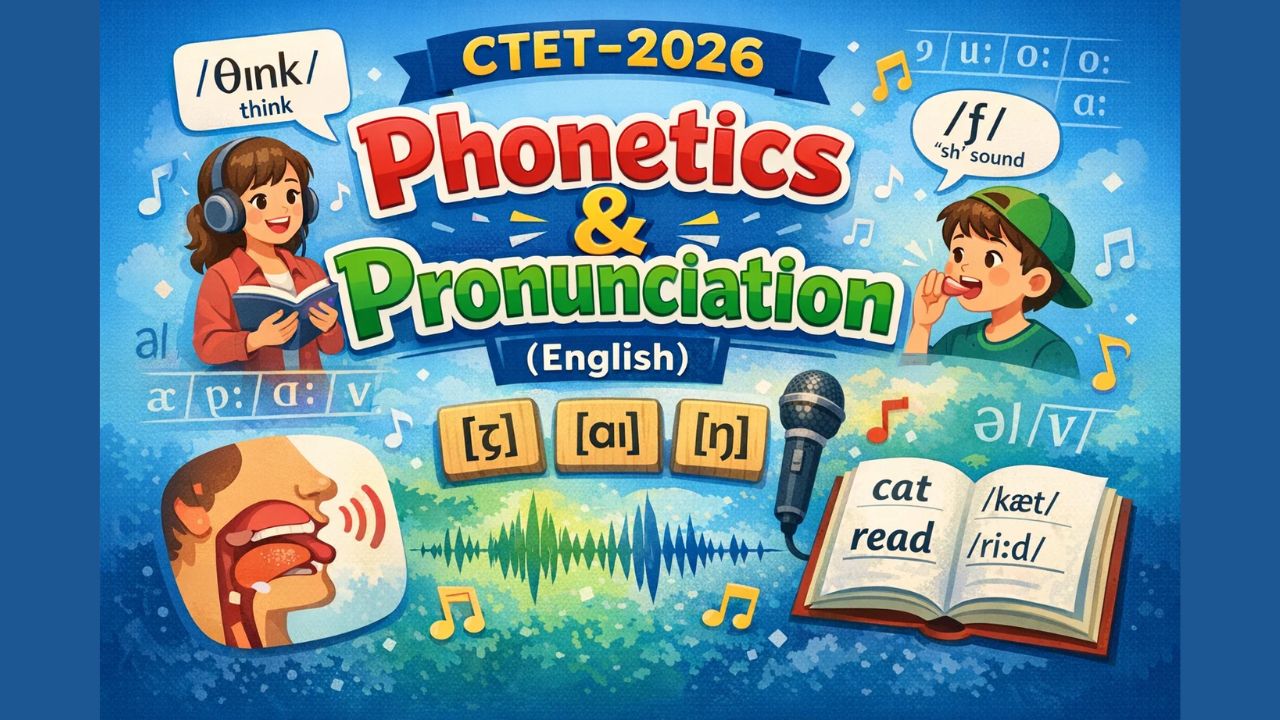
हा लेख CTET-2026 परीक्षेसाठी English phonetics आणि pronunciation वर आधारित आहे. यात word stress, sentence stress, intonation, vowels, consonants आणि basic IPA symbols यांचा समावेश आहे. शिक्षकांसाठी हा लेख मुलांना योग्य pronunciation शिकवण्यास आणि communication skills सुधारण्यास मार्गदर्शक आहे. Marathi-English mix मध्ये लिहिल्यामुळे सोप्या भाषेत अभ्यास करता येईल.
प्रस्तावना
भाषा शिकताना फक्त शब्दांचा अर्थ शिकणे पुरेसे नाही. शब्दांचा योग्य उच्चार (pronunciation) आणि भाषेतील ध्वनी (sounds) समजणे फार महत्वाचे आहे. Phonetics म्हणजे भाषेतील ध्वनींचा अभ्यास आणि Pronunciation म्हणजे शब्द योग्य पद्धतीने उच्चारणे. CTET परीक्षेत शिक्षकाच्या भूमिका लक्षात घेता, phonetics व pronunciation वर चांगली पकड असणे आवश्यक आहे.
For CTET-2026 Study Material click here
1. Stress & Intonation
Stress:
- एका शब्दात किंवा वाक्यात काही syllables/words वर जोर देणे म्हणजे stress.
- उदाहरण:
- Word Stress: ‘teacher’ → TEE-cher (पहिल्या syllable वर जोर)
- Sentence Stress: I am going to school. (महत्त्वाच्या शब्दावर जोर)
Intonation:
- वाक्यात आवाजाचा उठाव-गिराव म्हणजे intonation.
- Intonation बदलल्याने वाक्याचा अर्थ बदलतो.
- Example:
- Rising Intonation: Are you coming? (प्रश्न दाखवते)
- Falling Intonation: I am coming. (निर्णय/statement दाखवते)
- Example:
2. Phonetic Symbols (IPA – basic)
IPA (International Phonetic Alphabet) वापरून आपण शब्दांचे sounds universal पद्धतीने दाखवू शकतो.
- Example:
- /i:/ → seat
- /ɪ/ → sit
- /æ/ → cat
- /ʃ/ → ship
- /θ/ → think
टीप: CTET मध्ये शिक्षकासाठी basic IPA ची माहिती पुरेशी आहे.
3. Sounds of English (Vowels & Consonants)
A) Vowels (स्वर):
- Short Vowels: /ɪ/ (sit), /e/ (bed), /æ/ (cat), /ʌ/ (cup), /ɒ/ (hot), /ʊ/ (put)
- Long Vowels: /i:/ (seat), /ɑ:/ (car), /ɔ:/ (saw), /u:/ (food), /ɜ:/ (bird)
- Diphthongs (द्विस्वर): /eɪ/ (day), /aɪ/ (my), /ɔɪ/ (boy), /aʊ/ (now), /əʊ/ (go)
B) Consonants (व्यंजन):
- Voiced: /b/ (bat), /d/ (dog), /g/ (go)
- Voiceless: /p/ (pen), /t/ (top), /k/ (cat)
- Fricatives: /f/ (fan), /v/ (van), /θ/ (think), /ð/ (this), /s/ (sun), /z/ (zoo), /ʃ/ (ship), /ʒ/ (measure)
- Affricates: /tʃ/ (church), /dʒ/ (judge)
- Nasals: /m/ (man), /n/ (net), /ŋ/ (sing)
- Approximants: /l/ (lip), /r/ (red), /j/ (yes), /w/ (we)
4. Teacher’s Role in Pronunciation
- मुलांना शब्दांचे correct pronunciation शिकवणे.
- Stress आणि intonation वाक्यात योग्य वापरण्यास मार्गदर्शन करणे.
- Sounds, IPA आणि minimal pairs वर लक्ष देणे.
5. Importance for CTET
- Phonetics & pronunciation वर आधारित MCQs and short answers येऊ शकतात.
- शिक्षणात communication skills सुधारण्यासाठी phonetics महत्त्वाचे आहे.
- Students’ listening, speaking, reading skills सुधारण्यासाठी teacher ची भूमिका critical आहे.
CTET‑Style MCQs (50 Questions)
1. Which represents International Phonetic Alphabet?
A) Interactive Phonetic Alphabet
B) Internal Phonetic Alphabet
C) International Phonetic Alphabet
D) Innovative Phonetic Alphabet
Answer: C Doorsteptutor
2. How many consonant sounds are there in English?
A) 20 B) 24 C) 30 D) 10
Answer: B Testbook
3. Two vowel sounds pronounced together form:
A) Intonation
B) Bilabial
C) Diphthong
D) Penultimate syllable
Answer: C Testbook
4. The sound /ʃ/ is found in:
A) see B) ship C) chip D) zoo
Answer: B UG English
5. Word stress can:
A) Be ignored
B) Only on consonants
C) Change meaning
D) Occur everywhere
Answer: C UG English
6. Stress and intonation are studied in:
A) Articulatory phonetics
B) Suprasegmental phonology
C) Syntax
D) Semantics
Answer: B UG English
7. Which is an example of a bilabial sound?
A) /f/ B) /p/ C) /θ/ D) /v/
Answer: B UG English
8. The sound /ŋ/ in “sing” is:
A) Voiced alveolar nasal
B) Voiced velar nasal
C) Voiceless glottal fricative
D) Palatal approximant
Answer: B UG English
9. Which of the following is voiceless?
A) /b/ B) /d/ C) /g/ D) /k/
Answer: D Let’s Master Everything Simple
10. Minimal pair means:
A) Same spelling
B) Differ by one phoneme
C) Same meaning
D) Two stressed syllables
Answer: B Let’s Master Everything Simple
11. /w/ in “we” is:
A) Bilabial nasal
B) Labio‑velar approximant
C) Dental plosive
D) Palatal fricative
Answer: B Let’s Master Everything Simple
12. The schwa /ə/ represents:
A) Nasal sound
B) Mid‑central vowel
C) High front vowel
D) Voiceless stop
Answer: B Studocu
13. Phonetic transcription uses:
A) Roman numerals
B) IPA symbols
C) ASCII
D) Morse code
Answer: B Studocu
14. Intonation in speech refers to:
A) Loudness
B) Melody of speech
C) Pause
D) Breath
Answer: B Studocu
15. In yes/no questions, intonation is typically:
A) Falling
B) Rising
C) Neutral
D) Flat
Answer: B Studocu
16. Long vowels include:
A) /ɪ/ B) /i:/ C) /ʊ/ D) /e/
Answer: B (IPA basics)
17. Short vowels include:
A) /i:/ B) /ɪ/ C) /u:/ D) /ɔ:/
Answer: B (IPA basics)
18. The study of sounds in speech is:
A) Syntax B) Phonetics C) Morphology D) Lexicon
Answer: B Scribd
19. Word “cat” phonetic transcription is:
A) /kæt/ B) /kat/ C) /kʌt/ D) /CET/
Answer: A Studocu
20. Vowel sounds are produced with:
A) Complete obstruction
B) No obstruction
C) Air stopped
D) Air friction
Answer: B (phonetics fundamentals)
21. /p t k/ at syllable start are usually:
A) Voiced B) Aspirated C) Whispered D) Silent
Answer: B Quizgecko
22. Primary stress means:
A) Loudest syllable
B) Weakest
C) Longest only
D) Silent
Answer: A Quizgecko
23. Progressive assimilation affects:
A) Following sound
B) Preceding sound
C) No sound
D) Deleted sound
Answer: A Quizgecko
24. Elision refers to:
A) Addition of sound
B) Deletion of sound
C) Substitution
D) Punctuation
Answer: B Quizgecko
25. Which has /eɪ/ sound?
A) sit B) day C) dog D) cup
Answer: B (Diphthongs basics)
MORE (26–50) – Practice Continued
26. What is consonant cluster?
A) Single sound
B) Two vowels
C) Group of consonants
D) Neither
Answer: C Scribd
27. /f/ and /v/ differ in:
A) Place of articulation
B) Voicing
C) Nasality
D) Length
Answer: B Let’s Master Everything Simple
28. /tʃ/ in “chair” is:
A) Fricative
B) Affricate
C) Nasal
D) Vowel
Answer: B (IPA basics)
29. Sentence with falling tone shows:
A) Question B) Statement C) Surprise D) Hesitation
Answer: B (intonation basics)
30. Word “photoGRAPHic” primary stress on:
A) pho‑ B) to‑ C) GRAPH‑ D) ic
Answer: C UG English
31. /θ/ appears in:
A) think B) sink C) king D) wing
Answer: A (IPA basics)
32. /dʒ/ appears in:
A) jog B) log C) fog D) bog
Answer: A (IPA basics)
33. IPA /æ/ is sound in:
A) bat B) bet C) but D) boot
Answer: A (IPA basics)
34. Rhythm in speech mainly involves:
A) Stress patterns
B) Alphabet order
C) Sentence meaning
D) Text structure
Answer: A (suprasegmental)
35. Syllable is smallest unit of:
A) Word accent B) Phoneme C) Phrase
D) Sentence
Answer: A (phonetics concept)
36. Vowels are produced without:
A) Tongue B) Air obstruction
C) Lips movement
D) Voicing
Answer: B (phonetics fundamentals)
37. Consonants require:
A) No obstruction B) Some obstruction
C) Nasal only
D) Mouth closed
Answer: B (phonetics fundamentals)
38. Schwa is typically found in:
A) Stressed syllables
B) Unstressed syllables
C) Final word only
D) First word only
Answer: B (IPA basics)
39. Which intonation for WH questions?
A) Rising B) Falling C) Neutral
D) Flat
Answer: B Studocu
40. Word stress helps in:
A) Meaning change
B) Grammar only
C) Spelling only
D) Pronunciation
Answer: D (phonetics basics)
41. Which pair is based on vowel length?
A) ship vs sheep
B) pit vs pet
C) sit vs sat
D) pen vs pan
Answer: A Let’s Master Everything Simple
42. IPA stands for:
A) International Pronunciation Alphabet
B) International Phonetic Alphabet
C) Indian Phonetic Alphabet
D) Internal Phonetic Alphabet
Answer: B Doorsteptutor
43. /ʊ/ vowel is in:
A) boot B) book C) cat D) bed
Answer: B (IPA basics)
44. /ɔ:/ is a:
A) Short vowel B) Long vowel C) Consonant
D) Diphthong
Answer: B (IPA basics)
45. Primary stress indicates:
A) Loud syllable
B) Silent syllable
C) Soft syllable
D) Written mark
Answer: A Quizgecko
46. /j/ is:
A) Palatal approximant B) Nasal C) Fricative
D) Plosive
Answer: A (IPA basics)
47. Stress‑timed rhythm means:
A) Equal interval between stressed syllables
B) Equal between all syllables
C) No intervals
D) Random
Answer: A (suprasegmental concept)
48. Voiced consonants include:
A) /p/ B) /b/ C) /t/ D) /k/
Answer: B (phonetics basics)
49. Diphthong /aɪ/ in:
A) buy B) bet C) bat D) but
Answer: A (IPA basics)
50. Consonant sound requires:
A) No obstruction
B) Minimum obstruction
C) Some obstruction
D) Complete blockage only
Answer: C (phonetics fundamentals)
निष्कर्ष
Phonetics & Pronunciation शिकणे शिक्षकासाठी फार गरजेचे आहे. Word stress, sentence stress, intonation, vowels & consonants चे knowledge विद्यार्थ्यांना योग्य मार्गदर्शन करण्यासाठी उपयोगी ठरते. IPA symbols शिकल्याने universal pronunciation समजायला मदत होते.