
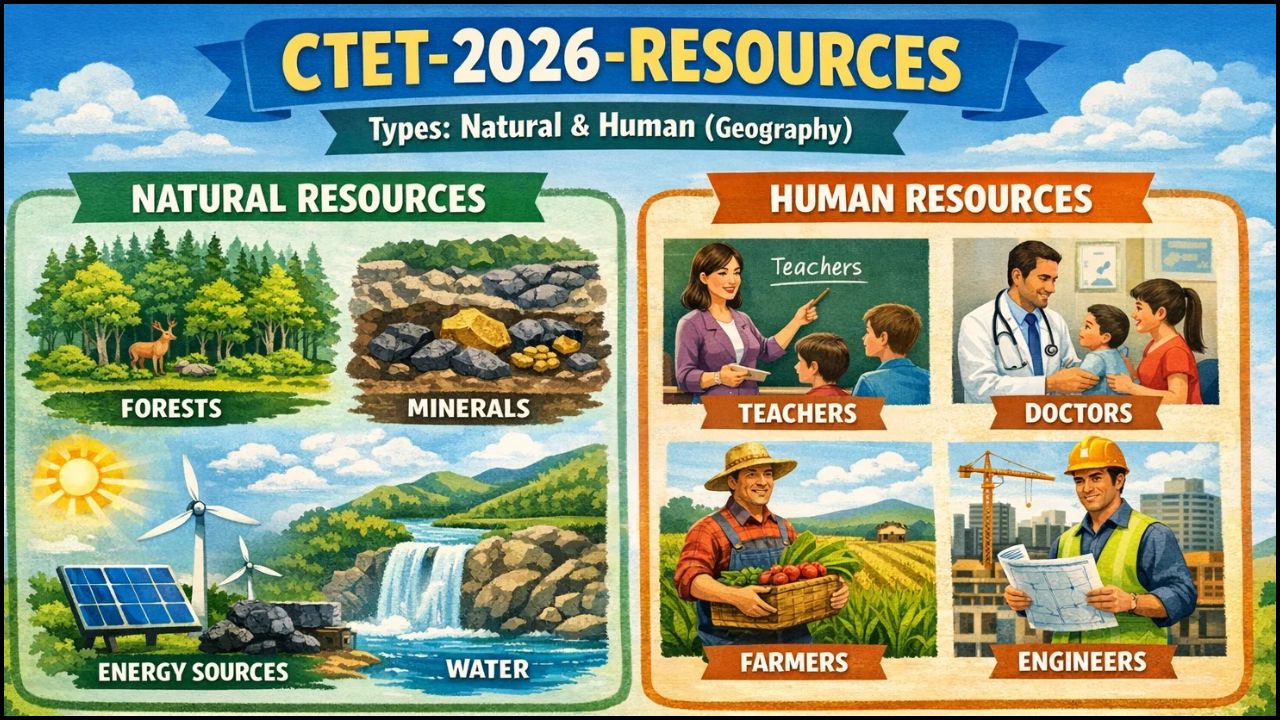
संसाधने (Resources) म्हणजे मानवासाठी उपयुक्त गोष्टी. Resources दोन प्रकारची असतात: Natural (जैविक, खनिज, जल, हवा) आणि Human (मानवाचे ज्ञान, कौशल्य, श्रम). योग्य व्यवस्थापनाने दोन्ही संसाधने समाजाच्या विकासासाठी आणि टिकाऊ प्रगतीसाठी उपयोगी ठरतात.
प्रस्तावना
संसाधने म्हणजे त्या गोष्टी ज्या मानवाच्या जीवनासाठी उपयुक्त आहेत. Resources are materials that are useful to humans for their survival and development. संसाधने जीवन जगण्यासाठी, उत्पादन करण्यासाठी आणि समाज उन्नत करण्यासाठी वापरली जातात. Resources can be classified into two main types: Natural Resources and Human Resources.
CTET 2026 – Child Development & Pedagogy Notes
Human Resources / Human Capital
नैसर्गिक संसाधने / Natural Resources
Natural resources are those that occur in nature and are available without human intervention.
उदाहरणे / Examples: जल (Water), माती (Soil), हवा (Air), सूर्यप्रकाश (Sunlight), खनिजे (Minerals), वनस्पती (Plants), प्राणी (Animals).
वैशिष्ट्ये / Features:
- नैसर्गिक आहेत, मानव निर्मित नाहीत.
- पृथ्वीवर नैसर्गिकरित्या उपलब्ध आहेत.
- काही संसाधने नवनिर्मित केली जाऊ शकत नाहीत (Non-renewable) तर काही renewable आहेत.
प्रकार / Types of Natural Resources:
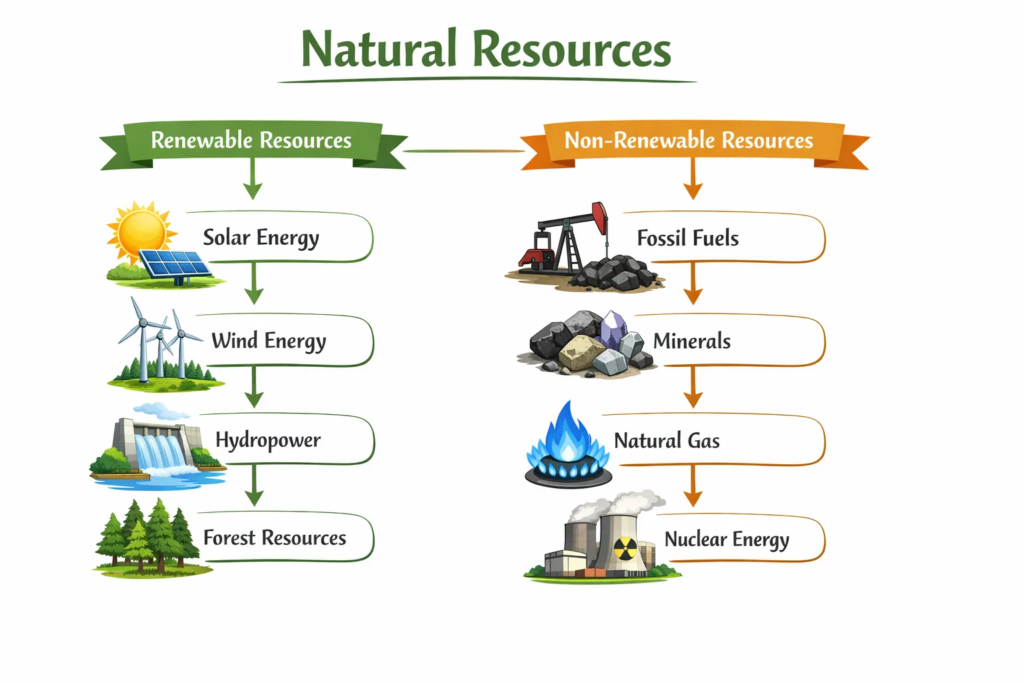
- Renewable Resources (पुनर्निर्मित होणारी संसाधने):
Resources that can be replenished naturally over time.- उदाहरण: जल, हवा, वनस्पती, प्राणी
- Non-Renewable Resources (अविनाशी संसाधने):
Resources that cannot be replaced once used.- उदाहरण: कोळसा (Coal), नैसर्गिक वायू (Natural Gas), खनिजे (Minerals)
- Flow Resources (प्रवाह संसाधने):
Resources that are available only when and where nature provides them.- उदाहरण: सूर्यप्रकाश, पवन (Wind), नदीचे पाणी
नैसर्गिक संसाधने — चित्र / Diagram:
मानवी संसाधने / Human Resources
Human resources म्हणजे माणसाच्या ज्ञान, कौशल्य आणि श्रमातून तयार होणारी क्षमता.
Definition: Human resources refer to the mental and physical abilities of people that contribute to production and societal development.
वैशिष्ट्ये / Features:
- Humans themselves are the source.
- Skills, education, knowledge, and labor improve productivity.
- Constantly developable through education and training.
Examples / उदाहरणे:
- Teachers (शिक्षक)
- Doctors (डॉक्टर)
- Engineers (अभियंते)
- Farmers (शेतकरी)
- Laborers (कामगार)
महत्त्व / Importance:
- समाजाची उन्नती साधणे (Contribute to social and economic development)
- उत्पादन प्रक्रियेत भाग घेणे (Involved in production processes)
- नवनवीन तंत्रज्ञान निर्माण करणे (Innovation and technology development)
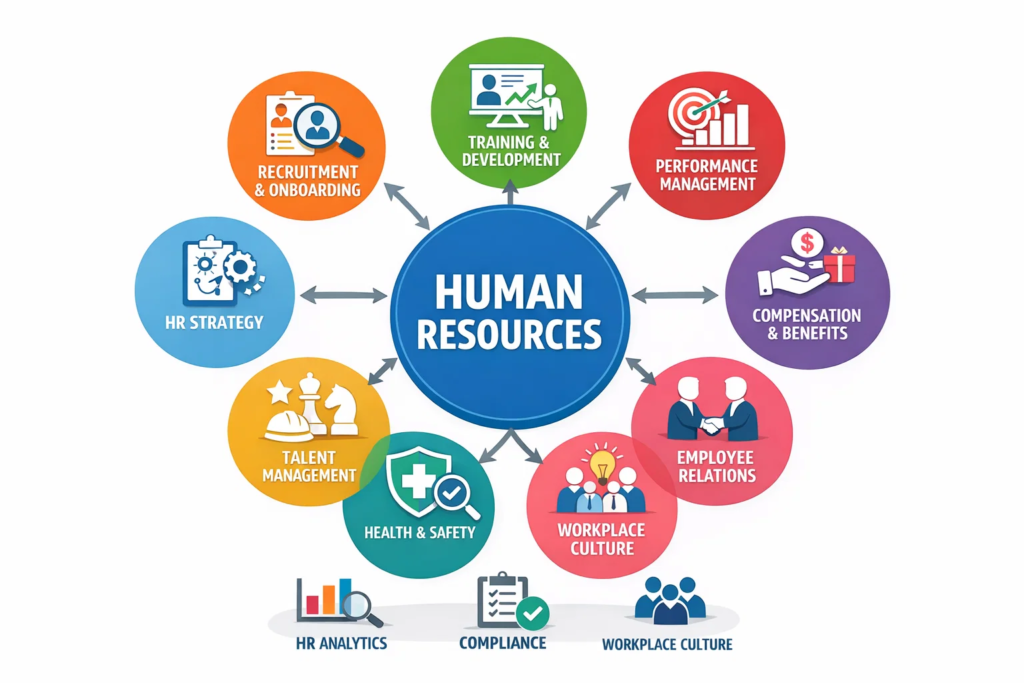
मानवी संसाधने —
Comparison / तुलना
| Aspect | Natural Resources (नैसर्गिक) | Human Resources (मानवी) |
|---|---|---|
| Source | Nature (प्रकृती) | Human beings (माणूस) |
| Renewable? | Yes/No depending on type | Always renewable via education and training |
| Usage | Raw materials, energy | Labor, skill, knowledge |
| Examples | Water, minerals, forests | Teachers, doctors, engineers |
MCQs for CTET 2026 (Sample / 5 Qs)
- Which of the following is a renewable resource?
a) Coal
b) Water ✅
c) Petroleum
d) Iron - Human resources include:
a) Minerals
b) Labor and skills ✅
c) Forests
d) Rivers - Non-renewable resources are:
a) Wind
b) Solar energy
c) Coal ✅
d) Water - Which resource is essential for innovation and technology?
a) Water
b) Human resources ✅
c) Soil
d) Sunlight - Flow resources are:
a) Minerals
b) Wind ✅
c) Coal
d) Forests - Which of the following is a natural resource?
a) Teacher
b) Coal ✅
c) Engineer
d) Doctor - Human resources are developed by:
a) Education and training ✅
b) Mining
c) Rainfall
d) Forests - Non-renewable resources are:
a) Sunlight
b) Coal ✅
c) Wind
d) Water - Renewable resources are:
a) Petroleum
b) Iron
c) Solar energy ✅
d) Natural gas - Labor, knowledge, and skill are components of:
a) Natural resources
b) Human resources ✅
c) Mineral resources
d) Flow resources - Minerals like gold and iron are classified as:
a) Renewable
b) Non-renewable ✅
c) Human resources
d) Flow resources - Which of the following is not a human resource?
a) Farmer
b) Doctor
c) Teacher
d) Coal ✅ - Which of the following is a flow resource?
a) Soil
b) Wind ✅
c) Coal
d) Iron - Water is considered:
a) Renewable resource ✅
b) Non-renewable resource
c) Human resource
d) Flow resource only - Forests provide:
a) Minerals
b) Air, timber, and medicine ✅
c) Knowledge
d) Labor - Human resource development improves:
a) Productivity ✅
b) Mineral extraction
c) Soil quality
d) Water supply - Which of the following is essential for economic development?
a) Coal
b) Human resources ✅
c) Sunlight
d) Wind - Soil and minerals come under:
a) Human resources
b) Natural resources ✅
c) Labor
d) Knowledge - Natural resources can be classified into:
a) Renewable and Non-renewable ✅
b) Skilled and Unskilled
c) Knowledge and Labor
d) Flow and Stock only - Which resource cannot be replaced once used?
a) Solar energy
b) Coal ✅
c) Wind
d) Forests - Human resources contribute to:
a) Innovation ✅
b) Mineral formation
c) Soil creation
d) Rainfall - Sunlight, wind, and rivers are examples of:
a) Renewable resources ✅
b) Non-renewable resources
c) Human resources
d) Minerals - Which of the following improves the quality of human resources?
a) Education ✅
b) Mining
c) Logging
d) Irrigation - Petroleum and natural gas are:
a) Renewable
b) Non-renewable ✅
c) Human resources
d) Flow resources - Human resources are directly linked with:
a) Knowledge and skill ✅
b) Minerals and coal
c) Water and soil
d) Forest and air
निष्कर्ष
संसाधने म्हणजे मानव जीवनाचे आधारस्तंभ आहेत. Natural resources आणि Human resources दोन्ही समाजाच्या विकासासाठी अत्यंत महत्त्वाचे आहेत. जिथे नैसर्गिक संसाधने उपलब्ध आहेत तिथे मानवी संसाधने योग्य वापरल्यास sustainable development साधता येऊ शकते.