
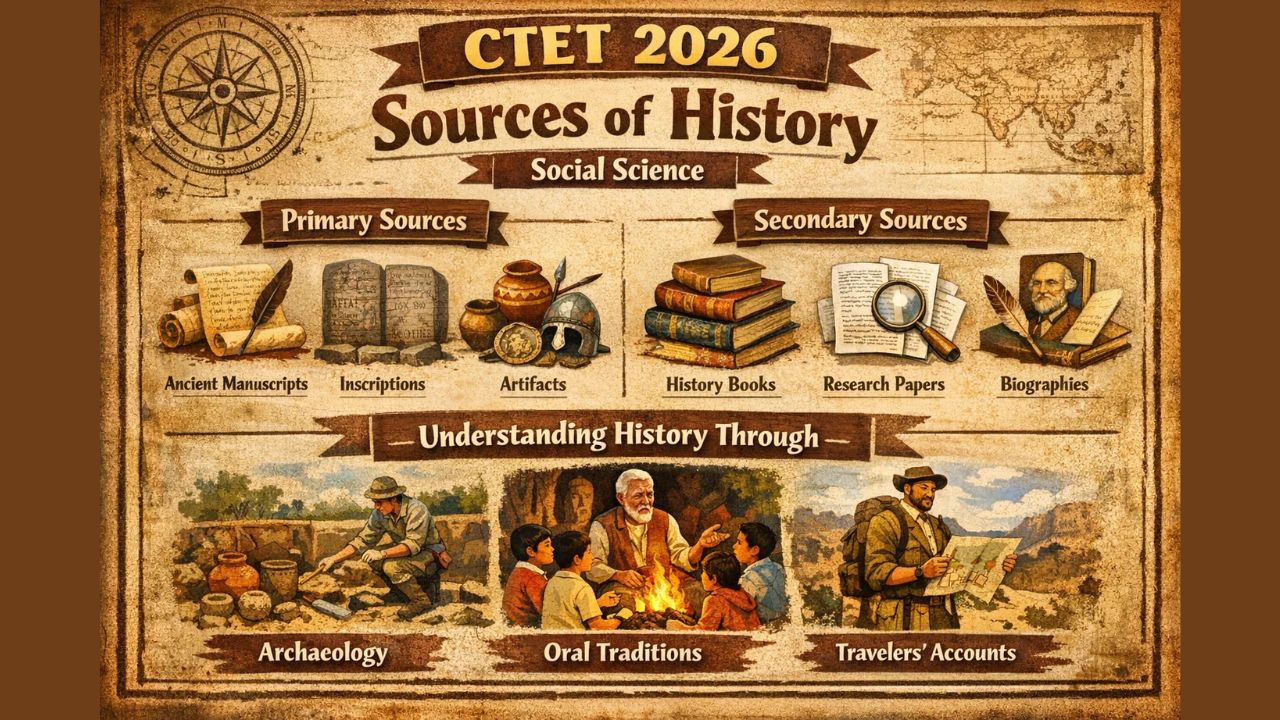
Sources of History-हा लेख इतिहासाचे स्रोत, त्यांचे प्रकार आणि इतिहास समजून घेण्यात त्यांचे महत्त्व स्पष्ट करतो.
प्रस्तावना
History is the study of the past. To understand history, historians rely on different sources that provide evidence about past events.
इतिहास म्हणजे भूतकाळाचा अभ्यास. इतिहास समजून घेण्यासाठी इतिहासकार विविध स्रोतांचा वापर करतात जे भूतकाळातील घटना स्पष्ट करतात.
CTET 2026 – बालविकास आणि शिक्षणशास्त्र
National Digital Library of India – इतिहास संसाधने
Importance of Sources
- Sources help us reconstruct past events.
- They provide insights into social, political, and cultural life.
- They are primary tools for historians.
स्रोतांचा महत्त्व:Sources of History
- भूतकाळातील घटना समजून घेण्यासाठी मदत करतात.
- सामाजिक, राजकीय आणि सांस्कृतिक जीवनाची माहिती देतात.
- इतिहासकारांसाठी प्राथमिक साधन आहेत.
Types of Sources – इतिहासाचे स्रोत
Sources of history can be broadly divided into two main categories:
A. Primary Sources (प्राथमिक स्रोत)
Sources created during the time of the event. They provide first-hand information.
Examples – उदाहरणे:Sources of History
- Inscriptions / शिलालेख: Stone or metal inscriptions that record events.
- Coins / नाणे: Tell about rulers, economy, and trade.
- Manuscripts / हस्तलिखित ग्रंथ: Letters, diaries, and official records.
- Archaeological remains / पुरातत्व अवशेष: Buildings, monuments, tools, and utensils.
Tip: Primary sources are considered the most reliable evidence because they are contemporary to the event.
B. Secondary Sources (द्वितीयक स्रोत)
Sources created after the event by someone who did not witness it.
Examples – उदाहरणे:Sources of History
- Books / ग्रंथ: Written by historians after studying primary sources.
- Research papers / संशोधन निबंध: Analysis of events.
- Biographies / चरित्रे: Life stories written later.
Tip: Secondary sources help interpret and analyze history, but may have bias.
Other Important Sources – अन्य महत्त्वाचे स्रोत
- Oral Sources / तोंडी स्रोत
- Folktales, songs, legends, and stories passed from generation to generation.
- Example: Tribal histories, local myths.
- Material Sources / भौतिक स्रोत
- Objects, tools, pottery, paintings, coins.
- Example: Harappan seals, sculptures.
- Visual Sources / दृश्य स्रोत
- Paintings, photographs, maps, sketches.
- Example: Mughal miniature paintings.
How Historians Use Sources – इतिहासकार स्रोतांचा वापर कसा करतात
- Collect sources from archives, museums, and sites.
- Evaluate the authenticity and reliability.
- Compare multiple sources for accuracy.
- Interpret the data to reconstruct past events.
Tip for CTET: Questions may ask you to identify examples of primary vs secondary sources or how historians validate sources.
Examples for Classroom Use – शालेय उदाहरणे–
- Primary source: Ashoka’s Edicts
- Secondary source: A history book about Mauryan Empire
- Oral source: Story of Rani Laxmibai told by elders
- Material source: Terracotta toys from Indus Valley Civilization
Quick MCQs for Practice – MCQs सरावासाठी
A. MCQs / Objective‑based Questions
- Which of these is a primary source of history?
a) Coins b) History textbook c) Biography d) Encyclopedia - Shilalekh (inscriptions) are considered examples of:
a) Material sources b) Primary sources c) Secondary sources d) Oral sources - A history textbook is:
a) Primary source b) Secondary source c) Oral source d) Material source - Which among these is an oral source?
a) Diary b) Folktale c) Manuscript d) Coins - Archaeological remains include:
a) Documents b) Coins c) Buildings & Tools d) Biographies - Which is a visual source of history?
a) Painting b) Letter c) Inscriptions d) Coins - MCQ: Harappan seals are considered:
a) Written source b) Secondary source c) Material source d) Oral source - Which of the following is NOT a primary source?
a) Diaries b) Coins c) Research article d) Letters - Manuscripts are:
a) Oral sources b) Primary written sources c) Secondary sources d) None - Rajtarangini is an example of:
a) Primary source b) Secondary source c) Oral source d) Material source
B. Short Answer / Fill‑in Questions
- Define ‘primary source’ of history.
- Give two examples of secondary sources.
- What do you mean by material sources of history?
- Name any two visual sources of history.
- Why are oral traditions important for history?
- Coins help historians to understand _________.
- Inscriptions provide information about _________.
- Manuscripts are considered _______ sources.
- Name any two archaeological sources.
- Folktales passed by elders are called _________ sources.
C. Assertion‑Reason / Match‑Type
- Assertion: Coins are reliable historical sources.
Reason: They often have inscriptions about rulers. - Assertion: Paintings are primary sources.
Reason: They can show contemporary social life. - Match:
A. Shilalekh 1. Oral
B. Folktale 2. Material
C. Pottery 3. Written
D. Photograph 4. Visual - Statement: Secondary sources are always unbiased — True/False?
- Choose the correct pair:
A. Manuscript – Written
B. Legend – Physical
C. Tool – Written
D. Book – Oral
D. Long/Descriptive Questions (History)
- Explain the difference between primary and secondary sources.
- How do historians use archaeological evidence to study the past?
- Discuss the importance of oral sources in reconstructing early history.
- Describe various types of material sources.
- What role do inscriptions play in understanding ancient societies?
E. Higher‑Order Thinking Questions (HOTs)
- A historian finds two conflicting inscriptions about a king’s date of reign. How should they resolve it?
- Evaluate the limitations of oral sources of history.
- Why might secondary sources sometimes be biased? Explain with an example.
- How do visual sources complement written records?
- Suggest ways to authenticate a prehistoric tool found in an excavation.
F. True / False
- True / False: A diary is a primary source.
- True / False: Research papers are primary sources.
- True / False: Coins can tell us about economy.
- True / False: Legends are examples of written sources.
- True / False: Paintings can show social customs of past.
G. One‑Word / One‑Line
- The study of ancient inscriptions is known as _______.
- __________ is a written source found on stone.
- Pottery is an example of _________ source.
- A person’s daily record is called ________.
- __________ refers to stories passed verbally over generations.
H. Compare & Explain
- Compare inscriptions and manuscripts as sources of history.
- Explain why coins are important for economic history.
- Distinguish between oral and written sources.
- How do archaeologists help historians?
- Evaluate the importance of visual sources in understanding cultural history.
Quick Answers / Keys (for Practise)
MCQs:
1‑Coins | 2‑Primary | 3‑Secondary | 4‑Folktale | 5‑Buildings & Tools
6‑Painting | 7‑Material | 8‑Research article | 9‑Written | 10‑Secondary
Fill‑ins:
16‑Economy | 17‑Events/Kingdoms | 18‑Primary | 20‑Oral
True/False:
36‑True | 37‑False | 38‑True | 39‑False | 40‑True
निष्कर्ष
Sources of history-इतिहासाचे स्रोत समजून घेणे भूतकाळाचा अचूक अभ्यास करण्यासाठी अत्यंत महत्त्वाचे आहे. प्राथमिक, द्वितीयक, तोंडी आणि भौतिक स्रोत आपल्याला सामाजिक, राजकीय आणि सांस्कृतिक जीवन समजून घेण्यास मदत करतात.