
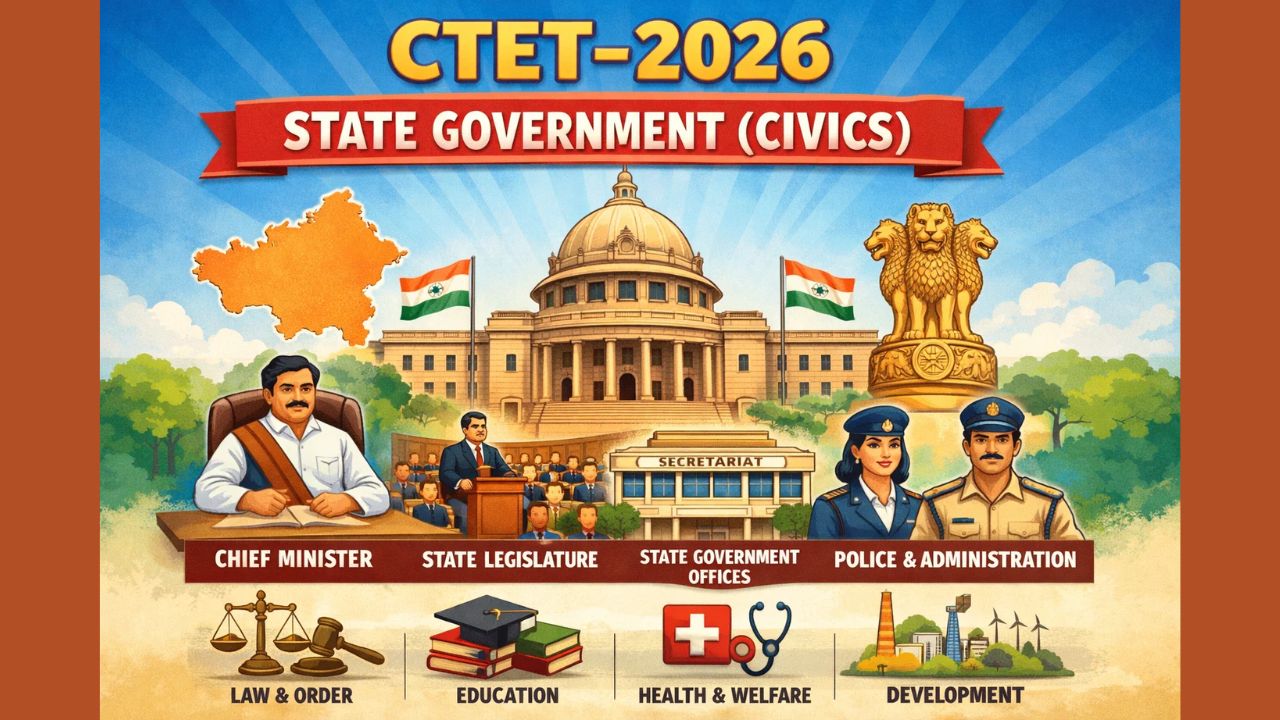
State Government (राज्य सरकार) हे भारतातील लोकशाही व्यवस्थेचे महत्त्वाचे अंग आहे. राज्य पातळीवर शासन चालवणे, कायदे बनवणे, कायद्यांची अंमलबजावणी करणे आणि नागरिकांना न्याय देणे ही राज्य सरकारची मुख्य कार्ये आहेत. राज्य सरकारचे तीन प्रमुख घटक म्हणजे विधिमंडळ, कार्यपालिका आणि न्यायपालिका होत.
प्रस्तावना
India is a Union of States, and the State Government plays a crucial role in the democratic system of the country.
भारत हा राज्यांचा संघ (Union of States) असून केंद्र सरकारबरोबरच राज्य सरकारे लोकशाहीच्या अंमलबजावणीत महत्त्वाची भूमिका बजावतात.
The State Government works at the state level and looks after administration, law and order, education, health, agriculture, transport, and many welfare schemes.
राज्य पातळीवर प्रशासन चालवणे, कायदा-सुव्यवस्था राखणे, शिक्षण, आरोग्य, शेती, वाहतूक व लोककल्याणकारी योजना राबवणे हे राज्य सरकारचे मुख्य कार्य आहे.
Organs of Government – Legislature, Executive & Judiciary
India.gov.in – State Government Section
Meaning of State Government / राज्य सरकारची संकल्पना
State Government is the government that governs a particular state in India.
राज्य सरकार म्हणजे भारतातील एखाद्या विशिष्ट राज्याचे शासन.
According to the Indian Constitution, powers are divided between:
- Union Government (Central Government)
- State Government
- Local Government
भारतीय संविधानानुसार सत्तेचे विभाजन केंद्र, राज्य आणि स्थानिक स्वराज्य संस्था यांच्यात केलेले आहे.
Organs of State Government / राज्य सरकारचे घटक
The State Government has three main organs:
- Legislature (Vidhan Mandal)
- Executive
- Judiciary
राज्य सरकारचे तीन प्रमुख घटक आहेत:
- विधिमंडळ
- कार्यपालिका
- न्यायपालिका
1. State Legislature / राज्य विधिमंडळ
The State Legislature is responsible for making laws for the state.
राज्य विधिमंडळाचे मुख्य कार्य कायदे बनवणे होय.
Types of State Legislature / विधिमंडळाचे प्रकार
- Unicameral Legislature – One House
(e.g., Maharashtra, Uttar Pradesh)
➝ विधानसभा + विधानपरिषद (Bicameral) - Bicameral Legislature – Two Houses
(Most states have only Legislative Assembly)
Legislative Assembly / विधानसभा
- Lower House
- Members are called MLAs (Members of Legislative Assembly)
- Directly elected by people
- Tenure: 5 years
विधानसभेचे सदस्य थेट जनतेद्वारे निवडले जातात, त्यामुळे ती लोकशाहीचा कणा मानली जाते.
Legislative Council / विधानपरिषद
- Upper House
- Members are partly elected and partly nominated
- Permanent House
विधानपरिषद ही स्थायी सभा असून तिला राज्याच्या कायदेप्रक्रियेत सल्लागार भूमिका असते.
2. State Executive / राज्य कार्यपालिका
The State Executive implements the laws made by the legislature.
राज्य कार्यपालिका कायद्यांची अंमलबजावणी करते.
Governor / राज्यपाल
- Constitutional head of the state
- Appointed by the President
- Acts on the advice of the Council of Ministers
राज्यपाल हा राज्याचा घटनात्मक प्रमुख असतो.
Chief Minister / मुख्यमंत्री
- Real executive head
- Leader of the majority party
- Appointed by the Governor
मुख्यमंत्री हा राज्य सरकारचा खरा प्रमुख असतो.
Council of Ministers / मंत्रीमंडळ
- Headed by the Chief Minister
- Responsible to the Legislative Assembly
मंत्रीमंडळ विधानसभेला जबाबदार असते, हीच लोकशाहीची खरी ताकद आहे.
3. State Judiciary / राज्य न्यायपालिका
Judiciary ensures justice and protection of rights.
न्यायपालिका न्याय देणे व मूलभूत हक्कांचे संरक्षण करते.
High Court / उच्च न्यायालय
- Highest court at state level
- Interprets the Constitution and laws
- Protects Fundamental Rights
उच्च न्यायालय हे राज्यातील सर्वोच्च न्यायालय आहे.
Powers of State Government / राज्य सरकारचे अधिकार
Legislative Powers
- Making laws on State List
- Subjects like police, agriculture, health, transport
Executive Powers
- Implementing laws
- Running administration
Financial Powers
- Levying state taxes
- Preparing state budget
राज्य सरकार आर्थिकदृष्ट्या केंद्रावर काही प्रमाणात अवलंबून असते.
Functions of State Government / राज्य सरकारची कार्ये
- Maintaining law and order
- Providing education and health services
- Developing infrastructure
- Implementing welfare schemes
राज्य सरकारचे मुख्य ध्येय लोककल्याण आहे.
State Government and Federal System / संघराज्य पद्धतीतील राज्य सरकार
India follows a Federal System with a strong Centre.
भारतामध्ये केंद्र मजबूत असलेली संघराज्य पद्धत आहे.
State Government ensures regional development and addresses local issues.
स्थानिक गरजांनुसार विकास साधणे हे राज्य सरकारचे वैशिष्ट्य आहे.
Importance of State Government / राज्य सरकारचे महत्त्व
- Strengthens democracy
- Brings governance closer to people
- Ensures balanced development
राज्य सरकारमुळे लोकशाही तळागाळापर्यंत पोहोचते.
Role of State Government in Education (CTET Focus)
- Implementing RTE Act
- Teacher recruitment
- Curriculum and textbooks (SCERT)
CTET परीक्षेत राज्य सरकारची शैक्षणिक भूमिका महत्त्वाची असते.
CTET-2026 | State Government (Civics) – PYQs MCQs (50)
1. The real executive authority in a State is vested in –
A) Governor
B) President
C) Chief Minister ✅
D) Speaker
2. The Governor of a State is appointed by –
A) Prime Minister
B) Parliament
C) President of India ✅
D) Chief Minister
3. Members of the Legislative Assembly are known as –
A) MPs
B) MLCs
C) MLAs ✅
D) Councillors
4. The tenure of the Legislative Assembly is –
A) 3 years
B) 4 years
C) 5 years ✅
D) 6 years
5. Which of the following is a permanent house?
A) Lok Sabha
B) Rajya Sabha
C) Vidhan Parishad ✅
D) Vidhan Sabha
6. State Legislature mainly performs which function?
A) Judicial
B) Administrative
C) Legislative ✅
D) Financial Audit
7. Who presides over the Legislative Assembly?
A) Governor
B) Chief Minister
C) Speaker ✅
D) Chief Justice
8. The head of the Council of Ministers is –
A) Governor
B) Chief Minister ✅
C) President
D) Speaker
9. To whom is the Council of Ministers responsible?
A) Governor
B) President
C) Legislative Assembly ✅
D) Supreme Court
10. Which court is the highest at the state level?
A) District Court
B) Supreme Court
C) High Court ✅
D) Lok Adalat
11. Subjects like police and agriculture belong to –
A) Union List
B) Concurrent List
C) State List ✅
D) Residuary List
12. Which organ interprets the Constitution?
A) Legislature
B) Executive
C) Judiciary ✅
D) Cabinet
13. The Governor acts on the advice of –
A) President
B) Prime Minister
C) Chief Minister & Council of Ministers ✅
D) Supreme Court
14. Who appoints the Chief Minister?
A) President
B) Prime Minister
C) Governor ✅
D) Speaker
15. Which of the following is NOT a function of State Government?
A) Education
B) Health
C) Defence ✅
D) Law & Order
16. The State Executive includes –
A) Governor only
B) Chief Minister only
C) Governor, CM & Ministers ✅
D) Judiciary
17. The State Judiciary ensures –
A) Policy making
B) Justice and rights protection ✅
C) Law making
D) Budget preparation
18. High Court judges are appointed by –
A) Governor
B) Chief Minister
C) President of India ✅
D) Parliament
19. Which system is followed in India?
A) Unitary
B) Federal ✅
C) Presidential
D) Dictatorial
20. The State Government works at –
A) National level
B) International level
C) State level ✅
D) Village level
21. The lower house of State Legislature is –
A) Vidhan Parishad
B) Vidhan Sabha ✅
C) Rajya Sabha
D) Lok Sabha
22. The budget of the state is presented by –
A) Governor
B) Chief Minister
C) Finance Minister ✅
D) Speaker
23. The State List is mentioned in which schedule?
A) 5th
B) 6th
C) 7th ✅
D) 8th
24. Which body maintains law and order?
A) Judiciary
B) Legislature
C) State Executive ✅
D) Election Commission
25. Who can dissolve the Legislative Assembly?
A) Speaker
B) Chief Justice
C) Governor (on CM’s advice) ✅
D) President only
26. Which one is NOT an organ of State Government?
A) Legislature
B) Executive
C) Judiciary
D) Election Commission ✅
27. State Government helps in –
A) Central defence
B) Local governance
C) Regional development ✅
D) Foreign policy
28. The real power lies with –
A) Governor
B) President
C) Chief Minister ✅
D) High Court
29. State Government strengthens –
A) Autocracy
B) Democracy ✅
C) Monarchy
D) Oligarchy
30. Which Act related to education is implemented by State Govt?
A) RTI
B) RTE ✅
C) GST
D) NITI Aayog
31. Who controls the state administration?
A) Governor
B) High Court
C) Chief Minister & Ministers ✅
D) President
32. The Legislative Council exists in –
A) All states
B) No states
C) Some states only ✅
D) Union Territories only
33. Which is a welfare function?
A) Making laws
B) Defence
C) Health services ✅
D) Foreign affairs
34. State Government derives its powers from –
A) Parliament
B) Constitution of India ✅
C) Supreme Court
D) Election Commission
35. The Speaker is elected from –
A) Legislative Council
B) Legislative Assembly ✅
C) High Court
D) Cabinet
36. Who is the constitutional head of the state?
A) Chief Minister
B) Governor ✅
C) Speaker
D) Chief Justice
37. Which institution prepares state laws?
A) Executive
B) Judiciary
C) Legislature ✅
D) Police
38. State Government is closer to –
A) Central government
B) People ✅
C) Supreme Court
D) President
39. The Council of Ministers works collectively under –
A) Governor
B) Speaker
C) Chief Minister ✅
D) Chief Justice
40. State Government ensures –
A) Global peace
B) Local welfare ✅
C) Defence
D) Foreign trade
41. High Court can issue –
A) Ordinances
B) Budgets
C) Writs ✅
D) Bills
42. The administrative head of a district is –
A) Governor
B) Collector (DM) ✅
C) MLA
D) Judge
43. State Government taxes include –
A) Income Tax
B) Customs Duty
C) State GST ✅
D) Corporate Tax
44. Who implements laws at state level?
A) Legislature
B) Judiciary
C) Executive ✅
D) Election Commission
45. Federalism means –
A) Power with one authority
B) Division of powers ✅
C) No Constitution
D) Military rule
46. The term ‘State Government’ refers to –
A) Central authority
B) Local body
C) Government of a state ✅
D) Judiciary only
47. Which subject is NOT in State List?
A) Police
B) Agriculture
C) Defence ✅
D) Public health
48. Who summons the state legislature session?
A) Chief Justice
B) Speaker
C) Governor ✅
D) President
49. State Government works under –
A) Dictatorship
B) Monarchy
C) Parliamentary system ✅
D) Presidential system
50. State Government is important because –
A) It controls defence
B) It governs locally ✅
C) It handles foreign affairs
D) It appoints President
निष्कर्ष
State Government is an essential pillar of Indian democracy.
राज्य सरकार हे भारतीय लोकशाहीचे महत्त्वाचे स्तंभ आहे.
It works for welfare, development, and good governance at the state level.
राज्य पातळीवर सुशासन व विकास घडवून आणणे हेच राज्य सरकारचे अंतिम ध्येय आहे.
For CTET-2026, understanding the structure, powers, and functions of State Government is very important.
CTET-2026 साठी राज्य सरकारची रचना, अधिकार व कार्ये समजून घेणे अत्यंत आवश्यक आहे.
CTET-2026 Quick Revision Points
- State Government = Legislature + Executive + Judiciary
- Chief Minister = Real head
- Governor = Constitutional head
- High Court = Highest state court