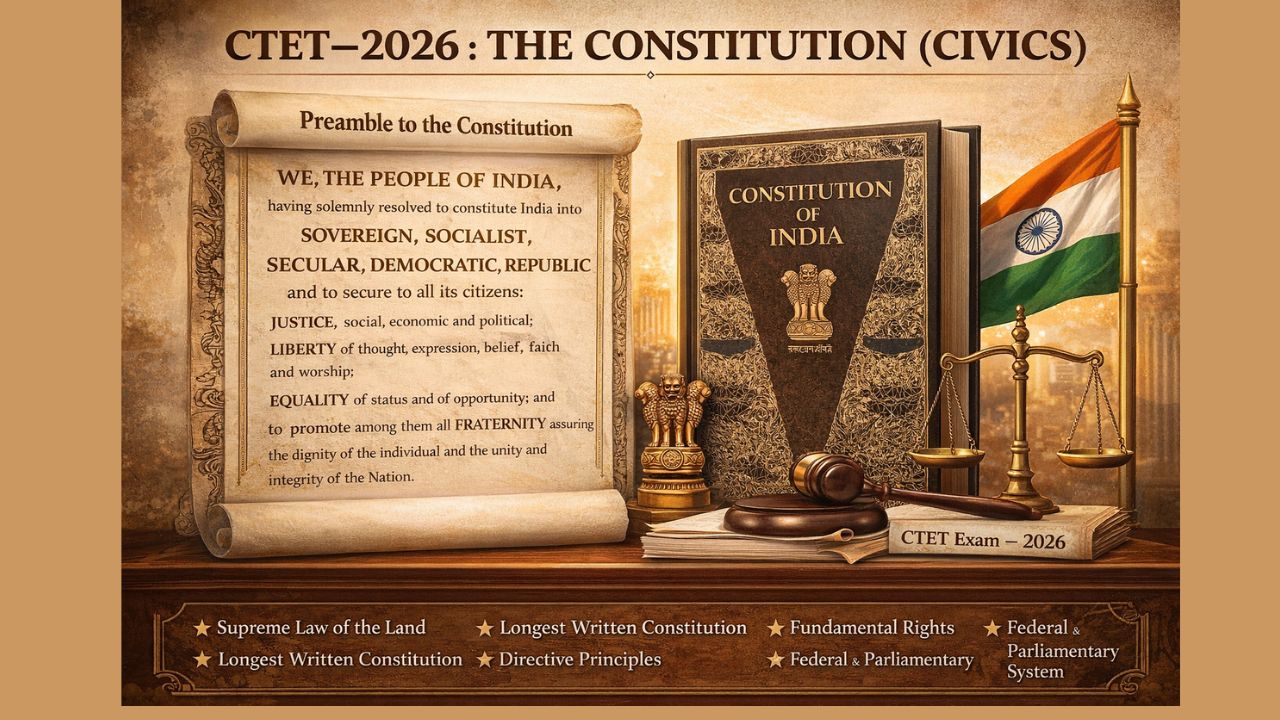
CTET–2026 (Civics) मधील “The Constitution” या घटकावर आधारित आहे. 30 गुणांची ही chapter-wise टेस्ट विद्यार्थ्यांची संविधानाविषयीची मूलभूत समज, महत्त्वाच्या कलमांची ओळख आणि परीक्षेची तयारी तपासण्यासाठी उपयुक्त आहे. ही टेस्ट MCQs, रिकाम्या जागा, जोड्या लावा व लघुउत्तरी प्रश्नांवर आधारित असून CTET परीक्षेसाठी उपयुक्त आहे.
प्रस्तावना
The Constitution म्हणजेच राज्यघटना हा कोणत्याही देशाचा सर्वोच्च कायदा (Supreme Law of the Land) असतो. भारताची राज्यघटना (The Constitution of India) ही जगातील सर्वात लांब आणि लिखित संविधान आहे. भारत एक लोकशाही, सार्वभौम, समाजवादी, धर्मनिरपेक्ष आणि प्रजासत्ताक राष्ट्र आहे, ही ओळख आपल्या संविधानामुळे मिळते.
CTET 2026 (Central Teacher Eligibility Test) साठी Civics मध्ये The Constitution हा अतिशय महत्त्वाचा topic आहे. शिक्षक म्हणून संविधानाची मूलभूत तत्त्वे समजून घेणे गरजेचे आहे, कारण शाळेत विद्यार्थ्यांमध्ये democratic values, equality, justice आणि rights रुजवण्याची जबाबदारी शिक्षकांवर असते.
Constitution of India – Official Text
Meaning of Constitution
Constitution म्हणजे देश चालवण्यासाठी बनवलेले मूलभूत नियम आणि तत्त्वांचा संच.
मराठीत सांगायचे तर,
संविधान म्हणजे शासनाची रचना, अधिकार, कर्तव्ये आणि नागरिकांचे हक्क स्पष्ट करणारा सर्वोच्च कायदा.
It defines:
- Structure of Government
- Powers of Legislature, Executive & Judiciary
- Rights and Duties of Citizens
Why do we need a Constitution?
संविधानाची गरज पुढील कारणांमुळे आहे:
- Rule of Law – कायद्याचे राज्य प्रस्थापित होते
- Protection of Rights – नागरिकांचे मूलभूत हक्क सुरक्षित होतात
- Limit on Government Power – सरकारच्या अधिकारांवर मर्यादा
- Social Justice – समानता व न्याय सुनिश्चित होतो
- Unity in Diversity – विविधतेत एकता टिकते
CTET मध्ये बहुतेक वेळा प्रश्न विचारला जातो:
“Why is Constitution important in a democracy?”
History of Indian Constitution
भारताची राज्यघटना बनवण्याची प्रक्रिया खूप दीर्घ आणि सखोल होती.
- Constituent Assembly स्थापन: 1946
- Drafting Committee Chairman: Dr. B. R. Ambedkar
- Total time taken: 2 years, 11 months, 18 days
- Adopted on: 26 November 1949
- Came into force on: 26 January 1950
26 जानेवारी हा दिवस Republic Day म्हणून साजरा केला जातो.
Salient Features of Indian Constitution
1. Lengthiest Written Constitution
Indian Constitution is the longest written constitution in the world. It has:
- Originally 395 Articles
- 22 Parts
- 8 Schedules (now 12 Schedules)
2. Sovereign, Socialist, Secular, Democratic, Republic
These words are mentioned in the Preamble.
- Sovereign – भारत स्वतंत्र आहे
- Socialist – सामाजिक व आर्थिक समानता
- Secular – सर्व धर्मांना समान वागणूक
- Democratic – लोकांनी निवडलेले सरकार
- Republic – राष्ट्रप्रमुख निवडून दिलेला
3. Federal System with Unitary Bias
भारतामध्ये Union and States अशी सत्ता विभागणी आहे.
However, in emergencies, the Constitution becomes unitary in nature.
4. Parliamentary System of Government
- President – Nominal Head
- Prime Minister – Real Executive
This system is borrowed from Britain.
The Preamble
Preamble is the soul of the Constitution. It reflects the ideals and philosophy of Indian democracy.
Preamble assures:
- Justice – Social, Economic & Political
- Liberty – Thought, Expression, Belief
- Equality – Status and Opportunity
- Fraternity – Unity and Integrity of the Nation
CTET मध्ये Preamble वरून statement-based प्रश्न येतात.
Fundamental Rights (मूलभूत हक्क)
Part III of the Constitution deals with Fundamental Rights.
Types of Fundamental Rights:
- Right to Equality (Articles 14–18)
- Right to Freedom (Articles 19–22)
- Right against Exploitation (Articles 23–24)
- Right to Freedom of Religion (Articles 25–28)
- Cultural and Educational Rights (Articles 29–30)
- Right to Constitutional Remedies (Article 32)
Dr. Ambedkar called Article 32 as the “Heart and Soul of the Constitution”.
Fundamental Duties (मूलभूत कर्तव्ये)
Fundamental Duties are mentioned in Article 51A.
They were added by 42nd Constitutional Amendment Act, 1976.
Some important duties:
- Respect Constitution, National Flag & Anthem
- Protect unity and integrity of India
- Promote harmony
- Safeguard public property
CTET मध्ये Rights vs Duties comparison प्रश्न येऊ शकतो.
Directive Principles of State Policy (DPSP)
Part IV contains Directive Principles.
They are non-justiciable, but morally binding on the government.
Examples:
- Equal pay for equal work
- Free legal aid
- Organisation of village panchayats
DPSPs aim at establishing a Welfare State.
Amendment of the Constitution (संविधान दुरुस्ती)
Indian Constitution is neither too rigid nor too flexible.
- Article 368 deals with amendment
- Some amendments require:
- Simple Majority
- Special Majority
- Ratification by States
Important Amendments for CTET:
- 42nd Amendment – Mini Constitution
- 44th Amendment – Right to Property removed from Fundamental Rights
Role of Constitution in Democracy (लोकशाहीतील संविधानाची भूमिका)
Constitution ensures:
- Participation of people
- Accountability of government
- Protection of minorities
- Peaceful transfer of power
Without Constitution, democracy cannot function effectively.
Importance of Constitution for Teachers (शिक्षकांसाठी महत्त्व)
As a teacher:
- You promote constitutional values
- Teach equality, justice, secularism
- Develop responsible citizenship among students
CTET expects teachers to understand this role clearly.
SHORT NOTES / REVISION POINTS
1️⃣ Constitution – Meaning
- Constitution = Supreme Law of the Land
- It defines structure, powers & functions of government
- नागरिकांचे Rights & Duties स्पष्ट करते
2️⃣ Indian Constitution – Key Facts
- Adopted on: 26 November 1949
- Implemented on: 26 January 1950
- Drafting Committee Chairman: Dr. B. R. Ambedkar
- Time taken: 2 years 11 months 18 days
3️⃣ Preamble
- Preamble = Soul of the Constitution
- Keywords:
- Sovereign
- Socialist
- Secular
- Democratic
- Republic
- Ideals: Justice, Liberty, Equality, Fraternity
4️⃣ Salient Features
- Longest written constitution
- Federal system with unitary bias
- Parliamentary form of government
- Independent judiciary
- Single citizenship
5️⃣ Fundamental Rights (Part III)
- Articles 14–32
- 6 Rights:
- Right to Equality
- Right to Freedom
- Right against Exploitation
- Right to Freedom of Religion
- Cultural & Educational Rights
- Right to Constitutional Remedies
- Article 32 = Heart and Soul of Constitution
6️⃣ Fundamental Duties (Article 51A)
- Added by 42nd Amendment (1976)
- Total Duties: 11
- Citizens’ moral responsibilities
7️⃣ Directive Principles (Part IV)
- Non-justiciable
- Aim: Welfare State
- Examples:
- Equal pay for equal work
- Free legal aid
- Panchayati Raj
8️⃣ Amendment of Constitution
- Article 368
- Constitution is flexible + rigid
- 42nd Amendment = Mini Constitution
9️⃣ Importance of Constitution
- Maintains democracy
- Protects minority rights
- Ensures rule of law
- Limits government power
🔟 Role of Teacher
- Promote constitutional values
- Teach equality & secularism
- Develop responsible citizens
50 MCQs (PYQs Based)
1. Indian Constitution is the:
a) Oldest constitution
b) Shortest constitution
c) Longest written constitution
d) Flexible constitution
👉 Answer: c
2. Chairman of Drafting Committee was:
a) Jawaharlal Nehru
b) Rajendra Prasad
c) Dr. B. R. Ambedkar
d) Sardar Patel
👉 Answer: c
3. Constitution came into force on:
a) 15 August 1947
b) 26 January 1950
c) 26 November 1949
d) 2 October 1950
👉 Answer: b
4. Preamble is related to:
a) Rights
b) Duties
c) Ideals of Constitution
d) Judiciary
👉 Answer: c
5. Word “Secular” was added by:
a) 44th Amendment
b) 42nd Amendment
c) 86th Amendment
d) 73rd Amendment
👉 Answer: b
6. Article 14 deals with:
a) Freedom of religion
b) Right to Equality
c) Right to education
d) Right to property
👉 Answer: b
7. Right to Constitutional Remedies is:
a) Article 19
b) Article 21
c) Article 32
d) Article 51A
👉 Answer: c
8. DPSPs are:
a) Enforceable
b) Legal rights
c) Non-justiciable
d) Political rights
👉 Answer: c
9. Fundamental Duties are mentioned in:
a) Part III
b) Part IV
c) Article 51A
d) Schedule 7
👉 Answer: c
10. Indian system of government is:
a) Presidential
b) Monarchy
c) Parliamentary
d) Dictatorship
👉 Answer: c
11–50 (संक्षेपात answers देत आहे – exam revision साठी)
- Republic means – Elected Head
- Federal system borrowed from – Canada
- Parliamentary system borrowed from – Britain
- Number of Fundamental Rights – 6
- Right to Property now is – Legal Right
- DPSP aim – Welfare State
- Constitution Amendment Article – 368
- Guardian of Constitution – Judiciary
- Single citizenship means – One citizenship for all
- Equality before law – Article 14
- Cultural Rights – Articles 29–30
- Freedom of religion – Articles 25–28
- Mini Constitution – 42nd Amendment
- Supreme law – Constitution
- Constitution adopted year – 1949
- Republic Day – 26 January
- Fraternity means – Brotherhood
- Justice types – Social, Economic, Political
- Constitution is living because – Amendable
- DPSP inspired by – Irish Constitution
- Fundamental Rights inspired by – USA
- Federalism in India – Union & States
- Constitution language – Hindi & English
- Indian democracy is – Representative democracy
- Citizens’ moral duties – Fundamental Duties
- Emergency converts system into – Unitary
- Equality of opportunity – Article 16
- Exploitation banned under – Article 23–24
- Child labour prohibited below – 14 years
- Education as right – Article 21A
- Judiciary is – Independent
- Constitution ensures – Rule of Law
- Teacher’s role – Value inculcation
- Constitution reflects – People’s will
- Parliament consists of – President + Houses
- Head of State – President
- Real executive – Prime Minister
- DPSPs guide – Government policies
- Democracy depends on – Constitution
- Constitution protects – Rights & Freedom
निष्कर्ष
भारतीय संविधान (The Constitution)हे केवळ कायद्यांचे पुस्तक नसून ते लोकशाही, समानता, स्वातंत्र्य आणि न्याय या मूल्यांचा आधार आहे. संविधानामुळे नागरिकांचे मूलभूत हक्क सुरक्षित राहतात आणि शासनाच्या अधिकारांवर मर्यादा येते. CTET–2026 च्या दृष्टीने The Constitution हा विषय अत्यंत महत्त्वाचा असून, शिक्षकांनी संविधानिक मूल्ये विद्यार्थ्यांमध्ये रुजवणे आवश्यक आहे. त्यामुळे संविधानाची योग्य समज ही चांगला नागरिक आणि जबाबदार शिक्षक घडवण्यासाठी अत्यावश्यक आहे.